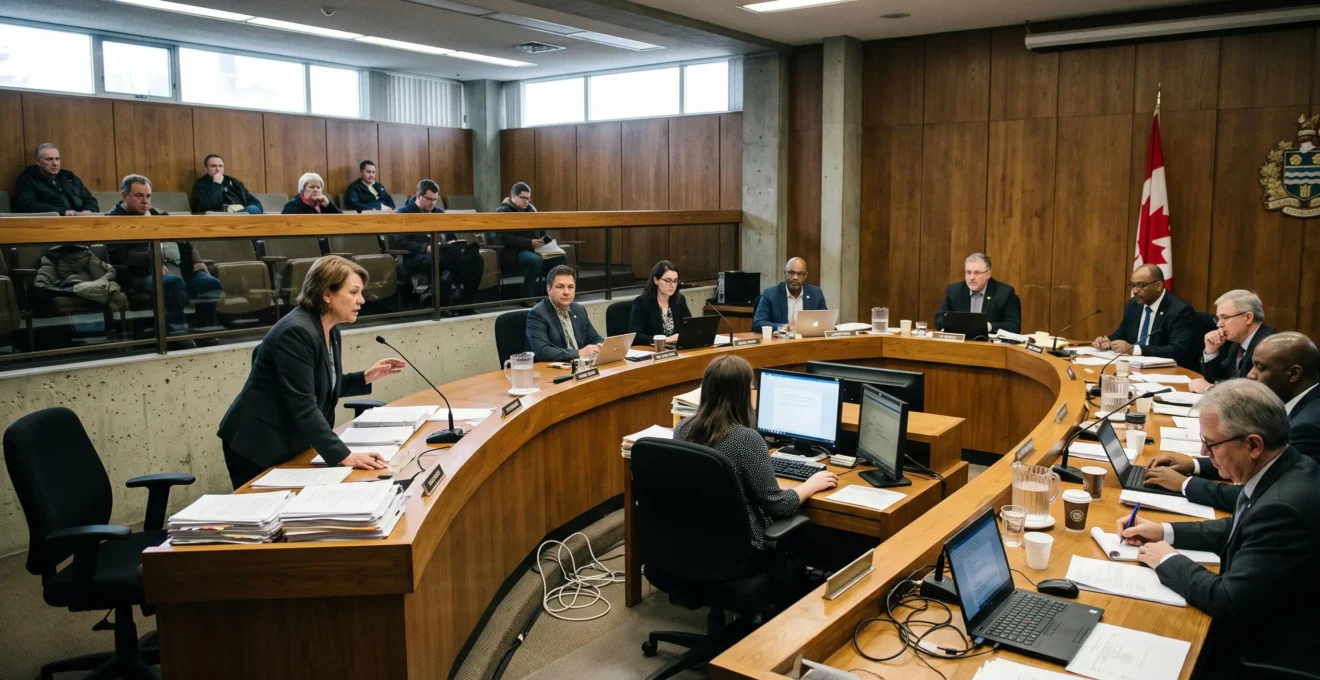
A debate at Winnipeg City Council can eventually change a property tax bill, determine which street gets repaired, influence a bus service or reshape a neighbourhood development. But the discussion itself is not necessarily the decision, and even an approved resolution may take considerable time to produce results.
Municipal decisions develop through a process involving city administration, committees, the mayor, councillors and, in certain circumstances, public participation. Proposals can be amended, referred for additional analysis, approved with conditions or reconsidered through later budget decisions. Understanding these stages helps residents distinguish political discussion from an enforceable or funded municipal action.
The most useful approach is to follow the actual recommendation and its decision history rather than relying on a debate headline. Winnipeg publishes meeting records that allow residents to examine proposals, compare changes and identify what happens after a vote.
For anyone concerned about neighbourhood services, taxes or long-term infrastructure, knowing where an issue sits in this process also reveals when public input may still influence the outcome.
Winnipeg council decisions: What residents should know
- Committee discussions, amendments and administrative reports can change a proposal before City Council reaches a final decision.
- Agendas, dispositions, minutes and meeting recordings help residents trace an issue and distinguish recommendations from adopted decisions.
- Approval does not automatically mean delivery: budgets, implementation planning and practical constraints determine when residents experience a change.
- Why Do Winnipeg Council Debates Sometimes Change a Proposal Before the Vote?
- How Can You Track a Winnipeg Council Issue From Agenda to Final Vote?
- Which Winnipeg Council Debates Matter Most to Everyday Residents?
- The Mistake of Treating Winnipeg Council Debate as a Final City Decision
- When Can Residents Comment on an Issue Before Winnipeg Council Decides?
- How Can You Follow a Winnipeg City Decision From Proposal to Implementation?
- Infrastructure or Services: Where Does Public Investment Affect Winnipeg Residents Most?
- How Does Public Sector Investment Shape Winnipeg’s Long-Term Development?
Why Do Winnipeg Council Debates Sometimes Change a Proposal Before the Vote?
Winnipeg council debates can change a proposal because councillors review recommendations, question their consequences and consider amendments before deciding what to approve. Committees may request additional information, propose revised conditions or recommend a different approach. The version ultimately considered by Council can therefore differ significantly from the proposal that first attracted public attention.
A municipal proposal often begins with an administrative report explaining a problem, outlining recommendations and identifying relevant financial or operational considerations. Winnipeg’s committee structure provides opportunities to scrutinize that information before a matter reaches the full Council. Depending on the subject, a standing committee or the Executive Policy Committee may review the item and make recommendations.
Changes can be substantive, affecting project costs, geographic coverage, service levels or implementation conditions. Other amendments may clarify language or change reporting timelines without fundamentally altering the intended outcome. Even seemingly minor changes should be examined when timing or wording affects what administration must do.
For example, imagine a hypothetical proposal to renew several residential streets. During committee consideration, councillors might request further cost estimates or propose changing the project’s scope. The eventual recommendation could cover fewer streets or require a subsequent report before funding is committed. This illustrates a possible decision pathway, not a documented Winnipeg case.
Public delegations may also provide information that councillors had not considered. Residents, community organizations and business representatives can explain local effects, identify overlooked concerns or recommend alternatives. Their comments do not guarantee an amendment, but they can become part of the committee’s consideration.
Deferrals and referrals are equally important. A deferred item has not necessarily been rejected; a referral to administration may mean further work is needed. Confidential matters can also limit what residents can see publicly, making it important to distinguish an incomplete public record from evidence that nothing happened.
The practical lesson is that a proposal is not frozen when it first appears on an agenda. Following changes to its wording, scope and conditions is essential to understanding the outcome.
How Can You Track a Winnipeg Council Issue From Agenda to Final Vote?
Residents can track a Winnipeg council issue by locating its agenda item, identifying the responsible committee, examining its supporting report and checking subsequent meeting records. The key is to follow the same matter through each decision stage, comparing the original recommendation with later dispositions and minutes to establish what was actually approved.
The City provides an official Decision Making Information System for council and committee records. Its meeting resources include agendas, minutes, dispositions, Hansard records and videos. These documents serve different purposes: an agenda identifies business scheduled for consideration, while later records help establish what occurred.
Start with the relevant report. Its recommendation states the proposed action, while the background and supporting materials explain the context. Where included, financial comments and appendices can reveal funding implications, correspondence or conditions that are not obvious from the agenda title.
Next, establish which body is considering the proposal. A standing committee recommendation is not necessarily the final decision of Council. Check whether the matter advances through another committee, returns to administration or reaches the full Council for consideration.
After the meeting, inspect the disposition and minutes. A recommendation may have been amended, adopted, deferred, referred or received as information. A document being received and filed should not be interpreted as approval of every action discussed within it. If the recorded decision does not make the outcome clear, examine the relevant debate record rather than assuming the original proposal passed unchanged.
Budget discussions require additional attention because several spending proposals may ultimately be addressed through consolidated budget decisions. Tracking an individual request may therefore require consulting both its original report and the adopted budget documents.
Five actions to build a council issue tracker
- Find the relevant agenda item and record its title, meeting date and report reference in a tracking note.
- Identify the responsible committee and record the next scheduled consideration date.
- Save the original recommendation and summarize its proposed action in one sentence.
- Review the meeting disposition, minutes or recording and document any amendment, referral or vote outcome.
- Check the subsequent Council record and produce a final status note distinguishing approval, pending consideration and implementation.
This simple record helps residents identify decisions that have genuinely advanced, rather than mistaking repeated discussion for a new approval.
Which Winnipeg Council Debates Matter Most to Everyday Residents?
The Winnipeg council debates with the most immediate household consequences generally involve property taxation, municipal fees, land use and the services residents use regularly. Budget choices affect costs and service capacity, while transportation, snow clearing, recreation and local development decisions can change daily routines, access and neighbourhood conditions.
The most important issue depends on where someone lives and which services they use. A transit service change can matter greatly to a household without a car, while a nearby development application may be especially significant to residents concerned about traffic, access or the use of adjacent land.
Several decision categories deserve particular attention:
- Taxes and fees: Budget and revenue decisions can change household costs directly.
- Transportation: Transit fares, service arrangements, street maintenance and road priorities can affect travel costs and reliability.
- Neighbourhood development: Zoning changes and development approvals can influence land use, traffic patterns and neighbourhood character.
- Winter maintenance: Snow clearing priorities and service standards affect mobility during Winnipeg winters.
- Community facilities: Recreation centres, libraries and public spaces depend on choices about maintenance, operating capacity and future investment.
It is useful to distinguish city-wide policies from geographically concentrated decisions. A broad transit funding decision can influence users across Winnipeg, whereas renewal of a particular street has a much more immediate local footprint. Some projects create both effects, especially when they involve important transportation connections.
Residents can prioritize debates using two questions: Will this change what I pay? And will it change the availability, quality or reliability of a service I use?
Decisions about maintenance standards and departmental resources may receive less public attention than major construction announcements. Yet their consequences can accumulate through service reliability, repair backlogs and the condition of public assets.
Investment choices also have indirect consequences. Improvements to transportation or public facilities may make particular areas more accessible or attractive to development. However, changes in property values or neighbourhood growth cannot be attributed to a council decision without supporting evidence.
A modest service adjustment may deserve closer scrutiny than a high-profile project if it affects residents more frequently or more directly.
The Mistake of Treating Winnipeg Council Debate as a Final City Decision
One common mistake is treating a Winnipeg council debate, committee recommendation or favourable vote as proof that a municipal project or service change is already settled. These events have different meanings. A debate records deliberation, a recommendation proposes action, and an adopted resolution establishes a decision whose implementation may still depend on funding, regulatory steps or administrative work.
The City of Winnipeg’s council and committee meeting information explains the framework within which these municipal decisions are considered. Residents need to identify both the decision-making body and the action it has authority to take.
Council sets municipal policy and approves decisions within its authority. The mayor and Executive Policy Committee play roles in political leadership and the consideration of municipal business, while standing committees examine matters within their mandates. City administration supplies professional analysis and is responsible for carrying out authorized work within the applicable constraints.
Not every approval is merely approval in principle. Some resolutions make decisions that take effect without a separate discretionary project approval. Others explicitly require additional reports, future funding, bylaw steps or implementation arrangements. The precise wording of the adopted resolution determines which interpretation applies.
Consider a hypothetical recreation facility expansion. Council could endorse further planning without authorizing immediate construction. Even where a project receives approval, detailed design, procurement, contractual arrangements and available funding may affect delivery.
A later council decision or budget process can also modify an earlier direction, subject to applicable law and existing obligations. Administrative feasibility may require a revised proposal, but administration cannot simply substitute an unauthorized policy decision for one properly reserved to Council.
This distinction matters for public participation. Residents who assume an initial announcement represents a completed outcome may overlook opportunities to influence subsequent funding or implementation choices. Conversely, residents should not assume every adopted decision remains open for reconsideration through the same process.
Following the decision’s actual status provides a more reliable basis for public discussion and helps residents direct questions to the institution responsible for the next stage.
When Can Residents Comment on an Issue Before Winnipeg Council Decides?
Winnipeg residents can provide input during relevant committee proceedings, eligible Council meetings, designated public hearings and municipal consultation processes. Opportunities depend on the type of issue and the meeting’s procedural requirements. Participation is often most useful before a recommendation is finalized or a required hearing concludes, when councillors still have decisions to make.
Speaking as a delegation gives residents an opportunity to present concerns or recommendations in the formal meeting process, subject to registration requirements and applicable rules. Written submissions can also communicate detailed concerns, while direct contact with a ward councillor may be useful for explaining local circumstances.
The City’s delegation guidance describes advance registration and the circulation of submissions to committee members as part of the public record. Residents should verify the current instructions and deadlines for the specific meeting before preparing to participate, rather than assuming that every forum follows identical procedures.
Public hearings are particularly important for certain planning and development matters. Where a formal hearing is required, residents should consult its notice to understand who may participate, what material can be submitted and when representations must be made. Development-related objections may concern matters such as access, compatibility, traffic or proposed approval conditions.
Different participation methods serve different purposes. A delegation can put an issue directly before the members considering it. A written submission is useful for presenting detailed observations or supporting information. Contacting a ward councillor can help connect an issue to local circumstances, particularly before it reaches a formal committee agenda.
Budget consultations and planning engagement processes provide opportunities to influence broader priorities before individual spending decisions emerge. Community committee meetings may also be relevant, depending on the subject and their mandate.
Strong public comments identify the proposal precisely, explain a concrete effect and request an actionable response. For example, a resident concerned about a street design could identify an access problem and ask councillors to consider a specific modification. Such a submission is generally easier to evaluate than an objection without supporting details.
Participation does not guarantee an outcome. Councillors may weigh competing views, budget considerations, statutory requirements and administrative advice. Nonetheless, timely and specific input can make the consequences of a proposal more visible.
The best time to engage is determined by the decision timetable, not simply by when a proposal begins attracting public attention.
How Can You Follow a Winnipeg City Decision From Proposal to Implementation?
Following a Winnipeg city decision through implementation requires more than confirming the Council vote. Residents should establish whether the approved action has funding, identify the responsible municipal department and check for subsequent planning, procurement or service-delivery evidence. A decision reaches residents when the authorized change is actually carried out, not merely when it appears in meeting minutes.
A municipal initiative can move through several stages: administrative preparation, committee consideration, Council decision, budget integration, detailed implementation planning and eventual delivery. The exact sequence varies. Some matters already have approved funding, while others require future financial decisions or additional authorization.
The difference between approval and implementation is particularly visible with infrastructure. An endorsed project may still require engineering work, contracting, coordination with utilities or construction scheduling. Service changes may require staffing, equipment, updated procedures or operational planning.
Residents can look for evidence appropriate to the type of decision. Capital budget listings can help establish the financial status of a project. Official project information and construction notices may indicate that work is moving toward physical delivery. City open-data resources may provide additional context where relevant information is published.
The absence of a public construction notice does not, by itself, prove that a project has been cancelled. It may still be in planning, or the next milestone may not yet have been communicated publicly. Equally, an allocation in a capital plan should not automatically be treated as confirmation that construction has begun.
Accountability becomes more useful when a resident asks a stage-specific question. Instead of simply asking why a project has not happened, they might request clarification about its current authorization, funding, responsible department or next implementation milestone.
Where the outcome remains unclear, the ward councillor may help obtain an explanation. Subsequent committee reports, budget updates and any relevant audit or review findings can also provide evidence of delays or changes in direction.
The objective is a documented account of progress, not an assumption that approval guarantees completion on a particular schedule.
Infrastructure or Services: Where Does Public Investment Affect Winnipeg Residents Most?
Public investment affects Winnipeg residents through both infrastructure and ongoing municipal services. Capital spending supports assets such as roads, bridges, water systems, transit vehicles and public facilities. Operating spending supports the continuing work required to deliver services. Infrastructure influences long-term capacity and physical conditions, while operating decisions often determine residents’ day-to-day experience.
The City distinguishes these two forms of spending in its official budget and finance information. Its capital budget supports investment in specific projects, while its operating budget addresses the ongoing cost of municipal programs and services.
These categories are connected. A new facility may create future operating and maintenance requirements. Replacing deteriorating infrastructure can change ongoing maintenance needs, although the financial effect depends on the asset and project. Consequently, the initial project price does not provide a complete picture of long-term public cost.
The distinction becomes clearer when comparing spending decisions:
| Criterion | Capital investment | Operating services |
|---|---|---|
| Typical focus | Building, renewing or acquiring physical assets | Providing and maintaining recurring services |
| Examples | Street reconstruction, bridge work, facility upgrades | Snow clearing, transit operations, recreation programming |
| Resident experience | Changes to infrastructure condition, capacity or accessibility | Changes to frequency, reliability, availability or service quality |
| Long-term concern | Asset lifespan and future maintenance obligations | Recurring affordability and sustainable service levels |
Capital projects can be highly visible, but geographic distribution matters. Renewing a local street directly benefits its users, while improvements to a major corridor may affect people travelling from several neighbourhoods. Decisions about where to invest can therefore raise questions of need, access and fairness across Winnipeg.
Operating services create a different form of impact. Transit availability, winter maintenance standards and facility operating hours can shape ordinary routines repeatedly. Maintaining an asset without sufficient resources to operate it may limit the public benefit of the original investment.
A useful evaluation therefore considers whole-life costs, expected changes in service quality and potential transfers of costs to users. A spending proposal that appears affordable in the current budget may create obligations in later years.
There is no universal answer to whether infrastructure or services matter more. A household facing an unreliable water connection may place immediate value on asset renewal, while another may be more affected by frequent changes to transit availability. Public decisions must consider both short-term needs and future obligations.
This combined perspective leads to a broader question: how do successive municipal investment decisions shape Winnipeg over many years?
Key takeaways for evaluating long-term city investment
- A project should be assessed against future operating, repair and replacement obligations, not just its initial approval.
- Neighbourhood investment choices influence accessibility and development opportunities over periods longer than a single Council term.
- Multi-year planning and budget consultations are important opportunities to examine priorities before individual projects are finalized.
How Does Public Sector Investment Shape Winnipeg’s Long-Term Development?
Public sector investment shapes Winnipeg’s long-term development by determining which infrastructure is maintained, where new capacity is added and which services can support future growth. Successive capital plans influence transportation, land use and neighbourhood conditions over many years. The effects depend on whether projects are funded, implemented and maintained, not simply on their initial approval.
Long-term municipal planning requires choices among existing infrastructure needs and potential future investments. Roads, bridges, water and sewer assets, transit infrastructure and community facilities all create ongoing obligations. Decisions to maintain existing systems or expand them can influence future municipal costs and the quality of services available to residents.
Deferred maintenance is especially important because postponing work does not eliminate the underlying asset need. The eventual consequences depend on the condition and type of infrastructure, but delay can increase operational risk or make future interventions more extensive. Conversely, replacing an asset earlier than necessary may limit funds available for other priorities.
Transportation decisions can have particularly persistent effects. Transit improvements may influence where development is practical, while major road investments can change accessibility and travel patterns. These relationships unfold alongside housing demand, private development, land-use rules and broader economic conditions. A municipal investment is therefore one influence among several, rather than a guaranteed cause of growth.
The geographic distribution of investment also deserves examination. Residents can ask whether a capital plan addresses the condition of existing assets, supports areas with changing needs and maintains reasonable access to public services. Evidence about project selection and expected outcomes is more informative than assuming that an equal amount of spending in every ward would necessarily produce equitable results.
Winnipeg’s budget framework connects annual decisions with longer-term capital planning. That makes future forecasts useful signals of municipal priorities, although planned spending can change before implementation. A project listed for a future year is not equivalent to a completed or irrevocably funded commitment.
Public involvement can be especially meaningful when long-term plans and budgets are being developed. By examining how projects fit into successive spending decisions, residents can identify recurring priorities and ask whether the City is balancing infrastructure renewal, service affordability and changing community needs.
Choose a development or infrastructure issue affecting your neighbourhood, examine its latest official status and ask your ward councillor about any unresolved funding or delivery questions. Long-term municipal accountability begins with understanding what was decided and checking what follows.
Where can residents check the result of a Winnipeg City Council vote?
The City’s Decision Making Information System provides access to council and committee records, including minutes and dispositions. Residents should locate the relevant meeting item and examine its recorded outcome. For individual voting positions, consult the available vote record or meeting proceedings rather than assuming every decision included a separately recorded individual vote.
Does a committee recommendation mean Winnipeg City Council has approved a proposal?
Not necessarily. Committees can make recommendations or take decisions within their authority. Where full Council approval is required, residents should check the subsequent Council record. The committee’s recommendation and the final adopted decision may differ.
Can a Winnipeg councillor change a decision affecting another ward?
Councillors participate in decisions according to the authority and procedures of the relevant municipal body. A city-wide Council decision may involve councillors from across Winnipeg, even when its effects are concentrated in one ward. A single councillor does not ordinarily control the collective outcome.
What should residents do when an approved city project appears delayed?
First, verify what Council approved and whether the project has funding or additional conditions. Then consult available capital budget information, project updates and subsequent committee records. Contacting the ward councillor with the original report reference and a specific question about the next milestone can help clarify its status.
Can written public comments become part of Winnipeg council records?
Yes, written submissions made through applicable meeting participation procedures can become part of the public record and be circulated to committee members. Requirements depend on the type of meeting and submission process. Residents should review current City instructions before submitting personal information or comments.