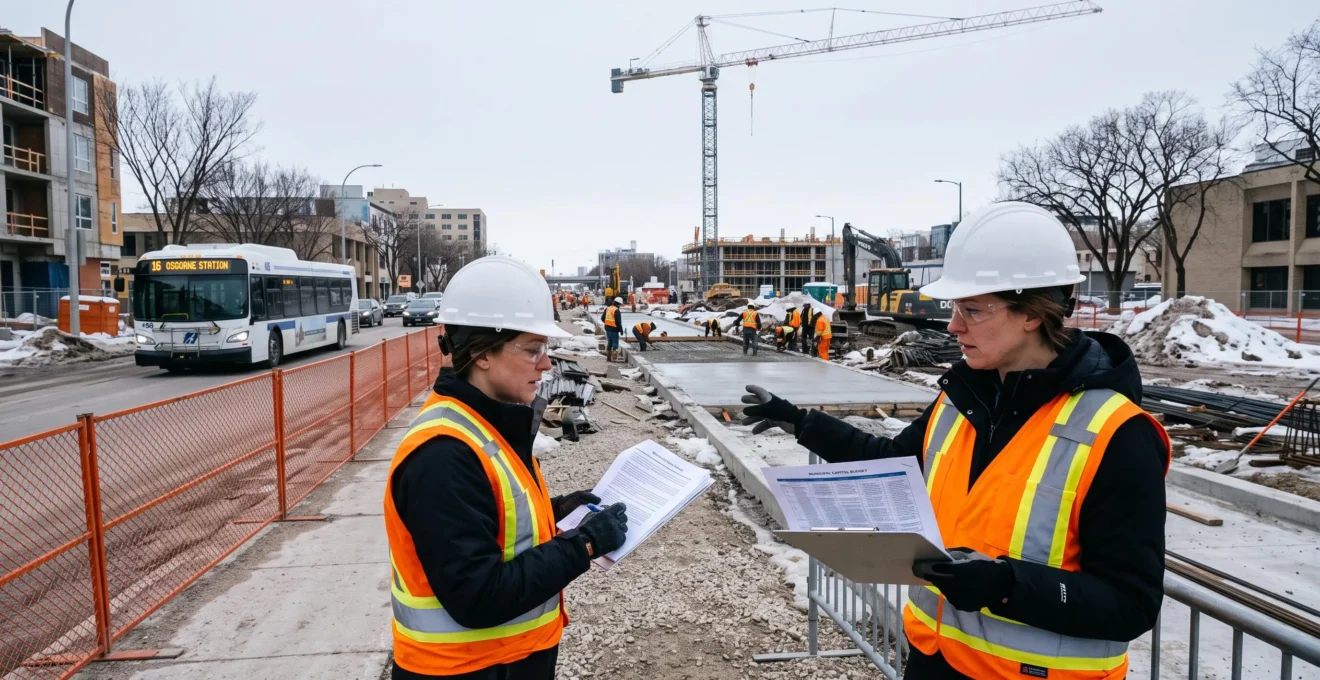
Major infrastructure projects in Winnipeg often depend on more than a City Council decision or a single government announcement. Replacing essential wastewater facilities, expanding rapid transit, and renewing major transportation corridors can require capital investments beyond what municipal revenues can comfortably finance alone.
Intergovernmental funding agreements move projects forward by distributing eligible costs, defining each funding partner’s obligations, and establishing conditions for public contributions. The City of Winnipeg may provide its own share through capital allocations, reserves, or borrowing, while Manitoba and the federal government contribute through applicable programs and negotiated arrangements.
But a funding announcement does not necessarily mean the full amount has been transferred, construction has been authorized, or future operating costs are covered. Understanding these distinctions helps residents identify which investments are financially supported, which remain conditional, and what evidence shows that a project is actually progressing.
Winnipeg infrastructure funding at a glance
- Large projects frequently require cost-sharing because municipal taxation and borrowing alone may be insufficient for their capital requirements.
- Federal and provincial contributions depend on program eligibility, approvals, agreements, and sometimes multi-year payment schedules.
- Residents can assess commitments through adopted capital budgets, government funding announcements, council records, and subsequent procurement and expenditure reporting.
- Why Do Major Winnipeg Infrastructure Projects Need Multiple Funding Partners?
- City, Province, or Ottawa: Who Pays for Major Winnipeg Infrastructure?
- When Is Infrastructure Funding Secured in the Life of a Winnipeg Project?
- How Can Residents Track Funding Commitments for a Winnipeg Infrastructure Project?
- Funding Announcement Mistakes That Can Mislead Winnipeg Infrastructure Watchers
- How Can You Track Whether Winnipeg Public Investment Actually Reaches a Project?
- How Can Winnipeg Prioritize Infrastructure When Every Project Cannot Be Funded at Once?
- Which Winnipeg Transit Projects Can Make Daily Travel More Reliable?
Why Do Major Winnipeg Infrastructure Projects Need Multiple Funding Partners?
Major Winnipeg infrastructure projects need multiple funding partners because construction costs can exceed what the City’s property taxes, fees, reserves, and borrowing capacity can reasonably support. Cost-sharing allows municipal, provincial, and federal governments to finance eligible portions of an investment while establishing conditions for approval, reporting, and payment. These arrangements can also determine which projects qualify for support.
Winnipeg is responsible for substantial local infrastructure, including roads, bridges, public transit facilities, and wastewater assets. Replacing or expanding these systems can require hundreds of millions of Canadian dollars, creating financial pressure alongside ordinary municipal services and existing infrastructure maintenance.
The City’s 2026 budget update describes a six-year capital program of approximately CAD 3.8 billion. That scale illustrates why financing decisions extend beyond a single annual property-tax increase or one year’s municipal operating surplus.
CAD 3.8 billion
Approximate size of Winnipeg’s six-year capital program described in its 2026 budget update. This is a planning envelope, not an amount already spent.
City of Winnipeg, 2026 multi-year budget update.
A cost-sharing agreement generally establishes which expenditures qualify for reimbursement or contribution, how the partners divide eligible costs, and what conditions must be satisfied. A project may also need municipal matching funds, completed planning work, or formal approvals before external contributions become available.
These conditions influence more than financing. A federal program focused on housing-enabling infrastructure, for example, may favour certain wastewater or water-system improvements. A transit-focused program may support corridor design or related facilities. Winnipeg must therefore consider program eligibility when determining the scope and timing of proposed work.
Capital contributions must also be distinguished from operating costs. Construction funding does not automatically finance future staffing, maintenance, utilities, rehabilitation, or service delivery. Winnipeg’s separate capital and operating budgets provide an important starting point for assessing these continuing obligations.
The practical value of a funding partnership depends on whether the project can be built without creating unaffordable future obligations. Identifying the participating governments is therefore only the first step; their actual financial responsibilities must also be examined.
City, Province, or Ottawa: Who Pays for Major Winnipeg Infrastructure?
Winnipeg infrastructure costs are divided according to the project, applicable funding program, and negotiated contributions—not a universal three-way formula. The City generally finances part of its municipal infrastructure investments, while Manitoba and Ottawa may contribute through conditional grants or other approved arrangements. Some projects also involve Indigenous governments, development partners, or other institutions.
This structure reflects an imbalance between infrastructure responsibilities and revenue sources. Winnipeg owns or manages extensive local assets but relies on a narrower set of revenue tools than senior governments. Federal and provincial governments possess broader fiscal capacity, although their contribution programs serve specific policy objectives and budget limits.
Winnipeg’s North End Water Pollution Control Centre provides a concrete example. The municipal 2026 budget update identifies the City’s one-third share of the nutrient removal project as CAD 500 million plus financing charges, with long-term debt proposed to finance the municipal portion.
The federal government’s 2024 Fall Economic Statement separately announced CAD 150 million for the North End Sewage Treatment Plant over four years beginning in 2026–2027. That amount was explicitly conditional on requirements of the Canada Housing Infrastructure Fund. These figures must not automatically be added together: the underlying project phases and funding arrangements need to be established to prevent double counting.
The following comparison explains the usual responsibilities without suggesting that every Winnipeg project follows identical percentages.
| Funding partner | Typical contribution | Important limitation |
|---|---|---|
| City of Winnipeg | Municipal capital allocations, reserves, eligible revenues, or borrowing | Requires appropriate budget and project approvals |
| Province of Manitoba | Provincial grants or negotiated project contributions | Depends on provincial programs and commitments |
| Government of Canada | Federal infrastructure program contributions | Subject to eligibility and agreement conditions |
| Other partners | Project-specific funding, land, or infrastructure contributions | Participation depends on the actual project arrangement |
Federal programs demonstrate why eligibility matters. Canada’s Housing Infrastructure Fund was introduced with a CAD 6 billion envelope, including provincial-territorial and municipal streams. Its conditions connect eligible infrastructure investments with housing capacity rather than guaranteeing funding for every proposed municipal project.
Where Winnipeg-area developments involve First Nations, Treaty Land Entitlement arrangements, school divisions, or other partners, the financial structure may extend beyond the three governments. Their exact roles should be determined from project-specific records rather than assumed.
The decisive question is not whether Ottawa, Manitoba, or Winnipeg announced the largest number, but which government has formally accepted responsibility for each identifiable portion of the project’s eligible costs.
When Is Infrastructure Funding Secured in the Life of a Winnipeg Project?
Infrastructure funding becomes progressively more secure as a Winnipeg project advances through planning, funding applications, budget approval, and executed agreements. An announcement alone may represent a conditional commitment rather than a completed financing arrangement. A municipal capital allocation is important evidence of authorization, but it does not independently establish that every external grant has been signed or transferred.
A typical project begins with a documented need. Engineers, planners, and municipal departments assess asset condition, capacity, safety, and future demand. Conceptual planning and design can then produce the cost estimates needed for grant applications and capital-budget decisions.
One useful way to interpret the project lifecycle is to distinguish these milestones:
- Need identified: a service problem or deteriorating asset is documented.
- Planning and design: project scope and preliminary costs are developed.
- Funding application: contributions are sought under eligible programs.
- Budget approval: the relevant governments authorize their planned contributions through applicable processes.
- Agreement execution: contractual funding terms and conditions are established.
- Procurement: tenders and contracts determine how approved work will be delivered.
- Construction and payment: eligible work proceeds, with funds released or reimbursed according to governing arrangements.
These stages can overlap or occur in different sequences. Some preliminary design work may be funded years before construction financing becomes available. Equally, a government can announce an intended contribution before all agreement conditions have been satisfied.
Winnipeg’s 2026 budget update demonstrates the distinction. Its preliminary capital planning identified CAD 13 million for Route 90 bridge replacement design and CAD 5.8 million for downtown rapid transit preliminary design. Those planning amounts must not be interpreted as financing for every subsequent construction phase.
Residents should prioritize the City of Winnipeg’s 2026 multi-year budget update and its adopted budget documents when examining municipal allocations. The final approved version matters because preliminary proposals can change during Council review.
Annual budget adoption authorizes municipal financial plans under the applicable framework. However, Council approval alone does not necessarily make a separate federal or provincial contribution unconditional. The external agreement, appropriation requirements, and payment conditions may still need to be verified.
A project can consequently be visible in public debate for years before construction begins. To understand its real financial position, residents must move beyond announcements and inspect the records accompanying each decision.
How Can Residents Track Funding Commitments for a Winnipeg Infrastructure Project?
Winnipeg residents can track infrastructure funding commitments by comparing the City’s adopted capital budget with federal announcements, Manitoba budget records, and municipal committee decisions. Matching the project name, scope, funding amounts, conditions, and fiscal years across documents helps distinguish proposed contributions from formally approved financing and money already spent.
Begin with the City’s published capital budget. Locate the project description, planned expenditures, external funding assumptions, and allocations across financial years. A total forecast cost should not be mistaken for the amount funded in the current year.
Next, identify the relevant provincial and federal announcements. An official release may disclose the maximum contribution, eligible funding program, expected payment schedule, and conditions that must still be fulfilled. Read the wording carefully: an amount described as available, allocated, or subject to agreement can represent a different financial status from an executed commitment.
For example, Canada’s 2024 Fall Economic Statement infrastructure funding provisions specify a CAD 150 million North End Sewage Treatment Plant announcement spread over four years from 2026–2027 and subject to program conditions. The announcement alone does not establish the amount subsequently disbursed.
Municipal standing committee agendas, meeting minutes, and Council decisions provide another layer of evidence. They can show when funding proposals, changes in scope, or approvals were considered. Residents should distinguish recommendations from final decisions when reading committee records.
Five actions to verify a Winnipeg infrastructure funding commitment
- Identify the exact project. Record its official name, location, and phase in a short project identification note.
- Find the adopted municipal allocation. Record the relevant capital-budget year, approved amount, and budget document reference.
- Check other government contributions. Create a comparison showing Manitoba and federal amounts, programs, and any stated conditions.
- Review Council decisions. Record the meeting date and decision status, distinguishing proposals from adopted approvals.
- Reconcile the numbers. Produce a one-page funding summary separating total estimated cost, approved contributions, conditional announcements, and expenditure figures when available.
A basic reconciliation can uncover important discrepancies. A press release may describe the entire project cost while its headline emphasizes the federal portion. The municipal budget may cover only one construction phase. Another document may report a multi-year allocation rather than a single annual payment.
Where documents disagree, record both figures and their dates before concluding that one is incorrect. Project scope, inflation, and revisions to the financing plan can produce legitimate differences.
Once that record is established, residents are better equipped to interpret new announcements critically and recognize when a familiar funding figure no longer describes the current project.
Funding Announcement Mistakes That Can Mislead Winnipeg Infrastructure Watchers
Winnipeg infrastructure funding announcements can mislead readers when projected costs, conditional grants, approved budgets, and completed payments are treated as equivalent. The most common errors include assuming every partner has signed, confusing one contribution with total project cost, and interpreting multi-year commitments as money already received. Later project revisions can further complicate comparisons.
Public announcements are useful evidence of government intentions, but their financial meaning depends on wording and subsequent decisions. A headline describing an investment does not necessarily establish that construction contracts have been awarded or that all participating governments have executed agreements.
Four distinctions are especially important:
- Announced versus approved: a proposed contribution may remain subject to formal budget decisions or program conditions.
- Total cost versus partner share: the headline amount may represent the entire investment rather than one government’s payment.
- Allocated versus transferred: a multi-year commitment is not proof that the full sum has reached the project.
- Original estimate versus revised budget: design changes, inflation, and procurement outcomes can alter the amount required.
Consider a hypothetical project estimated at CAD 300 million, with three governments initially expected to contribute CAD 100 million each. If its cost later rises to CAD 360 million, the original announcement does not explain who will cover the additional CAD 60 million. A revised agreement, additional borrowing, reduced scope, or another approved measure might be required.
The example illustrates a financing question, not an actual Winnipeg project’s funding history.
Announcement timing also deserves careful interpretation. Government budgets and election periods can increase attention to proposed investments, but timing alone is not evidence that a particular commitment is unreliable. The appropriate test is whether subsequent approved budgets and project records continue to support the announcement.
A historical release should therefore be treated as a dated snapshot. For a commitment announced in 2020, the relevant question in 2026 is whether its amount, conditions, and timetable remain applicable after later decisions.
Financial accountability ultimately requires more than confirming that a promise survived the budget process. Residents must also establish whether contracts were awarded, work progressed, and public expenditures followed the approved plan.
How Can You Track Whether Winnipeg Public Investment Actually Reaches a Project?
Residents can assess whether Winnipeg infrastructure funding reaches a project by comparing approved budgets with procurement awards, construction milestones, expenditure reporting, and audit findings. A recorded commitment indicates an intention or obligation to finance work; documented spending and verified delivery provide stronger evidence of implementation. The available records may nevertheless report costs at different levels of detail.
Start with the original financing baseline established during the funding review. Record the stated project budget, funding partners, expected completion period, and approved scope. This becomes the reference against which later changes can be evaluated.
Procurement records provide the next useful indicator. A tender announcement indicates that work is being sought, while a contract award establishes that a supplier or contractor has been selected under a procurement process. Neither alone proves that the full contract value has been paid.
Construction notices and project updates can then show whether the work is progressing according to the published schedule. A delay may result from design, site conditions, procurement, or revised scope; the underlying reason must be checked rather than inferred from the elapsed time.
City financial statements, budget updates, and project-specific reporting can help distinguish spending from planned allocations. Their usefulness depends on whether the expenditure figures identify the same project phase and reporting period. A citywide infrastructure spending total cannot establish how much was paid for one individual construction contract.
Audit reports provide another accountability layer. Winnipeg’s Auditor General and applicable provincial or federal review mechanisms may examine financial controls, procurement, performance, or compliance with funding conditions. However, the existence of an auditing body should not be interpreted as proof that it has audited a particular project.
A simple personal tracker makes these distinctions visible:
| Record | Information to capture | What it establishes |
|---|---|---|
| Funding announcement | Date, partner shares, conditions | Original stated commitment |
| Approved budget | Fiscal year, allocation, project scope | Municipal financial authorization |
| Tender and award | Procurement date, contractor, contract amount | Procurement progress |
| Construction update | Work completed, revised milestones | Reported physical progress |
| Financial or audit report | Recorded expenditures, findings, reporting date | Spending or independently reviewed information within its stated scope |
The most meaningful discrepancies often appear between these records: contracts above initial estimates, construction milestones moved beyond published dates, or expenditure figures that cannot yet be reconciled with original commitments.
Monitoring these results improves accountability, but it also reveals a broader policy issue: Winnipeg must choose which infrastructure needs to finance before every desirable project can enter the delivery stage.
How Can Winnipeg Prioritize Infrastructure When Every Project Cannot Be Funded at Once?
Winnipeg can prioritize infrastructure by assessing asset condition, service risks, expected public benefits, project readiness, and available financing. Council-approved priorities and external grant eligibility also influence which investments advance. Because municipal matching funds and staff capacity are limited, choosing one project can delay another even when both address legitimate infrastructure needs.
Municipal infrastructure decisions involve competing forms of urgency. A deteriorating bridge may raise safety and connectivity concerns. Wastewater upgrades can respond to environmental and capacity requirements. Transit improvements may address growing travel demand and unreliable service.
These projects are not always comparable through a single financial measure. Condition assessments, asset management planning, lifecycle costs, and service objectives help decision-makers evaluate their different consequences.
Winnipeg’s 2026 capital planning illustrates the range of competing priorities. It identifies more than CAD 1 billion for road renewal over six years, alongside planning resources for major bridge, road, and transit initiatives. The proposed allocations indicate priorities within a constrained program, not proof that every contemplated construction phase is financed.
Funding eligibility introduces another trade-off. A project matching a federal transit or housing-infrastructure program may become financially achievable sooner than a locally urgent project that does not fit an available stream. Access to external contributions can therefore affect the sequence of municipal investments.
There is also a practical cost to pursuing funding. Applications require planning, estimates, documentation, and administrative capacity. Even when a grant covers a substantial share, the City may need to supply matching funds and accommodate future operating or debt-service costs.
Residents evaluating priorities can ask three questions: What problem does the project solve? What is the cost of delaying it? What local resources must be committed to obtain external funding?
Answering those questions does not eliminate political judgment. It makes the trade-offs more transparent by showing the relationship between infrastructure condition, public benefits, eligibility, and long-term affordability.
Transit offers a practical illustration of these choices because the difference between designing a network and funding its construction directly affects when residents can expect improvements to everyday travel.
Key takeaways before evaluating transit investments
- A funded preliminary design is evidence of planning progress, not confirmation that construction financing has been secured.
- Infrastructure priorities should be assessed against service improvements and long-term costs, not only the value of external grants.
- For transit riders, route-specific reliability benefits matter more than the size of an announced project budget.
Which Winnipeg Transit Projects Can Make Daily Travel More Reliable?
Winnipeg transit investments most likely to improve daily reliability are those that reduce recurring delays through dedicated transit corridors, priority at intersections, and more efficient passenger movement. The benefits depend on where congestion occurs and which improvements are actually delivered. Residents should distinguish funded planning and ongoing infrastructure work from construction proposals still awaiting approval.
The City of Winnipeg’s Transit Master Plan establishes a long-term framework for improving the transit network. Approved in 2021, it presents a 25-year vision that includes six rapid transit corridors arranged into three lines.
The City identifies these rapid transit lines as BLUE, FX2, and FX3. Its published plan states that only BLUE uses rapid transit infrastructure along part of its route. This distinction matters because operating a designated rapid transit service does not necessarily mean that every section has a separated right-of-way.
Dedicated corridors can reduce interference from general traffic. Transit signal priority can help buses pass intersections more consistently, while boarding improvements can reduce delays at stops. These measures target travel-time variability rather than simply increasing the number of passengers a system can accommodate.
For an individual rider, reliability means that a route performs predictably. A project addressing a recurring bottleneck near a major intersection may be more useful to that rider than a distant network expansion that does not affect the daily journey.
However, the existence of a proposed improvement does not establish a measured reduction in delays. That requires operational performance data or a project-specific technical assessment.
Winnipeg’s published transit planning distinguishes several development stages:
- Primary Transit Network: launched in 2025, with associated infrastructure work identified as continuing through 2027.
- Downtown rapid transit corridor design: preliminary design has funding through the Investing in Canada Infrastructure Program, with design and engagement identified as continuing through 2028.
- Downtown corridor construction: remains subject to funding availability and Council approval, without a definitive construction date established in the cited plan.
These milestones show why planning progress should not be presented as a guarantee of near-term service improvements. The downtown corridor’s funded design work is a meaningful step, but financing and approving the construction phase are separate requirements.
Residents can narrow their assessment by identifying the slowest segment of their usual trip, checking whether a proposed project addresses it, and confirming the project’s status in the approved capital budget. A funded intervention with an identifiable delivery schedule offers stronger grounds for anticipating change than an unfunded long-term corridor proposal.
For a practical next step, choose one proposed improvement affecting a regular commute, record its current funding and approval status, and compare later project updates against that baseline. This connects government investment decisions to the service improvements residents can realistically evaluate.
Does an approved Winnipeg capital budget guarantee that a project will be completed?
No. An approved capital budget establishes municipal financial authorization within the applicable budget framework, but construction can still depend on external funding conditions, procurement, permits, project readiness, and subsequent decisions. Future-year forecasts should also be distinguished from money already spent.
Can Winnipeg begin project design before obtaining full construction funding?
Yes. The downtown rapid transit corridor is an example of funded preliminary design without a corresponding guarantee of construction financing. Early design helps establish project scope and prepare later decisions, but its approval does not automatically authorize the entire project.
Does federal infrastructure funding go directly to Winnipeg residents?
Infrastructure contributions normally support eligible project expenditures through the relevant public-sector funding arrangements rather than providing direct household payments. Payment and reimbursement procedures depend on the individual program and agreement. Residents benefit indirectly through the infrastructure and services delivered.
Who pays if a Winnipeg infrastructure project exceeds its original budget?
Responsibility depends on the applicable agreements, approved contributions, contractual arrangements, and subsequent decisions. Cost overruns do not automatically produce proportionate increases from every funding partner. The project may require additional authorization, revised financing, or changes to its scope.
Can residents verify that federal or provincial funding has actually been paid?
Residents can look for project-level expenditure reporting, government public accounts, grant reporting, and relevant audit findings. However, published budgets and announcements may not disclose every payment. Where available records identify only commitments rather than transfers, the amount actually disbursed should be treated as unverified.