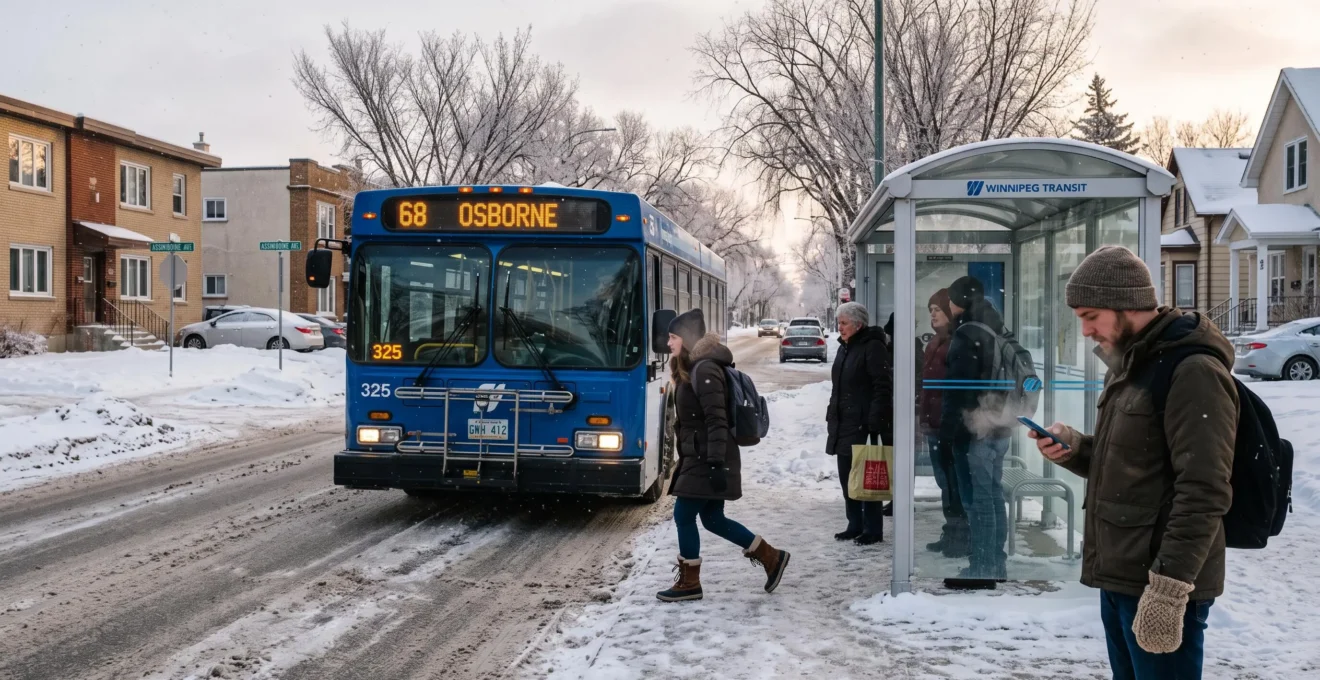
Winnipeg’s public transit system can better support everyday travel when residents can rely on understandable routes, manageable transfers, predictable arrival times, and accessible connections. For someone travelling to work, attending classes, collecting a child, or reaching a medical appointment, the most useful transit journey is not necessarily the fastest one on a schedule. It is the journey that works consistently from door to door.
Winnipeg introduced its redesigned Primary Transit Network and feeder routes on June 29, 2025. The network connects neighbourhood services with primary routes intended to provide clearer, more connected travel options. This structure creates opportunities for residents who depend on buses, but it also makes transfer planning, stop access, and service frequency important considerations.
Using transit effectively therefore means comparing complete journeys, allowing for Winnipeg’s seasonal conditions, and maintaining alternatives when a connection fails. These habits help residents assess whether a particular route can support daily life without needing a private vehicle as a backup.
Winnipeg Transit: what matters for everyday travel
- Predictable arrival times and reliable connections often matter more than the shortest advertised journey.
- Compare direct buses with transfer-based journeys using complete door-to-door time, service frequency, and winter waiting conditions.
- Use official trip planning, verify current fare rules, and prepare alternative departures for journeys with fixed arrival deadlines.
- Why Does Reliability Matter More Than Speed for Many Winnipeg Transit Riders?
- How Can a First-Time Rider Plan a Winnipeg Transit Trip With Transfers?
- Direct Bus or Transfer: Which Winnipeg Transit Trip Is More Reliable?
- Transit Planning Mistakes That Can Make a Winnipeg Trip More Difficult
- When Should Winnipeg Transit Riders Build Extra Time Into a Trip?
- How Can Winnipeg Riders Use Rapid Transit With Connecting Routes More Efficiently?
- How Can You Make a Winnipeg Rush-Hour Commute More Predictable?
- How Do Rapid Transit Corridors Change the Way Winnipeg Riders Travel?
Why Does Reliability Matter More Than Speed for Many Winnipeg Transit Riders?
Reliability matters more than speed when arriving at a predictable time is essential. A slightly longer bus journey that consistently fits a rider’s schedule may be more useful than a faster journey affected by irregular delays. This distinction is particularly important for Winnipeg residents coordinating employment, childcare, classes, and appointments without access to a private vehicle.
Scheduled travel time represents how long a journey should take under the published timetable. Predictable travel time describes how consistently that journey can be completed in practice. A route advertised as convenient may still be difficult to depend on if arrivals vary substantially between days.
Winnipeg’s winter conditions add practical complications. Snow accumulation can make stop access harder, extreme cold can complicate boarding and waiting, and road congestion can disrupt bus progression. When several buses encounter the same traffic delay, irregular spacing between departures can also develop.
Riders can evaluate reliability through a straightforward personal record. For several journeys, write down the scheduled arrival, actual arrival, departure period, weather conditions, and whether a connection was missed. Include different weekdays and times where possible, rather than judging the route by one unusually good or bad experience.
For example, a hypothetical commuter comparing two routes might discover that one generally takes longer but rarely threatens a shift start, while the other saves time only when every connection works. The comparison becomes especially valuable when an employer requires a fixed starting time.
Reliability can also influence housing and employment decisions. Living within an accessible walk of a frequent service may make regular travel easier, while accepting a shift that ends after connecting buses become infrequent can create ongoing difficulties.
A dependable transit network should support repeated daily commitments, not merely offer attractive journey times under ideal conditions. Riders can make better decisions by measuring the consistency of the entire trip.
How Can a First-Time Rider Plan a Winnipeg Transit Trip With Transfers?
A first-time Winnipeg Transit rider should identify the starting stop, destination stop, connecting routes, transfer location, and required arrival time before travelling. The most useful itinerary includes walking time, realistic connection margins, and the next available departure if a transfer is missed. Fare validity and physical stop accessibility should also be checked in advance.
The Winnipeg Transit Navigo trip planner allows passengers to enter an origin and destination, choose departure or arrival timing, and adjust walking and waiting preferences. For appointments or classes, selecting the required arrival time is often more practical than planning around an arbitrary departure.
Once an itinerary appears, examine the details rather than accepting the first option automatically:
- Identify the first boarding stop. Confirm the correct direction of travel and allow for the walk from the actual starting address.
- Check the route combination. Note where the first bus is expected to arrive and when the second is scheduled to depart.
- Inspect the transfer location. Determine whether both buses use the same stop, different platforms, or opposite sides of a street.
- Verify the fare transfer. Check that the payment method and transfer validity cover the intended connection.
- Prepare a fallback. Record the next connecting departure and identify a suitable waiting location.
Winnipeg Transit’s documented fare instructions describe a 90-minute transfer period. Cash-paying riders can request a paper transfer, which is scanned when boarding a connecting bus. With peggo e-cash, transfer eligibility is recorded automatically; a valid e-pass does not require a separate transfer. The period begins when the paper transfer is printed, so the first boarding time matters. Riders should confirm the latest policy before travelling.
A valid fare transfer does not guarantee a successful physical connection. A passenger may still miss the bus if the first service arrives late or the connecting stop requires a longer walk than expected.
Five checks before your first connecting journey
- Enter your origin, destination, and desired arrival time in Navigo; save the proposed itinerary.
- Write down both route names or numbers and their boarding directions; keep a two-leg route note.
- Identify the transfer stop and connecting departure location; save a stop-location reference.
- Check the current fare-transfer conditions for your payment method; note the applicable validity rule.
- Find the following connecting departure and an appropriate waiting location; save a backup connection plan.
First-time travel becomes considerably more manageable when the transfer is treated as a separate part of the journey, with its own timing, location, fare conditions, and contingency.
Direct Bus or Transfer: Which Winnipeg Transit Trip Is More Reliable?
A direct bus is often more reliable when it avoids a tight connection and reduces exposure to additional waiting, particularly in cold weather. However, a transfer can be the better option when connecting routes operate frequently or use a less congested corridor. The appropriate choice depends on complete travel time, departure frequency, and the consequences of a missed connection.
Transfers introduce another opportunity for disruption. Even if both buses normally operate as scheduled, a late arrival on the first route may cause the passenger to miss the second. The impact depends on how long it takes for another connecting bus to arrive.
Consider a hypothetical journey with a direct bus that takes 45 minutes and a two-bus itinerary scheduled to take 35 minutes. The transfer appears faster, but if the second route operates infrequently, one missed connection could eliminate the apparent saving. These are illustrative times, not measurements of actual Winnipeg routes.
The following comparison helps distinguish the main trade-offs.
| Decision factor | Direct bus | Journey with transfer |
|---|---|---|
| Connection risk | No scheduled bus-to-bus connection to miss | Depends on the first bus arriving before the second departs |
| Waiting exposure | Usually concentrated before boarding | Includes potential waiting between buses |
| Route frequency | May be limited on less frequent services | Can improve alternatives when both routes are frequent |
| Winter conditions | Less exposure to additional outdoor waiting | Requires attention to transfer shelter and walking conditions |
| Traffic disruption | May remain exposed to congestion throughout the journey | May benefit from a dedicated rapid transit segment |
To estimate the cost of a missed connection, compare the intended departure with the next scheduled departure on the connecting route. The difference indicates the additional scheduled waiting time if the intended bus is missed. Actual disruption may be greater if subsequent services are delayed.
Winter can change the balance substantially. A transfer that involves a comfortable outdoor wait in summer may become much less attractive during severe cold, especially where shelter or a cleared walking route is unavailable.
Conversely, a frequent primary route may provide several opportunities to recover from a missed bus. A transfer through such a service can be more practical than waiting for an infrequent direct route, provided the feeder connection is manageable.
The best option may change by time of day or season. Checking the frequency and recovery options of both alternatives is more useful than assuming that direct routes or transfers are always superior.
Transit Planning Mistakes That Can Make a Winnipeg Trip More Difficult
Winnipeg transit trips become more difficult when riders rely on route maps without checking schedules, underestimate walking distances, assume weekday service applies on weekends, or depend entirely on real-time predictions. These mistakes can lead to missed connections and unexpected waiting. A complete trip plan should account for when buses operate, where stops are located, and what happens if plans change.
A network map explains geographic connections but not necessarily usable travel combinations. Two routes may serve the same location without arriving and departing at compatible times. A connection is only practical when its scheduled timing and physical layout allow the rider to complete it.
Another common problem is planning for the wrong operating period. A route combination that appears convenient during weekday rush hour may offer fewer options on a weekend, holiday, or late evening. Travellers should enter the intended travel date and time rather than assuming that a familiar weekday itinerary applies universally.
Door-to-door time is also different from bus travel time. The journey includes walking to the stop, waiting, travelling, changing buses where required, and reaching the final destination. In winter, snow-covered sidewalks, difficult crossings, and inaccessible stop approaches may increase the practical effort involved.
Accessibility deserves attention beyond walking distance. Someone using a wheelchair, mobility aid, or stroller may need to confirm whether a stop can be reached safely and whether the necessary boarding and transfer arrangements suit their circumstances. An itinerary that is geographically short is not necessarily accessible.
Real-time arrival information is useful but should not be the only reference. Predictions may change, and service information may be temporarily unavailable. Keeping the scheduled departure of a following bus provides a fallback when a live prediction disappears or becomes unreliable.
For recurring journeys, save at least one alternate route combination and learn which nearby stops offer useful connections. This turns a disruption into a manageable decision rather than requiring a completely new journey plan at the roadside.
Once the route, operating period, walking conditions, and backup options are understood, the next consideration is how much additional time the trip genuinely requires.
When Should Winnipeg Transit Riders Build Extra Time Into a Trip?
Winnipeg Transit riders should allow additional time when journeys involve infrequent buses, tight transfers, severe winter conditions, or appointments with fixed deadlines. A suitable time buffer depends on how easily the journey can recover from a delay. Regular commuters can develop a more accurate margin by comparing their actual journey times with scheduled estimates.
Not every trip requires the same protection. A flexible shopping trip may tolerate a later arrival, whereas a medical appointment, examination, childcare collection, or job interview may have substantial consequences if a connection fails.
The most useful starting point is to identify the trip’s weakest segment. This might be an infrequent feeder bus, an exposed transfer stop, a difficult walk, or a route regularly affected by congestion.
Two types of buffer should be considered separately:
- Departure buffer: leaving earlier protects the overall journey against delays affecting any segment.
- Connection buffer: allowing more time between the first bus and the connecting departure reduces the risk of missing that particular transfer.
A generous connection buffer cannot compensate for every problem. If the first bus is cancelled or a connecting service is disrupted, riders may still need an alternative. Likewise, arriving early at a transfer stop does not guarantee a short wait when the connecting route operates infrequently.
Extreme cold warnings, snowstorms, changing road conditions, and major events can justify additional preparation. Check current service information and local weather warnings, and reconsider the journey if walking or waiting conditions create safety concerns.
A practical personal method is to record several actual door-to-door journey durations. Compare the longest observed trip with the usual scheduled estimate and use the difference to inform a buffer. The sample should include different conditions where relevant, but it should not be treated as a guarantee against an unusually severe disruption.
Hypothetical example: setting a commute buffer
Suppose a commuter’s planned door-to-door journey takes 40 minutes, but their own recent records include several trips closer to 55 minutes. The commuter could use the observed difference as a starting point for leaving earlier on days with strict arrival requirements.
If that itinerary includes an infrequent connection, they should also review the following departure to understand how a missed bus could extend the trip. The example illustrates a planning method, not measured performance on a specific Winnipeg service.
A useful buffer is based on actual route behaviour and the importance of the destination. It should make the journey more resilient without requiring unnecessarily early departures every day.
How Can Winnipeg Riders Use Rapid Transit With Connecting Routes More Efficiently?
Winnipeg riders can use rapid transit more efficiently by treating the corridor as the main travel segment and planning local connections around it. This means comparing nearby corridor access points, checking feeder-route frequency, and including all walking and transfer time. Dedicated infrastructure can reduce exposure to some road congestion, but it does not guarantee that every complete journey will be faster.
Winnipeg’s Southwest Transitway provides dedicated infrastructure for the BLUE rapid transit service, which began operating there on April 12, 2020. The corridor allows buses to avoid congestion on Pembina Highway, while feeder services were designed to connect surrounding neighbourhoods with rapid transit stations and important stops.
The Winnipeg Transit Southwest Transitway project information explains this corridor-and-feeder approach. Its original service description is useful for understanding the design, although current routes, frequencies, and station arrangements should be checked separately.
A corridor-based journey may involve three stages: a local bus to the corridor, a longer trip on the primary rapid transit service, and a final connection or walk to the destination. Some passengers need fewer stages, depending on their starting point and destination.
The most efficient entry point is not automatically the nearest station. A slightly longer walk to one station could be preferable to an additional bus connection, while a short feeder ride may help someone avoid a difficult walking route. Compare the available choices using total door-to-door time and the practical cost of waiting.
Station conditions matter as well. Before planning a winter transfer, verify available shelter, accessible paths, platform locations, and the walking distance between services. Riders travelling with bicycles should confirm applicable bicycle accommodation rules and boarding arrangements rather than assuming that every vehicle or station provides identical facilities.
Fare handling also needs verification. A station-based connection should not be assumed to use a separate payment system or platform validation process. Follow the current Winnipeg Transit instructions for the actual payment method and service.
Dedicated transitway infrastructure can make the corridor segment less exposed to adjacent traffic, but delays elsewhere in the network and disruptions affecting buses or stations can still influence overall journey time. The corridor’s advantages should therefore be evaluated together with the reliability of the feeder legs.
Rapid transit is most useful when the time gained on the main corridor outweighs the additional walking, waiting, and transfer requirements. This balance can differ greatly between neighbourhoods and travel periods.
How Can You Make a Winnipeg Rush-Hour Commute More Predictable?
A Winnipeg rush-hour commute becomes more predictable when riders compare several departure times, identify alternative route combinations, and understand where delays or crowding usually occur. Peak-period services may provide additional travel options, but congestion and high passenger demand can still affect the journey. Monitoring actual arrival times helps determine which departure offers the most dependable routine.
Commuters should distinguish between service patterns operating throughout the day and those available mainly during busy periods. Depending on the current route and timetable, peak travel may offer additional departures or service variations that are unavailable later.
Rather than relying on one itinerary, identify two or three workable combinations for the same origin and destination. One might be a preferred direct service, another a connection through a primary route, and a third an earlier departure that creates extra time before a fixed work or class start.
These alternatives should be checked before they are needed. An unfamiliar connection is less useful during a disruption if the rider must first determine its stop location, operating period, and timing.
Departure-time shifting can also help. As a personal experiment, compare journeys leaving approximately 20–30 minutes earlier or later than usual, where work or study commitments allow. Record the full trip duration and arrival variability across several comparable days. Any improvement should come from observed results rather than an assumption that travelling outside the busiest period always saves time.
Crowding is another practical consideration. Busy services may experience longer boarding times, and a heavily loaded bus may sometimes be unable to take additional passengers. Riders should note recurring patterns at their own stops and consider alternative departures when available.
The best observation period includes ordinary workdays as well as days with more difficult travel conditions. If two options perform similarly, the one involving less walking, fewer transfers, or more comfortable waiting may be preferable.
A predictable commute depends on having choices that are genuinely available at the required time. Knowing those alternatives makes the wider primary-route and rapid-transit network more useful in daily life.
Key takeaways for evaluating Winnipeg’s transit network
- Judge network improvements through complete journeys, including local access, transfers, and arrival reliability.
- Recognize that frequent primary services can improve flexibility while some riders face additional transfer requirements.
- Consider whether transit connections support regular access to employment, education, services, and essential destinations without a car.
How Do Rapid Transit Corridors Change the Way Winnipeg Riders Travel?
Rapid transit corridors change Winnipeg travel by connecting local neighbourhood services to a more clearly defined primary network. Instead of relying only on individual routes providing end-to-end journeys, passengers can combine local access with mainline services. This can improve connectivity and route choice, although transfer requirements mean the benefits vary according to where each journey begins and ends.
Winnipeg’s redesigned network, introduced on June 29, 2025, formalized a broader spine-and-feeder approach. Primary routes provide the network’s main connections, while feeder routes link neighbourhoods to those services. The City identifies frequency, directness, connectivity, and simplicity among the redesign objectives.
The City of Winnipeg announcement of the Primary Transit Network launch documents the implementation of this model. It also reports the expansion of On-Request service from four to 12 zones at launch. These are documented service-design changes, not proof that every individual journey became quicker or more punctual.
June 29, 2025
The date Winnipeg’s redesigned Primary Transit Network and its feeder routes began operating, marking an important shift in how neighbourhood and primary services connect.
City of Winnipeg, official network launch announcement.
Corridors using dedicated infrastructure can reduce a bus’s exposure to some general traffic delays. This is particularly relevant to the Southwest Transitway, where BLUE service can bypass congestion affecting Pembina Highway. However, corridor travel is still subject to operational disruptions, and local access routes do not necessarily receive the same protection.
The central trade-off is between more connected network options and additional transfers. Someone living near a well-served primary route may benefit from frequent connections to several destinations. Another passenger who previously used a direct bus may find that a new transfer increases walking or waiting.
Riders can assess whether the corridor model improves their own mobility by answering three questions:
- Does the primary service provide more usable departures at the times travel is necessary?
- Does any additional transfer create a manageable journey, especially during winter?
- Can the resulting network reach regular destinations within acceptable door-to-door travel times?
These questions also matter when considering where to live. A residence near accessible, frequent transit connections may reduce dependence on a private vehicle, but the usefulness of that location depends on actual travel patterns, not simply proximity to a line on a map.
As routes, frequencies, and feeder connections evolve, corridor-based travel may become more useful for some origin-destination pairs. Residents should verify current network details rather than relying on the original launch configuration or historical transitway descriptions.
Choose one trip made frequently—such as travelling to work, school, or a medical service—and compare its direct and connecting options using current schedules, practical stop access, and observed travel times. That comparison is the clearest way to determine whether Winnipeg’s transit network meets everyday needs without a private car.
Can Winnipeg residents manage everyday trips without owning a car?
For some residents, Winnipeg Transit can provide access to employment, education, shopping, and appointments without a private vehicle. Feasibility depends on the locations involved, service availability at the required hours, accessibility, and the reliability of necessary connections. Regular trips should be tested using current schedules and complete door-to-door travel times.
Does a Winnipeg Transit transfer allow unlimited travel for the whole day?
No. Winnipeg Transit’s documented fare instructions describe a 90-minute transfer period rather than an all-day entitlement. Cash payments, peggo e-cash, and valid e-passes have different transfer-handling procedures. Confirm the current rules for the payment method being used.
Should Winnipeg riders always choose a rapid transit route?
No. Rapid transit may offer advantages where dedicated infrastructure avoids road congestion, but reaching the corridor can add walking and transfer time. A direct bus or another primary route may be more convenient for certain journeys. Compare complete travel options before deciding.
How can someone check whether a transit itinerary is accessible?
Review the required walking distance, stop locations, boarding arrangements, and transfer conditions. Check current Winnipeg Transit accessibility information for any particular mobility requirement. Winter sidewalk conditions and access to the waiting area can also affect whether an itinerary is practical.
What should a rider do when a connecting bus does not arrive?
Check updated service information, identify the next scheduled connecting departure, and compare available alternatives. If conditions are unsafe, prioritize a suitable sheltered waiting location and reassess the journey. A previously saved backup itinerary makes these decisions easier.