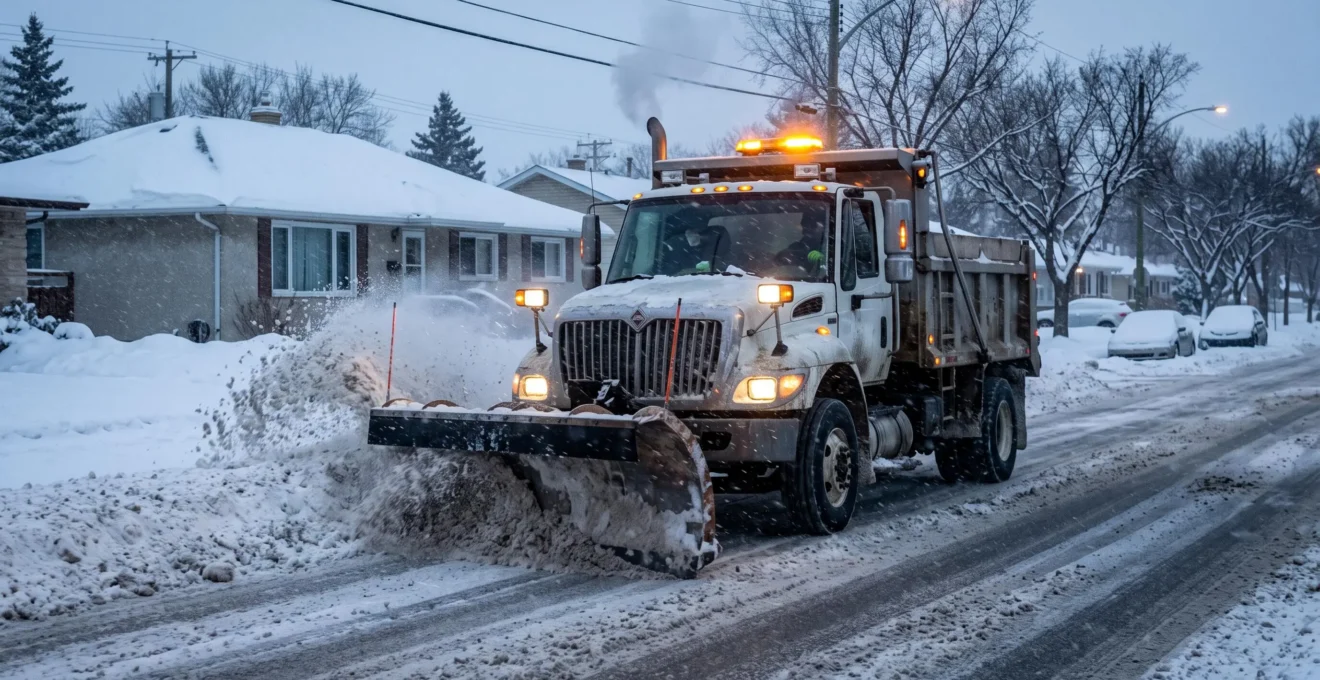
Winnipeg restores winter mobility through a staged snow-clearing system that puts major roads, bus routes and essential access corridors ahead of residential streets. After a significant snowfall, crews concentrate first on keeping the transportation network functioning. Neighbourhood plowing follows once higher-priority streets have reached acceptable conditions.
This approach explains why a regional road may have exposed pavement while a nearby residential street remains covered in compacted snow. It also explains why a street can be marked as cleared even when snowbanks remain along curbs or across driveway entrances.
The City of Winnipeg uses three street-clearing categories, designated Priority 1, Priority 2 and Priority 3. Each carries different operating standards, snowfall thresholds and expected conditions after plowing. Weather, drifting snow and parking restrictions can influence how quickly crews finish their work.
Residents can make better travel decisions by understanding those distinctions, following parking-ban notices and checking official clearing updates before leaving home.
Winnipeg snow clearing at a glance
- Major routes come first: Priority 1 regional streets and Priority 2 bus and collector routes receive attention before residential streets during major storms.
- Residential standards differ: Priority 3 streets are generally maintained with compacted snow rather than cleared to bare pavement.
- Check before travelling: Official snow operations maps, parking-ban announcements and 311 help residents verify conditions and scheduled work.
- Why Are Some Winnipeg Streets Cleared Before Others After a Snowstorm?
- When Should Winnipeg Residents Prepare for a Forecast Heavy Snowfall?
- How Can Residents Prepare for Winnipeg Snow Clearing Operations?
- Major Roads or Residential Streets: Why Does Winnipeg Clear Them Differently?
- Snow Clearing Mistakes That Can Complicate Winnipeg Winter Travel
- When Can Winnipeg Drivers Expect Roads to Improve After Heavy Snow?
- How Does Winnipeg’s Transportation Network Keep People and Goods Moving?
- When Is the Best Time for Different Types of Winnipeg Road Repair?
Why Are Some Winnipeg Streets Cleared Before Others After a Snowstorm?
Winnipeg clears streets according to their transportation function and assigned service priority, not simply the amount of snow on an individual block. Regional roads receive the highest priority because they support major traffic movements and essential access. Bus routes and collector streets follow, while residential streets are scheduled later during major storms.
The City of Winnipeg Snow Clearing and Ice Control Policy identifies three street priorities, rather than a five-level street hierarchy.
| Priority | Street classification | Normal clearing standard |
|---|---|---|
| P1 | Regional streets and certain streets serving Health Sciences Centre emergency access | Bare pavement across the pavement width under normal conditions |
| P2 | Non-regional bus routes, collector streets and certain other designated routes | Normally plowed to bare pavement |
| P3 | Residential and lightly used industrial streets | Normally maintained with compacted snow |
Priority 1 streets are generally addressed when snow accumulation exceeds 3 cm, using plowing, de-icing treatments or both. Priority 2 plowing is normally initiated after more than 5 cm of accumulation. Residential P3 operations are usually initiated following 10 cm of snowfall or equivalent local drifting conditions.
Those thresholds describe different service standards. They should not be interpreted as guarantees that every street will receive a plow immediately upon reaching a particular depth.
Another important distinction concerns snow clearing versus snow removal. Clearing generally moves snow away from the travelled portion of the street. Removal may involve mechanically blowing, relocating or hauling accumulated snow from locations where storage interferes with traffic, pedestrian movement or infrastructure.
Consequently, a plowed regional street can still have substantial snowbanks awaiting separate removal work. The presence of a windrow does not automatically indicate that routine plowing was skipped.
The City’s snow operations map provides a way to check street classifications and the status of major clearing operations. A resident can search by address rather than assuming that another neighbourhood has received preferential treatment.
Once those priorities are understood, preparing for a forecast storm becomes a practical matter of monitoring notices, arranging parking and allowing crews access to the streets they must clear.
When Should Winnipeg Residents Prepare for a Forecast Heavy Snowfall?
Winnipeg residents should begin preparing when a credible forecast indicates disruptive snowfall, rather than waiting for residential plows to arrive. Checking forecasts 24–48 hours beforehand provides a useful planning window, but it is not an official municipal notice period. Parking restrictions and clearing schedules must be confirmed through City announcements.
A practical preparation timeline separates early household planning from restrictions that become enforceable only when the City declares them.
| Planning stage | Useful action | Purpose |
|---|---|---|
| 24–48 hours before expected snowfall | Review forecasts, parking alternatives and essential travel plans | Reduce last-minute decisions |
| On the storm day | Check municipal notices and current road conditions | Identify active restrictions and changing hazards |
| When residential clearing is announced | Verify the assigned snow zone and scheduled shift | Move vehicles before the applicable restriction begins |
| After major clearing | Check street status and inspect driveway access | Confirm whether further work or personal clearing is needed |
Winnipeg operates several types of winter parking restrictions. The City of Winnipeg winter parking bans information distinguishes the annual Winter Route Parking Ban, extended restrictions, residential bans and other measures supporting snow operations.
The annual Winter Route Parking Ban can start at any point between November 1 and the end of April when conditions require. The City states that it announces the start seven days in advance. Once active, the ordinary restriction prohibits parking on designated winter routes between 2 a.m. and 7 a.m.
An Extended Winter Route Parking Ban can move the nightly starting time to midnight. Residential Parking Bans operate differently: neighbourhood streets are organized into lettered snow zones, with clearing scheduled in 12-hour shifts.
While a Residential Parking Ban is active, the ordinary Winter Route Parking Ban is suspended, potentially providing additional overnight parking choices, subject to other restrictions.
Vehicles left in restricted locations can be ticketed or towed. A published residential-ban penalty is $200, reduced to $150 with early payment. Residents should verify currently applicable amounts and restrictions rather than relying on an older notice.
Household preparations matter as much as vehicle placement. An emergency car kit, winter clothing, a charged telephone and a check on neighbours with limited mobility can reduce difficulties if travel becomes impractical.
The most useful preparation is one that leaves household members ready and keeps the roadway available for municipal crews. The next step is coordinating those preparations with the actual residential clearing schedule.
How Can Residents Prepare for Winnipeg Snow Clearing Operations?
Residents can support Winnipeg snow clearing by checking their assigned snow zone, moving vehicles before scheduled residential plowing and keeping avoidable obstacles off the roadway. Once work is underway, official status tools can distinguish an upcoming operation from an unfinished one, helping residents report genuine problems with accurate location details.
Residential clearing requires coordination across many streets. The City announces schedules for lettered snow zones, assigning operations to 12-hour shifts. A vehicle parked where plowing is scheduled can prevent equipment from clearing the intended roadway width.
Residents should also pay attention to temporary no-parking signs, which can apply to particular streets when additional snow-removal work is required.
Preparation does not end at moving a car. Where practical and safe, bins and other movable belongings should be kept out of the plow’s operating path. Property owners should also consider how cleared snow and windrows may affect access to their driveways and walkways.
To monitor progress, residents can use the City’s Know Your Zone tools for residential schedules and the broader snow operations map for major clearing activity. The map can identify operations that are upcoming, in progress, completed or not completed during their scheduled shift.
When reporting a suspected missed street to 311, useful details include the address, the relevant snow-zone shift, any visible obstruction and the status shown by the City’s reporting tools. This gives the service representative more specific information than a general complaint about neighbourhood conditions.
Five steps to prepare for residential snow clearing
- Identify your snow zone. Use Know Your Zone or 311 and record the assigned zone letter.
- Verify the schedule. Check the announced clearing shift and record its start and end times.
- Relocate your vehicle. Select a lawful parking location and confirm that your usual space is clear before restrictions begin.
- Check the street frontage. Move portable obstacles from the roadway where safe and create a short checklist of anything still requiring attention.
- Verify completion. Review the reported status after the shift and retain the location, time and relevant details if contacting 311.
Sidewalk responsibilities require separate attention because Winnipeg’s policy establishes municipal clearing standards for designated sidewalks and pathways, not an assumption that every pedestrian route receives identical service. Property-specific obligations should be checked against applicable City requirements.
Snow around fire hydrants can also obstruct emergency access. Residents who observe a significant obstruction can report its location without assuming responsibility for operating or maintaining municipal equipment.
Even with unobstructed access, the finished condition of a residential street will often differ from that of a major road. This distinction follows from Winnipeg’s operating standards rather than a promise of identical snow-free pavement everywhere.
Major Roads or Residential Streets: Why Does Winnipeg Clear Them Differently?
Winnipeg clears major roads and residential streets differently because they perform different transportation functions and have different maintenance standards. Priority 1 and Priority 2 routes are normally restored toward bare pavement, while Priority 3 residential streets are generally maintained with compacted snow. The distinction affects plowing intensity, expected surfaces and snowbank management.
Regional roads carry important traffic flows and connect major destinations. Maintaining them supports transit, emergency access, commercial travel and the wider street network. During major storms, the City also gives advanced Priority 2 plowing attention to bus routes.
On residential streets, the goal is not necessarily to remove every trace of snow. Crews generally plow the travelled surface while leaving compacted snow beneath. The resulting condition can remain noticeably different from that on a regional street.
| Operational feature | Major and collector routes | Residential streets |
|---|---|---|
| Street priority | Generally P1 or P2 | Generally P3 |
| Expected surface | Normally bare pavement | Compacted snow |
| Storm sequence | Cleared before P3 during major storms | Scheduled after higher-priority routes are satisfactory |
| Snowbanks | Removal where specified conditions warrant it | Windrows may remain beside roads and driveways |
| Service focus | Network mobility and essential routes | Local vehicle access |
Plowing moves snow sideways, often leaving a windrow across a driveway entrance. That barrier can be difficult to remove, especially when the snow is dense or refrozen. The City’s policy does not promise routine removal of every residential driveway windrow.
Residents should therefore plan for driveway access to require attention after a plow passes. People unable to clear heavy snow independently may need assistance from household members, neighbours or available community services. Eligibility for any local assistance program should be verified rather than assumed.
Snow removal on main routes is also conditional. Large boulevard accumulations may be moved or hauled where insufficient storage interferes with traffic lanes, sidewalks, bridges, underpasses or other safety-sensitive locations. A regional classification alone does not mean every snowbank will be transported away.
Maintaining every residential road to the same condition as a high-volume arterial would require a different level of treatment and operational resources. Winnipeg’s published hierarchy instead establishes differentiated standards according to road function.
Because plowed roads are not always free of snow or ice, understanding the clearing standard is only part of winter travel safety. Driver behaviour around operating equipment remains equally important.
Snow Clearing Mistakes That Can Complicate Winnipeg Winter Travel
Common mistakes during Winnipeg snow clearing include driving too close to plows, disregarding parking restrictions, placing shoveled snow back onto public travel surfaces and assuming a freshly plowed road is immediately safe. These behaviours can obstruct equipment, create hazards or mislead drivers about traction and available roadway width.
Large plowing vehicles need room to move snow and complete their passes. Following too closely reduces a driver’s opportunity to react, particularly when airborne snow limits visibility. Passing equipment without a clear, safe route can expose drivers to hidden windrows and narrow lanes.
Parking is another avoidable problem. Vehicles left on designated winter routes or within an active residential clearing zone can interfere with operations and may be subject to enforcement. Temporary no-parking signs deserve the same attention as recurring winter restrictions.
After clearing a driveway, residents should avoid depositing the removed snow onto streets, sidewalks or cycling facilities. Moving snow onto public travel surfaces can recreate obstructions, reduce visibility and contribute to icy conditions. Applicable municipal rules and enforcement provisions should be checked before making assumptions about specific penalties.
The timing of a trip also matters. Freshly plowed pavement may still contain compacted patches, slush or ice. Snowbanks can restrict sightlines at intersections, while wind may move loose snow back across recently cleared lanes.
Even when de-icing materials have been applied, their effectiveness depends on environmental conditions. Winnipeg’s snow policy identifies temperature as an important limitation and describes salt effectiveness as restricted at sufficiently low temperatures, including conditions around or below -7°C.
This means visible pavement should not be treated as proof of consistently good traction. Drivers should account for changes between streets, shaded intersections, bridges and areas affected by drifting.
During active operations, a practical driving approach is to leave more space, avoid unnecessary manoeuvres around plows and accept that traffic may move more slowly than usual.
Safer decisions depend on knowing what conditions to expect next. After a major storm, improvement happens in stages, and the meaning of a completed operation differs between street classifications.
When Can Winnipeg Drivers Expect Roads to Improve After Heavy Snow?
Winnipeg drivers can generally expect higher-priority streets to improve before residential roads after a major snowfall. Under normal average-storm conditions, Priority 1 and Priority 2 plowing each have a policy completion target of approximately 36 hours after the storm ends. Residential clearing follows later and can extend over multiple scheduled shifts.
Those figures are service standards, not guaranteed arrival times for a particular address. Heavy accumulation, continued snowfall, drifting and difficult surface conditions can change how recovery progresses.
The City identifies different performance expectations by street class.
| Street category | Normal operational expectation | Expected surface |
|---|---|---|
| Priority 1 | Plowing normally completed within 36 hours after an average storm | Bare pavement under normal conditions |
| Priority 2 | Plowing normally completed within 36 hours after an average storm | Bare pavement under normal conditions |
| Priority 3 | City-wide residential operation normally takes about five 12-hour shifts after initiation | Compacted snow |
A five-shift residential operation represents approximately 2.5 days of scheduled clearing activity. It should not be counted automatically from the moment snow begins falling, since residential operations are initiated according to conditions and after higher-priority streets have been addressed.
Blowing snow is particularly important in Winnipeg’s winter environment. A street cleared during one shift may accumulate new drifts while the wider operation continues. Similarly, very cold weather can limit the effectiveness of chemical ice treatments.
Rather than estimating road readiness from elapsed time alone, drivers can use the City of Winnipeg snow operations map. The interactive tool can display clearing priorities, parking bans and major-operation status by address.
For a practical check, enter the destination street or address, examine the indicated clearing status, and compare it with the route needed to reach that location. Information on busier connecting roads may be as important as the condition directly outside a home.
The map has an important limitation: it does not record every maintenance pass or isolated trouble-spot operation. A status of completed work also does not establish that the street is free from ice, new drifting or subsequent snowfall.
Drivers should supplement clearing status with current weather information and relevant local traffic advisories. When conditions remain uncertain, postponing a non-essential journey may be more reliable than assuming an operation has restored normal driving conditions.
Road recovery also depends on how well the rest of the transportation system remains connected. A cleared neighbourhood street offers limited mobility when surrounding transit and freight corridors are still disrupted.
How Does Winnipeg’s Transportation Network Keep People and Goods Moving?
Winnipeg keeps people and goods moving after major snowfall by prioritizing the road connections that support essential travel and the broader transportation network. Regional streets, bus corridors and key access routes receive early attention because delays on those roads affect transit, emergency access, deliveries and journeys across multiple neighbourhoods.
The city’s transportation network serves more than private vehicles. Residents rely on public transit, walking connections, cycling routes and commercial deliveries. Clearing only the roadway outside individual homes would not restore those interconnected movements.
The snow-clearing hierarchy reflects that wider role. Regional routes provide important cross-city links, while Priority 2 streets include non-regional bus routes and collectors. During major storms, bus routes receive advanced attention within Priority 2 operations.
This matters because a delay on a transit corridor can affect passengers far beyond the immediate location of the snowfall. Likewise, restricted access on a regional road can complicate journeys for commercial vehicles and essential services.
Winnipeg’s role in regional freight movement also makes winter road access economically significant. Truck journeys depend on connected urban streets and highway approaches, even though rail infrastructure and municipal road clearing operate under different responsibilities.
Jurisdiction matters when checking who maintains a particular road. Winnipeg’s municipal clearing services do not automatically cover provincial highways, including the Perimeter Highway. Provincial road maintenance and neighbouring municipal operations are governed separately, making the responsible road authority an important consideration when seeking updates or reporting problems.
Pedestrian access is another part of the network. Winnipeg’s snow policy establishes clearing provisions for certain sidewalks, active transportation facilities and park pathways. Priority 1 and Priority 2 sidewalks normally begin receiving attention following 5 cm accumulation or equivalent drifting, with a normal completion standard of 36 hours after an average storm.
These provisions do not mean every walkway has the same maintenance priority. A person who relies on walking or a mobility aid may still encounter gaps between cleared road crossings, sidewalks and transit stops.
For trip planning, the most useful approach is therefore to consider the complete route: access from the property, local street conditions, the main corridor and the final connection to the destination.
Once storm operations have restored essential movement, attention gradually returns to longer-term roadway conditions. Winter weather can expose pavement defects that require a different maintenance response from routine snow clearing.
Key points before assessing road repairs
- A street reported as plowed may still have compacted snow, ice or pavement defects requiring separate attention.
- Damage reporting should describe the precise location and observable road hazard rather than assume its cause.
- Routine snow clearing, emergency pavement maintenance and major reconstruction follow different operational needs.
When Is the Best Time for Different Types of Winnipeg Road Repair?
Winnipeg road repairs depend on the type and urgency of the damage. Major pavement reconstruction and resurfacing are generally better suited to suitable warm-season construction conditions, while hazardous defects may require temporary or emergency attention during colder months. Spring freeze-thaw cycles are particularly important because they contribute to pothole formation and expose weakened pavement.
Winnipeg’s winter road operations and pavement maintenance are closely related, but they have distinct purposes. Snow clearing restores travel access and manages winter surface conditions. Road maintenance addresses physical defects such as broken pavement, potholes and damaged road structures.
Freeze-thaw activity provides a clear explanation for why potholes become prominent during spring. Water from melting snow can enter pavement cracks or the underlying road structure. When that water freezes, expansion increases stress on already vulnerable material. Passing traffic adds further pressure until portions of the surface fail.
The City of Winnipeg pothole information identifies spring freeze-thaw cycles as a major cause of potholes and directs residents to report defects through 311 or the City’s online form.
| Road condition | Typical timing consideration | Appropriate response |
|---|---|---|
| Snow or ice obstructing movement | During winter conditions | Winter clearing or ice-control operations |
| Hazardous pothole | Whenever the hazard is identified | Report for municipal assessment and possible interim repair |
| Widespread pavement deterioration | When construction conditions permit | Assessment for more substantial rehabilitation |
| Major resurfacing or reconstruction | Generally during suitable construction weather | Planned roadwork subject to municipal priorities |
A temporary winter repair may address an immediate hazard without providing the same durability as a more extensive pavement treatment. The method selected depends on the condition of the surface and the City’s maintenance assessment; no single patching material should be assumed for every situation.
Snowplows can expose existing surface irregularities when accumulated snow is moved aside, but this observation does not establish that the equipment caused the damage. Freeze-thaw activity, pavement condition and traffic loading must be distinguished from unsupported assumptions about a particular defect.
Residents can improve the usefulness of a damage report by identifying the street, nearby intersection or civic address, the lane involved and the visible nature of the problem. Photographs may help where they can be obtained without entering traffic or creating additional hazards.
Reporting a pothole does not automatically mean the street will enter a major reconstruction program. Municipalities must assess immediate maintenance requirements separately from broader capital planning and resurfacing priorities.
Spring is an especially useful period for observing damage revealed by melting snow, but dangerous conditions should be reported whenever they become apparent.
For the next practical step, check the City’s current snow operations information before travelling, use 311 to report specific roadway defects, and distinguish an active clearing concern from a pavement problem requiring maintenance.
Does Winnipeg guarantee that every street will be cleared immediately after 10 cm of snowfall?
No. Approximately 10 cm of accumulation or equivalent drifting is a normal trigger for Priority 3 residential operations, not a promise of immediate service. Higher-priority routes must first reach satisfactory conditions during major storms, and residential clearing is then completed through scheduled operations.
Can a residential street be marked complete while packed snow remains?
Yes. Winnipeg’s normal Priority 3 standard is a compacted-snow surface rather than bare pavement. A completed clearing status must be interpreted according to the street’s classification and does not guarantee the absence of snow or ice.
What happens when snow returns after a street has already been plowed?
Additional snowfall or drifting can make further clearing necessary. The timing depends on accumulation, street priority, operating conditions and the City’s response. An earlier completed status should not be taken as confirmation of current road conditions after new snow.
Does Winnipeg’s snow-clearing map display every plow visit?
No. The official map reports major clearing operations and associated statuses, but it does not update for every maintenance activity or isolated trouble-spot operation. Residents should use the displayed information alongside current notices and 311 when appropriate.
Should drivers contact Winnipeg 311 about snow conditions on the Perimeter Highway?
The Perimeter Highway is a provincial highway, so its winter maintenance is not governed by Winnipeg’s municipal street-clearing priorities. Drivers should consult the appropriate Manitoba provincial road information and reporting services for highway-specific conditions.