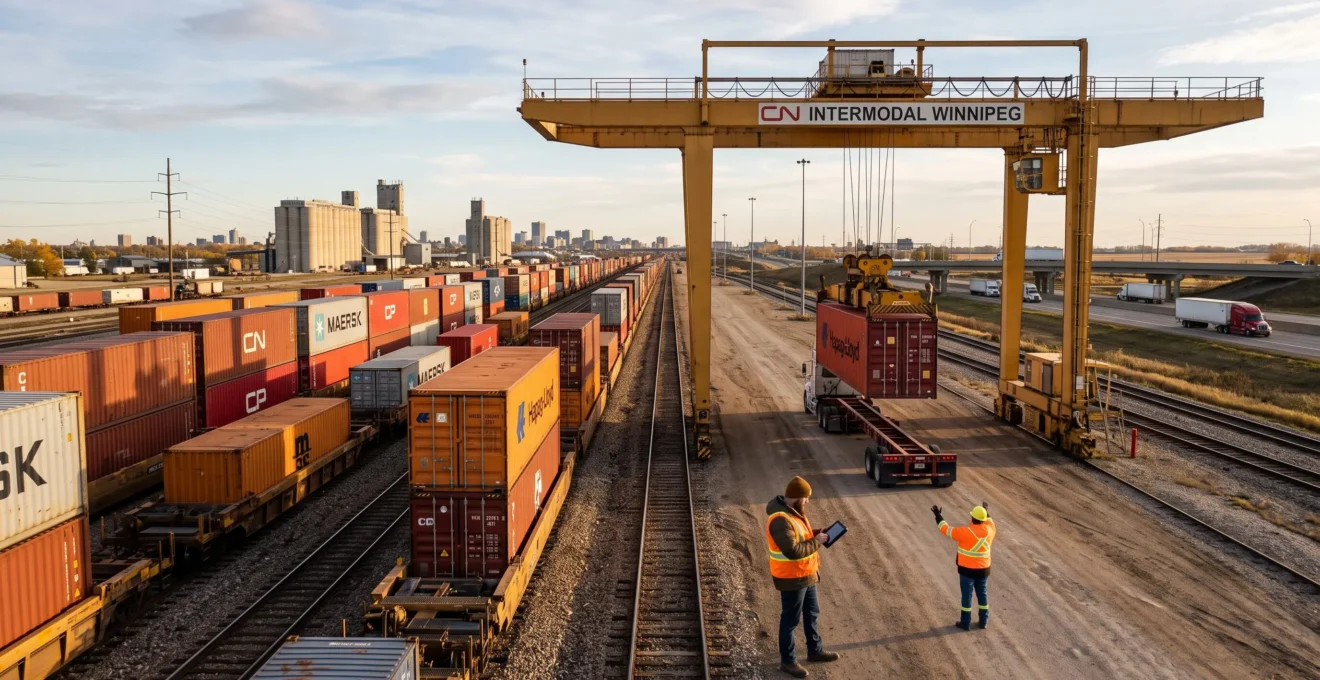
Winnipeg is a major transportation and logistics hub because several important Canadian freight networks intersect in and around the city. East–west railway corridors, the Trans-Canada Highway system, north–south connections to the United States and international air cargo services provide businesses with multiple ways to move goods between Western Canada, Central Canada and American markets.
Its importance extends beyond geographic location. Warehouses, industrial parks, intermodal terminals, trucking companies and distribution services create the operational infrastructure needed to consolidate shipments, transfer freight between transport modes and supply regional markets.
These advantages are particularly valuable for companies managing freight flows in several directions. However, Winnipeg is not automatically the cheapest or fastest distribution location for every business. Transportation economics depend on shipment origins, customer locations, delivery commitments, seasonal conditions and access to appropriate carriers.
Understanding Winnipeg’s logistics role therefore requires examining both the infrastructure that makes freight movement possible and the practical constraints that determine whether a particular distribution strategy will succeed.
Winnipeg’s transportation advantages at a glance
- Network convergence: Major railways, highways, cross-border corridors and air cargo services connect Winnipeg with Canadian and American markets.
- Distribution flexibility: Intermodal facilities, trucking networks and industrial parks support freight consolidation, warehousing and regional delivery.
- Business suitability: Winnipeg’s value depends on actual shipping lanes, total distribution costs, carrier capacity and seasonal operating requirements.
- Why Does Winnipeg’s Location Matter So Much for Canadian Freight Distribution?
- How Can a Business Evaluate Winnipeg for a Central Canadian Distribution Base?
- Road, Rail, or Air: Which Freight Mode Fits Different Winnipeg Logistics Needs?
- Freight Bottlenecks That Can Disrupt Winnipeg Supply Chains
- When Should a Company Reassess Its Winnipeg Freight and Distribution Strategy?
- Why Can One Winnipeg Transportation Disruption Affect Trips Across the City?
- How Can a Business Assess a Winnipeg Industrial Park Before Choosing a Site?
- Why Are Industrial Parks Important to Winnipeg’s Business and Employment Base?
Why Does Winnipeg’s Location Matter So Much for Canadian Freight Distribution?
Winnipeg’s location matters because it connects major east–west Canadian freight routes with north–south transportation corridors serving the United States. This network position allows carriers to consolidate shipments, transfer freight between transport modes and distribute goods across several markets. The advantage is strongest for businesses with multidirectional freight requirements rather than shipments travelling exclusively toward Eastern Canada.
Two major Canadian railway systems, Canadian National Railway (CN) and Canadian Pacific Kansas City (CPKC), serve Winnipeg. Their networks provide connections across Canada and into the United States, while the Trans-Canada Highway supports long-distance trucking between the Prairie provinces, Ontario and other regions.
Provincial Trunk Highway 75 provides an important southern route toward the Emerson–Pembina border crossing and the American highway network. Together, these corridors form part of Manitoba’s broader international trade connections, as described in the Manitoba government’s overview of transportation infrastructure.
However, being geographically central is not the same as minimizing freight costs. Winnipeg’s economic value comes from the interaction between infrastructure and actual shipment patterns.
Consider a hypothetical distributor receiving merchandise from Western Canada and supplying customers in Manitoba, Saskatchewan, northwestern Ontario and the northern United States. A Winnipeg facility could consolidate incoming shipments before allocating inventory to regional delivery routes. This arrangement might reduce duplicated warehouse handling and simplify inventory management compared with maintaining several small depots.
The same arrangement might be less attractive for a company whose entire customer base lies near Toronto or Montréal. In that situation, the cost of transporting goods eastward from Winnipeg could outweigh the benefits of centralized Prairie distribution.
Winnipeg is therefore better understood as a strategic handoff between Western and Central Canadian freight networks than as the universal centre of Canadian distribution. Although Manitoba is geographically in Western Canada, Winnipeg functions as a gateway toward Central Canadian markets through its highway and rail connections.
Location provides the opportunity for efficient distribution, but businesses must test whether the surrounding transportation network offers the services, capacities and transit times their operations require.
How Can a Business Evaluate Winnipeg for a Central Canadian Distribution Base?
A business should evaluate Winnipeg by comparing its total distribution costs and service performance against realistic alternative locations. The assessment must account for customer geography, inbound freight, transportation modes, warehouse expenses, labour requirements and inventory commitments. Winnipeg is competitive when its network advantages produce measurable savings or service improvements for the company’s specific shipment patterns.
The starting point is an origin–destination analysis. Map where suppliers ship from, where customers receive goods, shipment frequency, typical load sizes and required delivery windows. This establishes whether the operation depends primarily on Prairie distribution, national east–west transport, cross-border trade or a combination of these flows.
Next, compare Winnipeg with locations that could realistically serve the same customers, such as Regina, Saskatoon, Thunder Bay or the Greater Toronto Area. A location that appears attractive based on warehouse rent may prove expensive when outbound freight and additional inventory costs are included.
The following comparison framework helps separate the main decision variables.
| Criterion | What to measure | Why it matters |
|---|---|---|
| Transportation | Lane rates, shipment frequency, accessorial charges and transit times | Determines recurring freight expenditure and customer service reliability |
| Facilities | Warehouse rent, available floor space, loading capacity and expansion potential | Affects fixed costs and operating flexibility |
| Labour | Local wages, recruitment conditions, shift coverage and staff retention | Influences throughput and operational continuity |
| Inventory | Stock requirements, replenishment frequency and carrying costs | Captures expenses not visible in freight-rate comparisons |
| Carrier access | Available services, peak-season capacity and contract conditions | Tests whether published network connections translate into usable services |
| Resilience | Alternate routes, winter reliability and supplier concentration | Measures exposure to interruptions and recovery costs |
Different operations should assign different weights to these criteria. Bulk shippers may prioritize rail access, while less-than-truckload (LTL) distributors need dependable collection routes, trailer capacity and connections to regional terminals. Containerized importers should examine drayage costs and the specific intermodal services available at their chosen facility.
Businesses must also distinguish historical evidence from current market conditions. Published infrastructure descriptions establish network presence but do not confirm present warehouse vacancies, labour costs or available trucking capacity.
Five steps to validate a Winnipeg distribution decision
- Map freight flows: Compile a shipment-level origin–destination report covering representative operating periods.
- Model complete costs: Produce a comparison worksheet covering transport, labour, facilities and inventory for Winnipeg and competing locations.
- Validate transport access: Obtain written service proposals from relevant carriers or third-party logistics providers for the actual shipping lanes.
- Test operating conditions: Document winter service limitations, peak-season capacity and local delivery constraints through carrier interviews and site visits.
- Record the decision: Prepare a site-selection scorecard identifying expected costs, required service levels, assumptions and unresolved risks.
Carrier interviews are particularly important. A railway or highway passing through Winnipeg does not guarantee convenient terminal access or available capacity for a given shipment.
Once the location case is established, the next decision is how road, rail and air services should be combined to match the operation’s freight requirements.
Road, Rail, or Air: Which Freight Mode Fits Different Winnipeg Logistics Needs?
Road freight generally offers the greatest routing flexibility for Winnipeg’s regional distribution needs, while rail is suited to substantial recurring volumes on established long-distance corridors. Air cargo supports shipments with demanding delivery deadlines or high consequences of delay. The most effective logistics strategy often combines these modes rather than relying on a single transportation system.
Winnipeg’s access to both CN and CPKC networks creates opportunities for rail-based shipping and intermodal movements. These connections can support alternative commercial options, although service availability depends on the terminals, routes, equipment and contracts involved.
Truckload transport remains essential for movements requiring direct delivery, flexible departure schedules or connections between warehouses and regional customers. LTL services help consolidate smaller shipments travelling to several destinations without requiring a dedicated trailer for every order.
Air cargo through Winnipeg Richardson International Airport offers a different proposition: transportation speed can justify higher costs when shipment value, perishability or production continuity makes delivery time critical.
| Mode | Best suited to | Principal limitation |
|---|---|---|
| Full truckload | Large direct shipments, regional replenishment and flexible routing | Long-distance road costs and weather exposure |
| LTL trucking | Smaller shipments to dispersed commercial customers | Terminal handling and variable delivery schedules |
| Intermodal rail | Containerized, recurring long-distance freight with flexible lead times | Terminal access, schedules and drayage requirements |
| Conventional rail | Suitable bulk commodities and high-volume industrial movements | Rail infrastructure and service requirements |
| Air freight | Urgent, valuable or time-sensitive products | Higher transportation expense and shipment restrictions |
The most useful distinction is between a mode’s network availability and its operational suitability. Access to two major railway systems can improve routing options, but a warehouse without suitable intermodal services may still depend heavily on road transport.
A hypothetical retailer could move imported containers across Canada by rail, transfer them to trucks in Winnipeg and distribute inventory to stores throughout the Prairies. Such a strategy combines rail’s long-distance capacity with the flexibility of regional road delivery.
Remote northern destinations require additional planning. Seasonal roads, limited transportation alternatives and specialized regional carriers may impose delivery calendars unlike those used for southern Canadian markets. Companies serving these communities must model those constraints separately.
Similarly, aerospace components, medical supplies or sensitive perishables may justify air cargo when late arrival creates substantial consequences. Freight mode selection should therefore account for the total cost of meeting delivery requirements, not simply the quoted transport price.
Because every mode depends on surrounding infrastructure and operating conditions, businesses must also understand where disruptions can undermine an otherwise efficient distribution network.
Freight Bottlenecks That Can Disrupt Winnipeg Supply Chains
Winnipeg supply chains face disruption risks from severe winter weather, flooding, border interruptions, infrastructure incidents and recurring capacity constraints. These problems affect transportation in different ways: some temporarily block routes or delay equipment, while others reduce operating flexibility over longer periods. Effective contingency planning must distinguish sudden incidents from structural service limitations.
Extreme Prairie winter conditions can interfere with vehicle inspections, loading operations, equipment performance and highway travel. Snow, ice and cold-related maintenance requirements may affect both local pickup schedules and long-distance deliveries.
Spring flooding represents a different exposure. The Red River has historically created significant flood risk around Winnipeg, although substantial flood-control infrastructure protects the city.
According to Manitoba Infrastructure’s Red River Floodway information, the expanded floodway was designed to provide protection against a flood event with an estimated annual exceedance probability of approximately one in 700. This protection does not mean that every industrial property, access road or transportation corridor is immune to flooding.
Cross-border freight has a further dependency: operations at the Emerson–Pembina crossing. Customs requirements, congestion or interruptions at this gateway can affect shipments moving between Manitoba and the United States.
A documented historical example illustrates the consequences. In February 2022, a blockade caused a multi-day suspension of normal operations at Emerson. The Canada Border Services Agency recorded a suspension beginning February 10 and service resumption February 16, with commercial traffic redirected to other Manitoba crossings, including Winkler, Gretna and Tolstoi.
Real-world disruption: Emerson border closure in February 2022
The Canada Border Services Agency documented the interruption of normal border services at Emerson during the February 2022 blockades. Commercial traffic was redirected through alternative Manitoba ports of entry.
This incident demonstrates that an established cross-border corridor can become temporarily unavailable and require operational rerouting. It does not establish current congestion levels or the capacity available at alternative crossings during routine operations.
The Canada Border Services Agency‘s briefing on the 2022 border disruptions provides the historical details. Businesses can use the incident as a reason to establish alternate-routing procedures, not as evidence that Emerson is routinely congested.
Rail interruptions, bridge restrictions and major highway closures can also produce substantial diversions because several long-distance freight corridors converge around Winnipeg. Alternative routes should be identified with carriers before they are needed.
Meanwhile, recurring driver availability, warehouse staffing and peak-season capacity requirements call for longer-term measures such as contract diversification, workforce planning and realistic lead times.
Resilient logistics operations combine seasonal preparation, alternative carrier arrangements and continuous performance monitoring, with particular attention to disruptions that repeat often enough to affect the underlying distribution strategy.
When Should a Company Reassess Its Winnipeg Freight and Distribution Strategy?
A company should reassess its Winnipeg distribution strategy when meaningful changes in customer geography, freight costs, shipment profiles or service performance weaken the assumptions behind its original network design. Annual reviews are a useful baseline, but persistent capacity failures, major infrastructure developments or substantial changes in the business may justify an earlier evaluation.
The need for reassessment is not necessarily evidence that Winnipeg has become unsuitable. Distribution networks evolve as companies add customers, change suppliers, adopt new sales channels and modify their inventory policies.
For example, a company originally focused on Prairie retail replenishment might gradually acquire a customer base concentrated in Ontario. Its Winnipeg warehouse may remain effective for Western Canada while becoming less efficient as the sole distribution facility for the expanded business.
Several developments should prompt a structured review:
- Geographic shifts: Customers, suppliers or inventory origins move toward different markets.
- Sustained freight inflation: Key shipping lanes become consistently more expensive relative to alternatives.
- Recurring service failures: Delivery performance or carrier availability deteriorates across multiple periods.
- Product changes: The business moves from bulk shipments toward parcel fulfillment, or develops different handling requirements.
- Infrastructure changes: New terminal services, transportation improvements or industrial developments create alternative network configurations.
An effective annual review compares updated origin–destination maps, transport spending, inventory carrying costs and service-level results with the assumptions recorded at the previous assessment.
However, one difficult quarter should not automatically trigger a warehouse relocation. A severe winter event or isolated carrier incident may temporarily distort costs and delivery performance without changing the long-term suitability of Winnipeg.
Reviewing twelve-month trends can help separate recurring problems from temporary shocks. Businesses should also identify whether deterioration affects all carriers or only particular transportation contracts.
Where shipping patterns have changed substantially, the choice is not limited to staying in Winnipeg or relocating entirely. A hybrid network may retain Winnipeg for Prairie and cross-border distribution while adding another facility closer to an emerging customer concentration.
Such decisions require comparing facility costs, inventory duplication, freight savings and delivery performance across the complete network. A second facility may shorten some deliveries while creating additional stock and operating expenses.
Any review should also consider disruptions within Winnipeg itself, because efficient national transportation connections can still be constrained by the city’s local road network.
Why Can One Winnipeg Transportation Disruption Affect Trips Across the City?
A single Winnipeg transportation disruption can affect trips across multiple neighbourhoods because major road corridors, river crossings and industrial access routes share a connected network. When a bridge, arterial road or important intersection becomes unavailable, traffic shifts to alternative routes. Those routes may already carry significant passenger and commercial traffic, creating additional delays well beyond the original incident.
The Red and Assiniboine rivers shape Winnipeg’s road network. Bridges concentrate vehicles at defined crossing points, while major roads connect residential areas with employment districts, industrial parks, freight terminals and the airport area.
When a significant crossing becomes unavailable, drivers cannot simply move to an equivalent parallel road at every location. Instead, traffic may have to travel farther to reach another bridge, increasing volumes on connecting streets.
For freight operators, these disruptions can affect several linked activities within a single delivery cycle:
- Trucks arriving from regional highways may reach warehouse docks later than scheduled.
- Container drayage trips between intermodal terminals and nearby distribution centres may take longer.
- Late arrivals can disrupt loading appointments and cross-docking schedules.
- Drivers may incur additional operating hours or detention charges, depending on contract terms.
- Outbound deliveries may be delayed when inventory is not transferred on time.
Consider a hypothetical operation transferring goods from an intermodal facility to a warehouse before local delivery. If an important access corridor closes, the inbound vehicle may miss its warehouse appointment. The resulting delay could affect a loading crew, an outbound driver and several customer delivery windows, even if the original incident involved only one road segment.
Seasonal conditions can amplify the problem. Snow and ice reduce effective road capacity, while summer construction can limit alternative lanes. Flood-related restrictions introduce additional route uncertainty where individual roads or properties remain exposed.
Businesses can reduce disruption exposure by testing alternative routes, scheduling appointments with realistic buffers and coordinating with carriers about congestion-sensitive movements.
Where possible, deliveries to major logistics areas can be scheduled outside local peak periods. However, this must be balanced against warehouse operating hours, driver availability and customer receiving requirements.
These considerations become especially important when selecting an industrial property, where a short map distance from a highway may conceal difficult access conditions during actual operating hours.
How Can a Business Assess a Winnipeg Industrial Park Before Choosing a Site?
A business should assess a Winnipeg industrial park through practical due diligence covering freight access, permitted uses, facility capacity, workforce availability and site-specific environmental risks. The best property is not necessarily the one closest to a highway or airport. It is the location that reliably supports the company’s actual transportation movements, staffing model and future operating requirements.
Industrial property assessments should begin with truck access. Review how vehicles enter and leave the property, which roads connect the site with major freight corridors and whether large trucks can maneuver safely within the yard.
A distribution warehouse may need substantial trailer parking, separate inbound and outbound circulation, loading docks suited to its equipment and space for temporary trailer storage. A light manufacturing operation may prioritize electrical service, production layouts and access for specialized freight.
Zoning permissions must be verified for the intended activity. Warehouse use, outdoor storage, truck parking, manufacturing and cross-docking may face different municipal requirements or property restrictions.
Site visits should go beyond physical inspection. Businesses should arrange trial journeys between candidate properties and important destinations, such as intermodal facilities, highway connections, major customers and the Emerson border corridor. Testing routes at realistic departure times can reveal delays that straight-line distances do not capture.
The labour market is equally important. A facility may have excellent freight access but create recruitment difficulties if employees cannot reach it conveniently or if nearby employers compete for the same workforce.
Evaluate commuting routes, transit access where applicable, parking capacity and the geographical area from which employees could realistically travel.
Additional due diligence should examine property-specific flood exposure, insurance requirements, utility capacity, expansion potential, municipal development plans and restrictions contained in lease or ownership agreements.
For refrigerated warehousing or automated logistics facilities, electrical capacity and service reliability deserve particular attention. For high-turnover trucking operations, yard configuration and gate access may have greater operational importance than additional interior floor space.
A site assessment should conclude with a written comparison of mandatory requirements, operational trade-offs and unresolved issues requiring confirmation from the municipality, property owner or relevant service provider.
The broader value of these industrial properties is that their concentration supports the logistics services, employment and infrastructure that make Winnipeg a functioning distribution centre.
Key considerations before examining Winnipeg’s industrial economy
- Infrastructure works as a system: Freight terminals, access roads, utilities and industrial land must support one another.
- Clustering creates operational opportunities: Nearby carriers, warehouses and service providers can make freight consolidation and regional distribution more practical.
- Future capacity matters: Businesses should evaluate industrial expansion potential and infrastructure plans alongside current property conditions.
Why Are Industrial Parks Important to Winnipeg’s Business and Employment Base?
Industrial parks are important to Winnipeg because they concentrate transportation, warehousing, manufacturing and supporting services in areas equipped for commercial and industrial activity. This concentration makes freight handling more practical, supports a specialized labour market and connects local businesses with national distribution networks. Industrial capacity is therefore a fundamental part of Winnipeg’s economic role, not simply a consequence of its location.
Freight operations depend on infrastructure that individual businesses cannot always provide economically. Industrial areas allow companies to benefit from established road access, utilities, suitable land uses and nearby commercial services.
When warehouses, trucking companies, freight forwarders and manufacturers operate near one another, they create opportunities for shorter local transfers and consolidated transport movements. These benefits depend on actual service arrangements, but physical proximity can reduce some of the coordination challenges faced by dispersed facilities.
Industrial activity also supports employment beyond warehouse floors and loading docks. Transportation businesses rely on dispatchers, mechanics, logistics coordinators, customs specialists, equipment suppliers, administration teams and other professional services.
Statistics Canada’s 2021 Census Profile for Winnipeg provides a historical measure of this economic base. It reported 27,430 people in the city’s labour force classified under transportation and warehousing, alongside 34,390 in manufacturing and 11,145 in wholesale trade.
27,430
People in the City of Winnipeg’s labour force classified under transportation and warehousing in the 2021 Census, based on 25% sample data. This is a historical industry labour-force measure, not a count of warehouse positions currently filled.
These figures demonstrate that transportation, manufacturing and wholesale activities formed a substantial part of the city’s industry base in 2021. They do not establish the number of current jobs within industrial parks, nor do they prove that clustering alone caused the recorded employment levels.
The operational relationship nevertheless matters. A sufficiently concentrated base of freight customers can help support recurring trucking routes, shared logistics services, intermodal drayage and specialized industrial suppliers.
Winnipeg’s inland-port-style development also illustrates the strategic importance of coordinating transportation infrastructure and industrial land. Areas associated with logistics development around the airport and major freight corridors provide opportunities for businesses requiring proximity to transportation services.
Future growth will depend partly on whether suitable industrial land, road connections, utilities and workforce capacity expand alongside demand. Increasing e-commerce activity or freight volumes does not automatically produce economic benefits if access roads, warehouses or labour availability become constraints.
Businesses should therefore examine municipal development plans, infrastructure proposals and site availability rather than assuming that every industrial area offers equivalent expansion potential.
For a company considering Winnipeg, the logical next step is to compare actual freight flows, carrier proposals and industrial property requirements in a single location assessment. That evidence will show whether Winnipeg should function as its primary distribution hub, a regional facility or one component of a broader Canadian logistics network.
Is Winnipeg considered part of Central Canada or Western Canada?
Winnipeg is geographically and conventionally part of Western Canada. In logistics discussions, however, it may be described as a gateway toward Central Canada because major transportation routes connect Manitoba with Ontario and markets farther east. The distinction matters when assessing distribution coverage rather than applying geographic labels alone.
Does Winnipeg have access to both major Canadian railway networks?
Yes. CN and CPKC serve Winnipeg through their broader railway networks. However, the presence of both companies does not guarantee that every warehouse, industrial property or shipper can access both systems directly. Terminal services, routing availability, equipment and commercial arrangements must be confirmed individually.
Can Winnipeg support international freight distribution?
Winnipeg can support international distribution through its cross-border road and rail connections, intermodal services and airport cargo facilities. Businesses importing or exporting goods must still assess customs procedures, shipment documentation, carrier availability and the cost of reaching their specific international markets.
Are Winnipeg warehouses protected from Red River flooding?
Winnipeg benefits from major flood protection infrastructure, including the Red River Floodway. However, regional flood-control measures do not establish that every warehouse parcel, access route or industrial property is protected against all flooding scenarios. Property-specific flood exposure, drainage conditions and insurance requirements should be investigated before occupancy.
Is a single Winnipeg warehouse enough for nationwide Canadian distribution?
A single Winnipeg warehouse may support nationwide distribution for some businesses, particularly those with flexible delivery windows and balanced regional freight flows. Companies requiring rapid delivery to distant, densely populated markets may benefit from additional facilities. The appropriate network depends on customer locations, transportation costs, inventory requirements and service commitments.