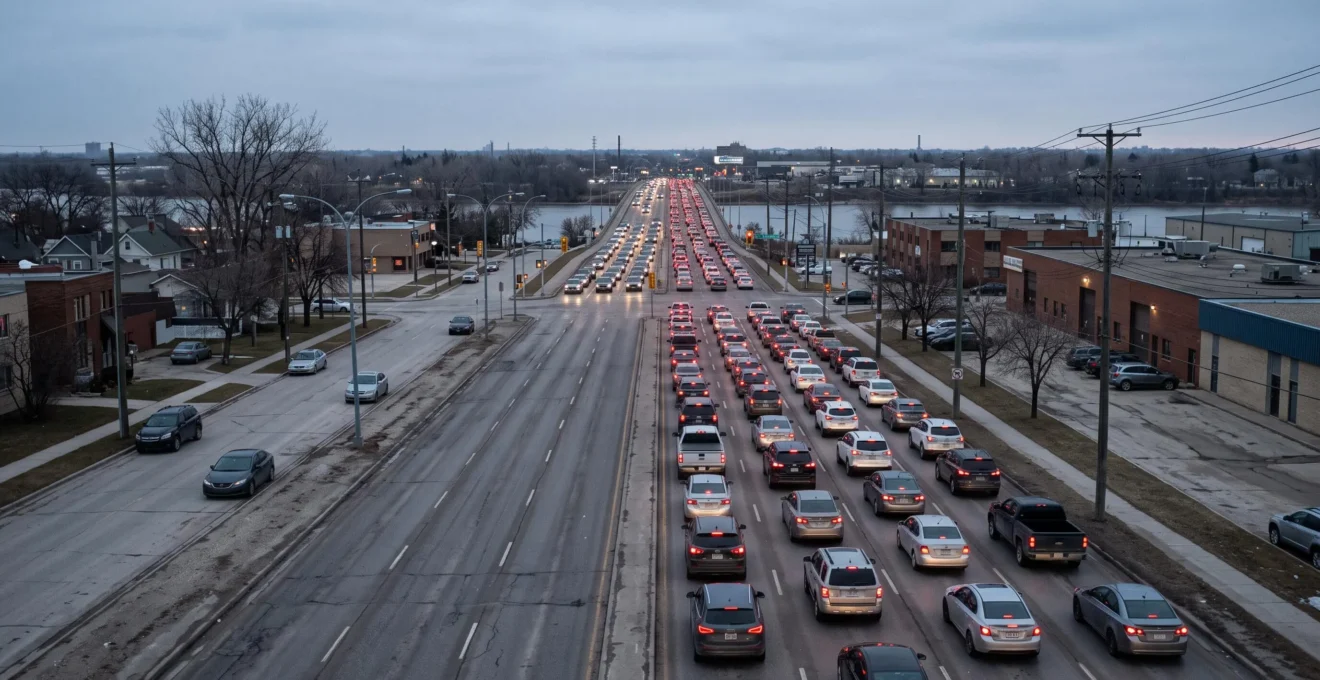
Winnipeg’s major arterial roads connect neighbourhoods with downtown, employment districts, shopping areas and destinations across the city. Corridors such as Kenaston Boulevard, Pembina Highway and Henderson Highway carry substantial cross-city demand because they provide continuity that smaller streets cannot always match. Yet their importance also makes them sensitive to congestion at busy intersections, river crossings and construction zones.
The Red and Assiniboine rivers, railway corridors and differences in street connectivity influence how traffic moves between districts. A driver may have several parallel streets available but only a limited choice of suitable crossings. Consequently, selecting a different road does not necessarily remove the underlying delay.
Understanding these constraints helps commuters plan beyond the fastest route displayed on a navigation screen. The practical objective is to combine suitable arterial connections with tested alternatives, dependable departure times and realistic expectations about seasonal conditions.
Winnipeg arterial travel at a glance
- Major arterials support cross-city connections, but intersections and limited crossings can concentrate congestion.
- A useful backup route avoids the original bottleneck instead of merely following another street toward it.
- Comparing actual journey times, adjusting departure schedules and checking roadwork notices can improve commute predictability.
- Why Does Congestion on a Winnipeg Arterial Spread Into Nearby Roads?
- How Can You Plan a Backup Route for a Busy Winnipeg Arterial?
- Fastest Route or Most Reliable Route: Which Is Better for a Winnipeg Commute?
- Arterial Road Mistakes That Can Make a Winnipeg Commute Worse
- When Should Winnipeg Drivers Adjust Departure Times for Major Arterial Routes?
- How Can You Make a Winnipeg Rush-Hour Commute More Predictable?
- Why Can Winnipeg’s Street Grid Make Some Detours Easier Than Others?
- How Can Winnipeg Commuters Reduce Delays During Peak Travel Hours?
Why Does Congestion on a Winnipeg Arterial Spread Into Nearby Roads?
Congestion spreads from a Winnipeg arterial when traffic demand exceeds the capacity of an intersection or road segment and drivers seek nearby alternatives. Vehicles leaving the main corridor can increase queues on collector roads and residential streets. When those alternatives reconnect at the same bridge or intersection, they may redistribute congestion without resolving the original bottleneck.
Consider a busy period on Kenaston Boulevard, Henderson Highway or Pembina Highway. A queue forming around a major junction can encourage motorists to seek a parallel route. That additional traffic increases turning movements and traffic volumes on streets that may have less capacity than the arterial.
The effect can extend beyond the immediate junction. If several routes feed into the same constrained crossing, delay can accumulate along their approaches. Winnipeg’s Red and Assiniboine rivers are especially important because crossing opportunities are more limited than ordinary street-grid connections.
Traffic spillover is not the same as added network capacity. A residential street might temporarily offer a shorter queue, but its intersections, stop signs and lower operating speeds can limit any advantage. As more drivers discover the same alternative, its travel-time advantage may disappear.
Neighbourhoods such as River Heights and St. Vital contain streets where drivers may consider local detours, although the extent of actual shortcutting depends on the specific location and conditions. Winnipeg addresses speeding and shortcutting concerns through measures described in the City of Winnipeg‘s traffic calming program.
Measures such as speed humps, curb extensions and turn restrictions can make residential streets less attractive for through traffic. They also reinforce an important distinction: a road suitable for local access is not necessarily designed to replace a high-capacity arterial.
Spillover makes commute planning less predictable because an alternative that performs well on one day might receive diverted traffic on another.
Before turning onto a quieter road, identify where the arterial queue originates and whether the alternative eventually returns to that same constraint. This is the starting point for building a dependable backup route.
How Can You Plan a Backup Route for a Busy Winnipeg Arterial?
A dependable backup route should bypass the constraint that regularly delays your primary arterial, not simply follow a different street name. Begin by identifying the troublesome intersection, bridge or construction zone. Then locate another practical connection, evaluate its restrictions and test its travel time during your normal commuting period before relying on it.
For example, a commuter using Pembina Highway might investigate another north–south approach. Whether that alternative is useful depends on the destination, available connections and where congestion actually occurs. If both routes converge at the same busy crossing, they remain exposed to the same delay.
The strongest alternative changes the bottleneck. For cross-river travel, this may require evaluating a different bridge or approach rather than a neighbouring street. However, a more distant crossing can introduce substantial additional travel, so it is not automatically preferable.
Use the following criteria to compare candidate routes before testing them:
| Factor | What to examine | Why it matters |
|---|---|---|
| Distance | Additional kilometres and travel direction | A long detour may cancel time saved at the bottleneck. |
| Intersections | Traffic signals, stop signs and turning movements | Repeated stops can make a short alternative slower. |
| Shared constraints | Bridges, underpasses and major junctions | A shared bottleneck can delay both routes. |
| Local restrictions | Turn restrictions, school zones and speed limits | Legal and safe access must take priority. |
| Winter suitability | Snow-clearing priority and road conditions | Some alternatives become less practical after snowfall. |
Google Maps or Waze can help compare estimated journeys, while municipal notices provide information about scheduled restrictions. These tools are useful checks, but a live recommendation should not replace familiarity with the route.
Test a candidate on an ordinary workday at your usual departure time. Record the door-to-door duration and note difficult turns, queues or seasonal hazards. A route tested only on a quiet weekend provides limited evidence about weekday rush-hour performance.
Keep at least one clear decision point before the known bottleneck. Once a vehicle has entered an extensive queue, reaching the alternative may be difficult or unsafe.
The next question is whether the backup needs to be faster or simply more consistent, since those qualities do not always occur together.
Fastest Route or Most Reliable Route: Which Is Better for a Winnipeg Commute?
The better commute route depends on whether minimizing average travel time or arriving consistently matters more. The fastest estimated route may offer the shortest typical journey, while a different route may produce a narrower range of arrival times. For fixed commitments, reliability often deserves greater weight; for flexible journeys, speed may be the main consideration.
Travel-time reliability describes how predictably a journey can be completed. As explained in the Federal Highway Administration primer on travel-time reliability, predictable recurring congestion differs from unexpected delays caused by incidents, weather or changing road capacity.
A congested arterial can still be reliable if its delay is consistent. Conversely, a usually fast route may be unreliable if occasional incidents produce substantial delays. Neither road type automatically performs better.
For a practical comparison, imagine two hypothetical commute options:
| Measure | Route A | Route B |
|---|---|---|
| Typical journey | 25 minutes | 29 minutes |
| Long-delay day | 45 minutes | 34 minutes |
| Pattern | Faster on ordinary days, more variable | Slightly slower, more consistent |
| Potential preference | Flexible arrival time | Fixed arrival commitment |
These invented figures illustrate the decision principle only. They do not describe any measured Winnipeg corridor.
A commuter beginning a fixed shift might choose Route B if repeated observations confirm its consistency. Someone with a flexible schedule might prefer Route A while accepting the possibility of an unusually long journey.
To compare real options, record departure and arrival times across multiple comparable weekdays. Test each route over at least several trips, ideally including a full working week for each option. Calculate typical duration and examine how far the slowest observations differ from it.
A small personal log is a useful starting point, not a statistically rigorous reliability assessment. Longer observation periods better capture infrequent disruptions.
Navigation applications may offer typical travel-time information for future departures, but displayed features and estimates vary. Check whether an estimate represents current traffic, historical patterns or a predicted arrival window rather than assuming a single value captures uncertainty.
Repeat the comparison when winter weather or major construction changes route conditions. Winnipeg’s optimal choice can differ by season.
Reliability also depends on avoiding recurring planning mistakes, particularly when a familiar arterial seems like the obvious choice despite changing conditions.
Arterial Road Mistakes That Can Make a Winnipeg Commute Worse
Winnipeg commuters can increase their travel delays by assuming that major arterials are always faster, leaving just as congestion builds, ignoring announced roadwork or taking unsuitable residential shortcuts. These decisions overlook the actual source of delay. A better approach is to evaluate current constraints, available alternatives and the timing of each journey.
Automatically choosing the widest road is a common planning error. Kenaston Boulevard, Pembina Highway and other major corridors provide important connections, but their capacity does not eliminate delays at signals, turning points or crossings.
A route with fewer kilometres can take longer if traffic accumulates at one critical intersection. Conversely, a parallel street with many stop signs may not provide meaningful savings. The relevant comparison is total door-to-door journey time, not road classification alone.
Another mistake is departing after a familiar congestion wave begins. Even a modest change in departure time can affect how much queued traffic a driver encounters. The benefit is corridor-specific and should be tested rather than assumed.
Ignoring construction can also undermine an established routine. Winnipeg’s road construction season generally runs from mid-May through October, according to City of Winnipeg road construction information. Municipal project and lane-closure maps cover various forms of road and utility work.
Announced restrictions may change lane availability, turning movements or access to particular approaches. A route that performed consistently before a project can become less dependable while work continues.
Finally, aggressive shortcutting through residential streets can introduce numerous turns, parked vehicles, pedestrians and lower speed limits. In winter, snowbanks and narrower usable roadways add further complications.
A detour is not worthwhile if it requires unsafe manoeuvres or non-compliance with local restrictions. Drivers should respect residential access, school zones and posted controls regardless of the navigation application’s estimate.
Many of these errors can be reduced without changing roads at all. Choosing a better departure time may address the recurring congestion that originally motivated the detour.
When Should Winnipeg Drivers Adjust Departure Times for Major Arterial Routes?
Winnipeg drivers should consider adjusting departure times when their usual journey overlaps recurring traffic buildup or when scheduled activities change demand along their route. Departing before a predictable peak may reduce exposure to queues, but the best window depends on the corridor, direction, destination and season. Comparing actual journey times is more reliable than following a citywide rule.
Morning commuter traffic often moves toward downtown and major employment destinations, while afternoon demand includes return journeys and trips to other activity centres. However, Winnipeg does not function as a single inbound-and-outbound corridor: traffic patterns vary across employment districts and cross-city connections.
Where queues build rapidly, reaching a bottleneck before demand intensifies can matter more than a small difference in distance. A slightly earlier departure may therefore change the entire journey, rather than merely shifting the arrival time.
Consider testing departure times in manageable increments, such as 10 or 15 minutes, across a two-week observation period. Record the time you leave, arrival time, total duration and any unusual conditions. Compare journeys on similar weekdays to avoid drawing conclusions from incompatible trips.
Look for the point where a small change in departure time produces a noticeably different journey duration. That transition can reveal the most useful departure window for your particular route.
School schedules, events at major venues and winter conditions can shift the pattern. Snowfall may increase journey times even outside conventional peak periods, while holiday schedules can alter demand.
For commuters who cannot change their starting time, the same observations remain useful. Instead of searching for a new departure window, estimate an arrival buffer using the slower journeys in the log. Give extra weight to comparable winter or construction conditions.
Departure flexibility and arrival reliability are separate decisions. Even a fixed schedule benefits from knowing when delays are likely and how large they can become.
Once the departure window is understood, it can become part of a repeatable commute routine with clear decisions for incidents, closures and important arrival commitments.
How Can You Make a Winnipeg Rush-Hour Commute More Predictable?
A predictable Winnipeg commute combines a familiar primary route, a tested backup, a consistent departure policy and a clear reason for switching plans. The aim is not to eliminate every delay but to reduce unexpected variations in arrival time. Monitoring announced road restrictions and comparing actual travel times makes the system more dependable than reacting to traffic after entering a queue.
Begin by defining your normal journey: starting point, destination, typical departure window and recurring bottlenecks. Choose a default arterial route based on repeated experience rather than the result of a single navigation search.
Next, establish a backup that avoids at least one major constraint affecting the primary journey. The alternative should have known access points and manageable turning movements.
Set a trigger for switching. For example, a verified incident affecting the primary crossing before you reach the last practical decision point may justify using the backup. If both options depend on that crossing, switching may offer little benefit.
Check planned construction and lane restrictions at the beginning of the commuting week. Before an important trip, review current conditions and compare them with normal travel-time patterns where available.
For a fixed appointment, base the arrival buffer on observed slower journeys rather than the shortest recorded duration. If your personal record is limited, allow for greater uncertainty, especially in winter.
Different transport modes may also help. Winnipeg Transit or a suitable park-and-ride arrangement could reduce exposure to particular road segments, depending on available services, schedules and the location of the destination. Compare the full journey, including transfers and waiting, before adopting a mixed-mode routine.
Build a five-step Winnipeg commute reliability plan
- Mark your primary bottleneck: write down the arterial, intersection or crossing and the point where delays regularly begin.
- Identify one viable alternative: save a backup route with its different connections and any restrictions that affect it.
- Measure real journeys: create a dated log containing departures, arrivals, route choices and unusual conditions.
- Define a switching rule: record the alert or observable condition that would justify changing routes before entering the bottleneck.
- Set an arrival buffer: document a practical departure policy for ordinary days and one for time-critical commitments.
Review the plan periodically because construction, changing work schedules and seasonal conditions can reduce the usefulness of an established alternative.
Its effectiveness still depends on the underlying street network. Understanding where Winnipeg’s grid provides real flexibility, and where it ends at a physical barrier, makes every backup decision more informed.
Why Can Winnipeg’s Street Grid Make Some Detours Easier Than Others?
Winnipeg’s street grid makes some detours easier because parallel and intersecting streets provide multiple ways to move between nearby destinations. However, the grid loses flexibility where rivers, railway corridors and limited crossings interrupt connectivity. A detour may work well within one part of the city but provide little benefit when every practical alternative converges on the same bridge or underpass.
Many established Winnipeg neighbourhoods have relatively regular street patterns. Drivers can sometimes change their north–south or east–west approach without making a large circuit around the city.
That flexibility is strongest when the destination can be reached through several connected streets without passing through a shared bottleneck. It weakens when a river, rail corridor or other physical feature limits the number of available connections.
The Red and Assiniboine rivers illustrate this distinction. Several streets might run toward a river, but only specific bridges carry motor traffic across it. Changing the approach road does not necessarily change the capacity constraint at the crossing.
Railway crossings and underpasses create similar network dependencies. A detour that appears direct on a map may still lead toward the same restricted connection.
Before choosing an alternative, examine the network in this order:
- Locate the original delay and determine whether it affects a road segment, intersection or crossing.
- Identify the physical barrier, if any, that limits nearby connections.
- Compare genuinely different crossings or approaches that serve the destination.
- Check turning restrictions, local access and the total distance of each alternative.
- Confirm that weather and current closures do not make the selected option unsuitable.
Winter changes the calculation substantially. Winnipeg classifies roads into snow-clearing priorities, with major regional roads generally receiving higher priority than residential streets. The City’s street snow-clearing priority map helps explain these classifications.
Priority 1 includes major regional routes, while Priority 3 covers residential streets, which are generally maintained with a compacted snow surface. Actual road conditions still depend on the weather and ongoing operations.
A residential-grid detour that is convenient on dry pavement may therefore become less attractive following significant snowfall. It should not be treated as a permanent all-season substitute without reassessment.
The grid offers flexibility, but it does not eliminate the need for major arterials. Effective cross-city travel comes from understanding how local streets, high-capacity corridors and critical crossings work together.
Key decisions before your next commute
- Identify whether your regular delay is caused by general traffic volume or one specific crossing or intersection.
- Compare routes by their consistency as well as their estimated journey time, especially when arrival deadlines matter.
- Review departure windows, construction restrictions and winter road suitability before relying on a familiar backup.
How Can Winnipeg Commuters Reduce Delays During Peak Travel Hours?
Winnipeg commuters can reduce exposure to peak-hour delays by identifying arterial bottlenecks, choosing suitable backup connections, adjusting departure times when possible and checking road restrictions before travelling. No single technique guarantees a faster journey. Combining route knowledge, timing and travel-time observations provides a more adaptable approach to cross-city commuting.
Start with the constraint that affects your journey most often. For some drivers, that will be an intersection along a major arterial. For others, it will be the bridge or connection needed to travel between districts.
Once that constraint is understood, choose a response suited to the problem. Regular demand-related congestion may be better addressed through departure timing, while a localized closure could justify a tested alternative.
These adjustments serve different purposes:
- Route selection: avoids a specific capacity or access constraint when a viable alternative exists.
- Departure timing: reduces exposure to recurring traffic buildup when schedules allow flexibility.
- Reliability planning: accounts for the possibility of unusually long journeys.
- Roadwork monitoring: identifies announced restrictions before they affect a planned trip.
- Seasonal review: checks whether a previously useful option remains practical in winter or during construction.
Small changes can complement one another. For instance, leaving earlier may reduce exposure to ordinary peak congestion, while keeping a backup route provides another option if a separate incident develops. The combined value depends on actual conditions and should be evaluated through repeated journeys.
Information is most useful before reaching the decision point. An incident notification received after joining a long queue may no longer permit an effective route change. Checking conditions before departure, then following a planned switching rule, can support calmer decisions.
Longer-term changes also matter. Construction projects, altered employment locations, new commuting patterns and different transit services can change which corridors are useful. A reliable commuting routine should therefore be revisited rather than treated as permanent.
There is no universal fastest arterial route through Winnipeg. The best choice depends on the origin, destination, direction of travel, available crossings and the conditions at the time of the trip.
For your next regular workweek, record the main point of delay, compare departure times and verify one suitable alternative. Use those observations to establish a practical route and arrival-buffer policy that can be updated as Winnipeg’s road conditions change.
Which Winnipeg arterial roads are important for cross-city commuting?
Kenaston Boulevard, Pembina Highway and Henderson Highway are examples of important Winnipeg arterial corridors. They help connect different parts of the city, but their usefulness for an individual commute depends on the origin, destination and required crossings. No single arterial is necessarily the fastest choice for every cross-city trip.
Are residential streets a good alternative when Winnipeg arterials are congested?
Residential streets may provide alternative connections, but lower speed limits, stop signs, turning restrictions and local traffic can offset any potential benefit. They may also reconnect to the original bottleneck. Drivers should respect traffic-calming measures and avoid treating neighbourhood roads as unrestricted high-capacity shortcuts.
How should drivers compare commute routes after heavy snowfall?
Compare current road conditions, snow-clearing priorities and the restrictions affecting each route. Major regional roads generally receive higher snow-clearing priority than residential streets, but this does not guarantee a congestion-free journey. A backup used in summer should be reassessed after significant winter weather.
Can navigation apps predict Winnipeg commute delays accurately?
Navigation applications can provide useful estimates based on available traffic information, but they cannot guarantee arrival times. Unexpected incidents, weather and changing demand can alter conditions. For important journeys, compare estimates with personal travel-time observations and allow a reasonable buffer.
How often should a Winnipeg commuter review their regular route?
A practical approach is to check announced restrictions weekly and reassess the broader route plan when construction, seasonal weather, work schedules or commuting destinations change. More frequent checks are useful during active roadwork or unusual conditions. The objective is to keep the plan relevant without rebuilding it every day.