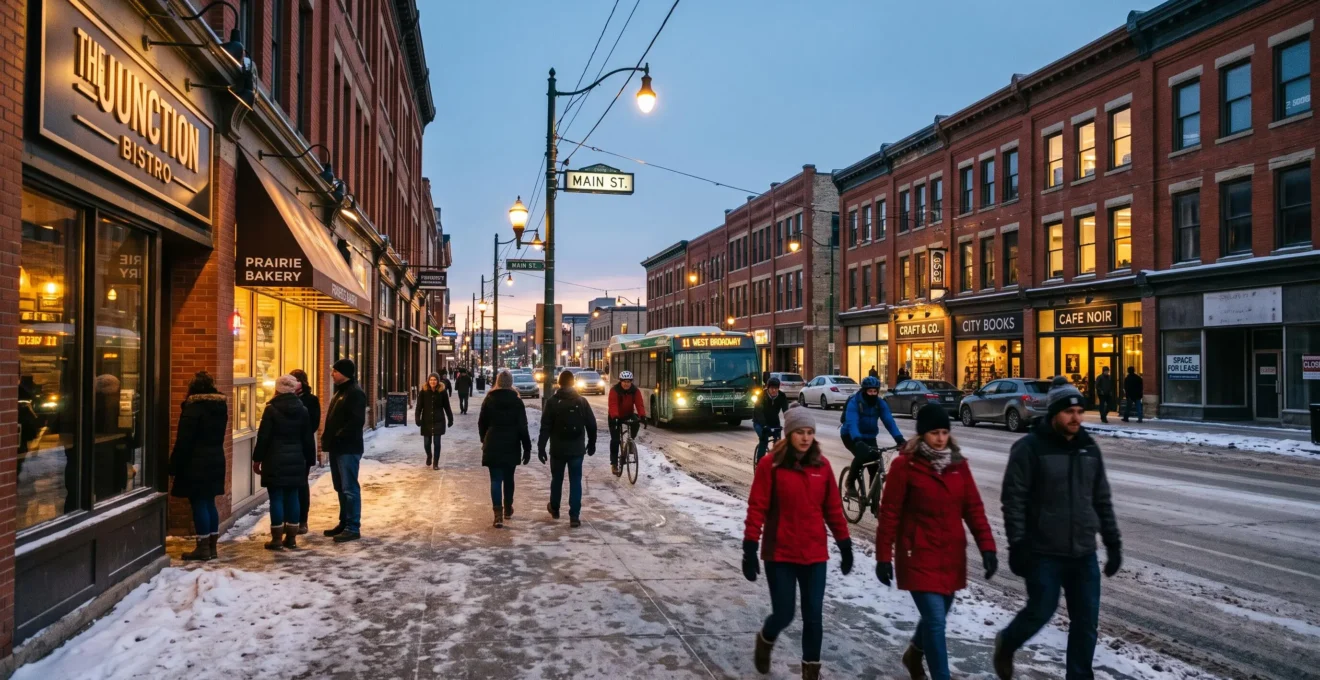
Downtown revitalization in Winnipeg works when physical investment translates into more people using the centre regularly, for more reasons and across more hours of the week. Streetscape upgrades, new housing, offices, public spaces and public funding matter, but their practical value depends on whether they create repeat activity that supports businesses, improves perceptions of safety and gives residents reasons to stay rather than simply pass through.
Winnipeg’s adopted City of Winnipeg’s CentrePlan 2050 reflects that broader approach. The plan combines residential growth, active streets, greening, downtown activity and long-term implementation, with a stated goal of welcoming 20,000 new residents downtown over 25 years. That target is a planning objective rather than a completed outcome, so the more useful question is how residents and businesses can recognize whether change is actually taking hold.
What makes downtown revitalization durable in Winnipeg
- Daily and year-round activity matters more than isolated events or cosmetic upgrades.
- Success should be judged through outcomes such as storefront occupancy, repeat visits, business survival and activity outside office hours.
- A mix of residents, workers, public investment, useful public spaces and sustained operations is more resilient than relying on any single intervention.
- Why Does Downtown Winnipeg Need Everyday Activity, Not Just Physical Upgrades?
- How Can You Tell Whether a Winnipeg Downtown Revitalization Project Is Working?
- More Residents or More Offices: Which Better Supports Downtown Winnipeg?
- Downtown Revitalization Mistakes That Can Limit Long-Term Results in Winnipeg
- When Should Winnipeg Expect Results From a Downtown Revitalization Initiative?
- Why Does Local Spending Matter to Winnipeg Neighbourhood Businesses?
- Why Do Some Winnipeg Public Parks Attract More Everyday Use Than Others?
- How Does Public Sector Investment Shape Winnipeg’s Long-Term Development?
Why Does Downtown Winnipeg Need Everyday Activity, Not Just Physical Upgrades?
Downtown Winnipeg needs everyday activity because buildings and streets become economically useful only when people return often enough to support businesses, transit and public spaces. A festival can fill a district for a weekend, but cafés, convenience stores, restaurants and services need repeat customers on ordinary mornings, evenings and weekends. Physical improvements help most when they make that routine use easier and more attractive.
The distinction is important because destination traffic and habitual traffic behave differently. An event visitor may buy a meal once and leave. A resident, worker or regular visitor may make a coffee run, pick up groceries, meet someone after work and return on the weekend. Those repeated transactions give ground-floor businesses a more predictable base of demand.
Downtowns that are active only during weekday office hours face a “dead hours” problem. A restaurant or shop cannot base its entire operating model on a short lunchtime peak if evenings and weekends remain weak. More sustained usage changes the calculation: longer active periods allow businesses to spread sales across more hours and make staffing, rent and inventory easier to justify.
Activity also affects perceived safety. More pedestrians, customers, workers and residents provide informal observation of streets and entrances. This does not mean pedestrian volume solves every safety issue, but it helps explain why activity and confidence can reinforce one another rather than requiring one to be fully solved before the other improves.
Winnipeg’s climate makes year-round accessibility particularly important. Advice borrowed from milder cities can underestimate the value of weather-protected routes, comfortable indoor connections and winter programming. A revitalization strategy that performs only in warm months leaves businesses exposed to long seasonal gaps.
For residents and businesses, the strongest sign of improvement is therefore repetition: people returning because downtown supports ordinary life as well as special occasions.
How Can You Tell Whether a Winnipeg Downtown Revitalization Project Is Working?
A Winnipeg downtown revitalization project is working when observable behaviour changes, not merely when construction finishes or funding is announced. Useful signals include lower ground-floor vacancy, more evening and weekend foot traffic, longer visits, stronger business survival and activity spreading beyond a few showcase blocks. These outcomes should be tracked over time because structural change usually lags behind visible upgrades.
One of the clearest distinctions is between outputs and outcomes. Money spent, sidewalks rebuilt and buildings renovated are outputs. More daily visits, higher occupancy and businesses remaining open are outcomes. A project may complete all of its construction targets without yet producing the street-level activity residents were promised.
A locally relevant baseline already shows why this matters. The Downtown Winnipeg BIZ year-end downtown snapshot reported ground-floor vacancy at 35.8% in 2025, compared with 32% in 2024. The figures apply to the BIZ monitoring area rather than every downtown property, but they make storefront occupancy a concrete measure residents can revisit over time.
35.8%
Ground-floor vacancy reported for 2025 in the Downtown Winnipeg BIZ monitoring area, showing why storefront occupancy remains an important revitalization indicator.
Downtown Winnipeg BIZ, 2026 year-end snapshot.
Timing complicates evaluation. Public-space improvements may be visible immediately, while office occupancy, business formation and residential conversion can take years. Declaring success or failure after only a short period can confuse normal lag with a genuinely weak strategy.
Block-level observation is often more revealing than a downtown-wide average. A few strong corridors can improve overall statistics while adjacent streets remain largely vacant or inactive. Residents and business owners can therefore build a simple local record rather than waiting for a single headline metric.
A five-step downtown progress check
- Choose one block and record the number of occupied and vacant ground-floor units, producing a dated storefront count.
- Visit once during a weekday and once during an evening or weekend, producing two comparable pedestrian observations.
- Record whether people are staying, shopping or dining rather than only passing through, producing a short activity log.
- Repeat the observation at regular intervals and note which businesses remain open, producing a basic survival timeline.
- Compare the block with one nearby corridor, producing a side-by-side note that reveals whether improvement is concentrated or spreading.
Revitalization becomes more credible when multiple indicators move in the same direction and improvement persists long enough to change everyday decisions about where to live, work, invest and spend time.
More Residents or More Offices: Which Better Supports Downtown Winnipeg?
Neither residents nor offices are sufficient on their own. Offices concentrate demand into weekday commuting, lunch and after-work periods, while residents create a broader baseline across mornings, evenings, weekends and seasons. Downtown Winnipeg is more resilient when both groups are present because they support different businesses, transit patterns and services at different times.
Office workers remain important because concentrated weekday demand can support cafés, restaurants, transit and professional services. A strong employment base also gives downtown a role that cannot be replicated entirely through housing. However, an office-heavy district can empty quickly after work if relatively few people live nearby.
Residents change the pattern of demand. Grocery stores, pharmacies, personal services, casual dining and neighbourhood retail become easier to sustain when customers are present beyond business hours. Winnipeg’s official planning direction reflects that logic: the City of Winnipeg page on living and visiting Downtown identifies residential development as a priority and sets targets of at least 350 new downtown dwelling units per year until 2030 and 500 per year afterward. These are municipal targets, not completed-unit counts.
The office-to-residential conversion debate also requires practical limits. Not every office building can be converted efficiently. Deep floor plates, window access, plumbing arrangements and building configuration can make some properties poor housing candidates. A realistic strategy therefore assumes that a portion of office stock will remain and seeks complementary uses rather than treating conversion as a universal solution.
| Criterion | Residents | Offices |
|---|---|---|
| Strongest demand periods | Evenings, weekends and daily household needs | Weekday mornings, lunch and after-work periods |
| Businesses supported | Groceries, services, neighbourhood retail and dining | Cafés, restaurants, transit and professional services |
| Transit effect | More varied all-day travel patterns | Concentrated commuter demand |
| Main limitation | Housing growth alone does not replace employment functions | Office districts can become quiet outside working hours |
The trade-offs also extend to affordability, tax revenue and transit. More housing can strengthen all-day activity but may intensify affordability pressures if supply and policy do not keep pace. Offices contribute employment and taxable activity but can leave demand overly concentrated into narrow periods.
For Winnipeg, the question is therefore less about choosing housing or offices than about building a mix that keeps streets and businesses useful throughout the week.
Downtown Revitalization Mistakes That Can Limit Long-Term Results in Winnipeg
Downtown revitalization can underperform when visible improvements are treated as substitutes for demand, investment is scattered too thinly, rising rents displace the businesses that helped create activity, or strategies are copied from cities with different conditions. Winnipeg’s climate, density, transit patterns and existing vacancy mean that local context must shape how and where interventions are applied.
One common mistake is confusing appearance with economic function. New planters, murals, paving or lighting can improve a block, but they cannot by themselves create enough customers to sustain shops and services. If the number and frequency of users remain unchanged, the improvement may be attractive without becoming self-supporting.
A second risk is dispersion. Spreading limited resources across many small projects can make each intervention too weak to change behaviour or perception. Concentrating improvements in a connected area can sometimes produce a clearer shift because businesses, public space and pedestrian activity reinforce one another.
Revitalization can also create a rent gap. As an area becomes more desirable, commercial rents may increase faster than existing independent businesses can absorb. That can remove businesses that gave the district its distinct character. Longer lease structures, incubator spaces and other affordability mechanisms can help, but they must be designed around actual local conditions rather than treated as universal fixes.
Copying another city’s model is particularly risky in Winnipeg. A strategy built around year-round outdoor foot traffic may perform very differently in a prairie winter. Before importing a model, decision-makers should examine climate adaptation, transit access, density, housing supply, business demand and the practical distance people are expected to walk.
The most durable interventions are those that improve the physical environment while also strengthening the reasons people have to return, spend and remain in the area.
When Should Winnipeg Expect Results From a Downtown Revitalization Initiative?
Winnipeg should expect revitalization to unfold in stages rather than all at once. Cleanliness, lighting, maintenance and programming can change relatively quickly, while business response may take years and structural shifts in occupancy, housing or major property investment usually take longer. The important distinction is between normal lag and a project whose core assumptions about demand, funding or anchor uses are failing.
Momentum is sequential. Early improvements can make a place easier to use; more activity can then support businesses; successful businesses give people additional reasons to return; repeat use can justify further private and public investment. If one stage does not hold, the next may not develop as expected.
Winnipeg’s current planning framework explicitly treats downtown change as long term. CentrePlan 2050 spans a 25-year period, while the City reported in February 2026 that implementation was continuing and that a report recommended referring a four-year, $8-million downtown investment to the 2027 budget process. The amount was a funding recommendation at that point, not proof that the full sum had already been approved or spent.
A project that is still maturing should show at least some intermediate movement: more programmed activity, improving maintenance, new leases, construction progress or increasing repeat use. By contrast, repeated project delays, disappearing anchor tenants, persistent vacancy and unreliable operating funding may indicate that the original assumptions need to be reconsidered.
Businesses face a different timeline from planners. A small operator with a short lease and narrow margins may not be able to wait several years for a district to improve. Temporary programming, targeted maintenance and other low-cost interventions can therefore matter as bridges between long-term capital plans and the immediate conditions businesses face.
The best evaluation asks whether each stage is creating the conditions for the next one rather than expecting every indicator to improve simultaneously.
Why Does Local Spending Matter to Winnipeg Neighbourhood Businesses?
Local spending matters because neighbourhood businesses survive on repeated purchases, not only on total spending across the downtown economy. Money spent with locally rooted businesses can circulate through wages, nearby suppliers and services, while spending that leaves the local economy more quickly provides less continuing support. For individual businesses, however, frequency and timing are often just as important as the total amount.
A downtown restaurant may receive strong weekday lunch traffic but struggle on weekends. A convenience retailer may depend on residents and workers making frequent low-value purchases. A personal-service business may need appointments spread across the week. These different operating models mean that an increase in aggregate spending does not automatically help every type of business equally.
Consistency matters because fixed costs continue even during quiet periods. Rent, insurance, utilities and staffing do not disappear when foot traffic drops after 5 p.m. This is why revitalization efforts benefit from tracking when customers arrive as well as how many arrive.
Residents and workers can influence that pattern directly. Someone who already spends downtown at lunchtime can shift an occasional purchase to an evening or weekend, helping extend demand into the periods when many businesses have fewer customers. That does not require spending more overall; it changes when and where part of existing spending occurs.
Business survival thresholds differ, so even modest changes in repeat demand can matter differently by sector. Independent restaurants generally face different labour, inventory and occupancy pressures from service businesses or convenience retail. Revitalization works better when strategies recognize those distinctions instead of treating all storefronts as interchangeable.
For Winnipeg residents and workers, supporting downtown vitality can therefore be as practical as spreading routine purchases across more businesses, times of day and days of the week.
Why Do Some Winnipeg Public Parks Attract More Everyday Use Than Others?
Winnipeg parks attract everyday use when they fit into ordinary routines rather than functioning only as occasional destinations. Location along walking routes, active edges, seating, washrooms, useful programming and winter adaptation can matter more than size alone. A park that gives people reasons to stop repeatedly can support surrounding street activity, while a beautiful but isolated space may remain quiet for much of the day.
Daily-use parks tend to connect with what is already happening around them. Entrances facing active streets, nearby cafés, transit stops and clear walking routes increase the chances that people encounter the space during errands, commuting or lunch breaks. Seating and amenities then give them a reason to stay instead of simply crossing it.
Seasonality is especially important in Winnipeg. A park designed mainly for summer can become functionally dormant for a large part of the year. Winter uses such as skating, protected seating, warmed shelters and wind mitigation can extend activity and keep public space connected to downtown life during colder months.
A well-used park can also act as a downtown anchor. People who stay for twenty or thirty minutes may create pedestrian movement around cafés, shops and nearby streets. An empty park has the opposite effect: even if physically attractive, it can reduce the sense of activity along its edges.
Residents can evaluate a park with a simple observation method. Count users at two different times, note whether they are staying or passing through, and repeat the observation in colder weather. This reveals whether the space supports habitual use rather than only peak-season visits.
When public spaces become part of ordinary routines, they contribute directly to the wider network of activity that downtown businesses and streets depend on.
What to keep in mind
- Physical improvements matter most when they create repeat use and reduce uncertainty for people deciding whether to live, visit or invest downtown.
- Public spending should be judged not only by completed projects but also by the operating commitments that keep those projects useful.
- Location, continuity and who benefits from investment are as important as the headline amount being spent.
How Does Public Sector Investment Shape Winnipeg’s Long-Term Development?
Public sector investment shapes Winnipeg’s long-term development by creating conditions that influence where residents, businesses and private investors are willing to commit. Transit, libraries, streets, public spaces and infrastructure can reduce uncertainty and make particular areas more usable. The effect depends not only on how much is spent but also on where investment is concentrated, how consistently it is maintained and whether operating funding continues after construction.
Public investment can be catalytic because private decisions often depend on conditions governments help establish. A developer may respond to improved infrastructure or a clearer long-term plan. A business may view a well-maintained, active street as less risky than an area where public improvements are announced but not sustained.
Consistency is therefore important. Stop-and-go funding can make future conditions harder to predict even when cumulative spending is substantial. By contrast, recurring commitments to maintenance, programming, transit frequency and public-space operations can demonstrate that an area will continue functioning after the ribbon-cutting stage.
The location of investment also determines who benefits. Improvements can raise the attractiveness and value of an area, but those gains may increase costs for existing residents or businesses. Housing policy, affordability measures and commercial support mechanisms can become important when revitalization increases displacement pressure.
Capital and operating spending should also be distinguished. Building a new facility is visible and finite; maintaining it, staffing it, programming it and keeping access reliable are recurring obligations. Long-term outcomes often depend on these less visible commitments because a poorly operated asset can lose activity even after a successful opening.
A practical next step for residents, businesses and property owners is to track one planned public investment alongside nearby vacancy, pedestrian activity and business changes over time, then judge whether the project is translating into stronger everyday use rather than relying on the investment announcement alone.
Is downtown revitalization mainly about attracting more residents?
No. More residents can strengthen evening, weekend and household demand, but offices, visitors, public spaces, transit and services also matter. Winnipeg’s planning direction prioritizes residential growth while still treating downtown as an employment, activity and investment centre.
What is one of the easiest indicators residents can monitor themselves?
Ground-floor occupancy is relatively easy to observe. Residents can record occupied and vacant storefronts on the same block at regular intervals, then combine that information with evening and weekend activity to see whether street-level conditions are improving.
Can festivals and major events revitalize downtown on their own?
They can increase visits temporarily, but they do not replace daily demand. Long-term vitality depends on people returning for ordinary activities such as work, meals, shopping, services, recreation and social visits throughout the year.
Why is winter adaptation important for downtown Winnipeg?
Strategies that depend heavily on outdoor pedestrian activity can lose effectiveness during colder periods unless routes, public spaces and programming are adapted. Winter-ready amenities help reduce the seasonal drop in activity that can otherwise weaken businesses and public spaces.
How long should residents wait before judging whether revitalization is successful?
There is no single universal timetable. Maintenance, lighting and programming can change relatively quickly, while business occupancy, residential growth and major property investment usually require longer observation. The more useful approach is to look for a sequence of improving indicators rather than expect every outcome at once.