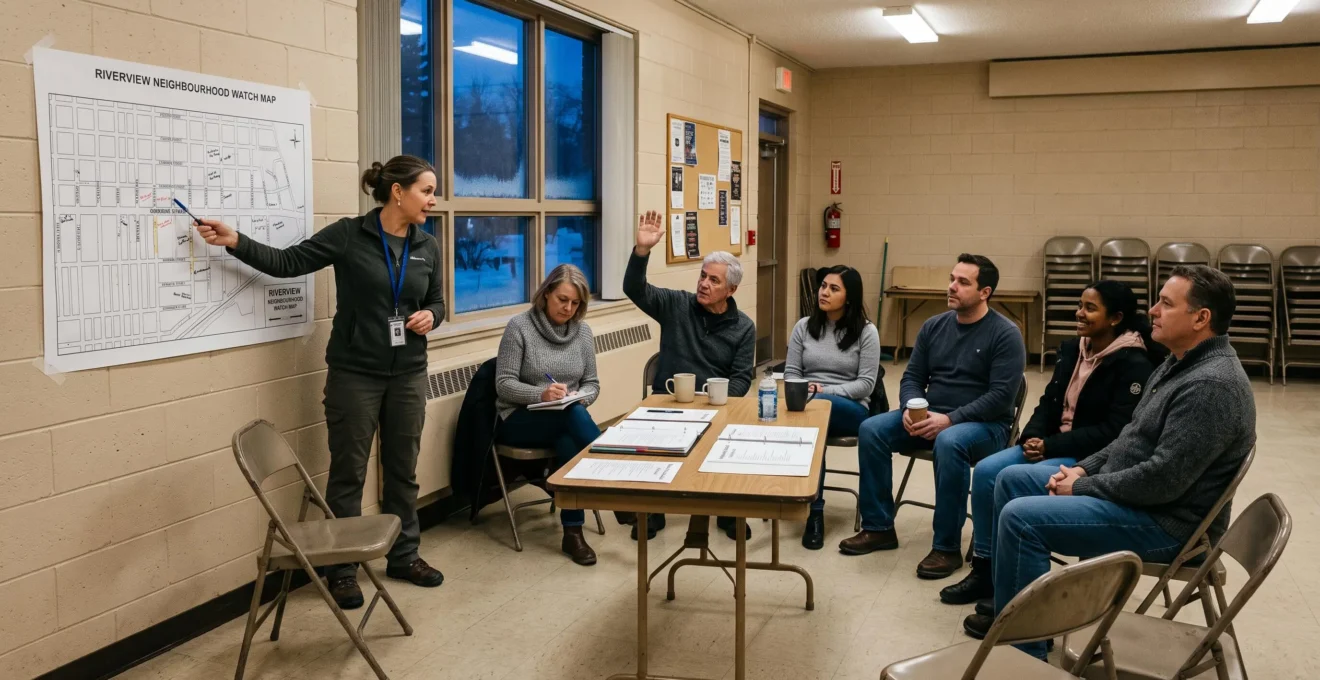
Neighbourhood Watch programs can improve community safety in Winnipeg by helping residents recognize concerning activity, communicate responsibly and report relevant information to the appropriate authorities. Their value comes from coordinated awareness and prevention, not from residents taking law enforcement into their own hands.
The Winnipeg Police Service supports a community-run Neighbourhood Watch program that encourages people to look out for neighbouring properties. Participation can help residents establish dependable contacts, identify recurring problems and make everyday crime-prevention habits more consistent.
However, an organized watch is not automatically the best solution for every street. A small informal network may be sufficient where neighbours already communicate effectively, while an organized program can provide useful structure when concerns extend across several blocks. Understanding that difference, and keeping safety responsibilities clearly defined, helps residents build an initiative that remains practical and inclusive.
Winnipeg Neighbourhood Watch: Essential Points
- Observe and report: Residents support safety by documenting relevant behaviour and contacting authorities, never by confronting suspected offenders.
- Organize around real needs: Start with neighbour relationships, clear responsibilities and a reliable communication method before considering a formal watch.
- Use the right service: Call 911 for emergencies, 204-986-6222 for non-emergency police matters, and 311 for municipal service concerns.
- Why Can Neighbourhood Watch Improve Safety Without Becoming Vigilantism?
- How Can Winnipeg Residents Start a Neighbourhood Watch Without Creating Confusion?
- Informal Neighbour Network or Organized Watch Program: Which Fits Your Block?
- Neighbourhood Watch Mistakes That Can Put Winnipeg Residents at Risk
- When Should a Winnipeg Neighbourhood Consider Starting a Watch Program?
- Police or Another Service: Who Should Handle Common Winnipeg Safety Concerns?
- Why Can Local Sports Build Stronger Community Connections in Winnipeg?
- How Does Local Law Enforcement Fit Into Everyday Public Safety in Winnipeg?
Why Can Neighbourhood Watch Improve Safety Without Becoming Vigilantism?
Neighbourhood Watch can support safer streets because residents become more attentive to their surroundings and better prepared to communicate useful observations. Unlike vigilantism, a legitimate watch does not investigate, pursue or punish suspected offenders. Its purpose is to encourage prevention, responsible observation and accurate reporting through established police channels.
The distinction is fundamental. A resident who notices someone apparently attempting to enter a neighbour’s home can observe from a safe location and report the circumstances. Following that person, attempting detention or organizing a confrontation would introduce danger and move outside the watch’s intended role.
The Winnipeg Police Service Neighbourhood Watch program identifies observing neighbouring properties and reporting suspicious activity as central activities. It also distinguishes Neighbourhood Watch from the Citizens on Patrol Program, which is a separate community safety initiative.
There is research suggesting that neighbourhood watch initiatives can contribute to crime prevention, although the size and cause of any benefit remain uncertain.
16%–26%
Approximate relative crime reduction associated with neighbourhood watch programs in a 2008 Campbell systematic review. The historical evaluations often combined several prevention measures and do not predict the effectiveness of a current Winnipeg program.
Campbell systematic review of neighbourhood watch effectiveness, Bennett, Holloway and Farrington, 2008.
Possible mechanisms include improved reporting, more consistent property security and greater perceived observation. The review did not determine precisely how much each mechanism contributed to the reported outcomes. Deterrence is therefore a plausible explanation rather than a guaranteed result.
Responsible groups should establish behavioural safeguards: no confrontation, no weapons used in a watch role, no pursuit, and no assumptions about criminality based on race, clothing, age or appearance. Reports should describe observable actions rather than personal stereotypes.
Written expectations are valuable because they make these boundaries understandable to every participant. An incident involving harassment or unauthorized intervention could undermine neighbour relationships and the credibility of the entire initiative.
Building those expectations into the group’s design from the beginning is more useful than attempting to correct unsafe habits after they become established.
How Can Winnipeg Residents Start a Neighbourhood Watch Without Creating Confusion?
Winnipeg residents can start a Neighbourhood Watch by identifying interested neighbours, defining a practical area and applying through the Winnipeg Police Service’s block captain process. A simple written agreement about responsibilities, reporting and communication helps prevent confusion. Organizers should distinguish official application requirements from additional practices they voluntarily adopt.
Begin by speaking with residents on the same street or nearby blocks. Determine whether enough people are interested in maintaining regular communication, rather than simply signing up after a concerning incident.
Winnipeg’s official application requests contact information and a description of the proposed Neighbourhood Watch area, including street names and numbers where possible. It also explicitly states that block captains are not vetted by the Winnipeg Police Service and operate independently in their communities.
The Winnipeg Neighbourhood Watch block captain application provides the relevant municipal form. Completing it should not be interpreted as police certification or professional accreditation.
Beyond the application itself, organizers can choose to prepare a short participation charter. This is a recommended organizational measure, not a documented municipal requirement. It can specify:
- The streets and properties included in the group’s communication area.
- The coordinator’s responsibilities and a backup contact.
- What participants should observe, record and report.
- Which incidents go directly to police rather than through group discussion.
- How contact information is collected, stored and removed.
Communication should be straightforward. A small block might prefer a phone tree, while another could use a private messaging group. Whatever the channel, residents should avoid sharing unverified accusations, sensitive personal information or messages that delay necessary emergency reporting.
Five actions to launch a practical Winnipeg watch
- Assess interest: Speak with nearby residents and produce a list of people who voluntarily want to participate.
- Define coverage: Identify the intended streets and prepare a written area description.
- Apply for a block captain role: Use the Winnipeg Police Service’s official application and retain a copy of the submitted information.
- Agree on boundaries: Prepare a one-page charter covering observation, reporting, privacy and prohibited confrontations.
- Test communication: Choose a private contact method and complete a harmless test message confirming that participants understand how it works.
During an initial 90-day trial, a group could focus on introducing neighbours, reviewing household security habits and identifying poorly lit locations. This suggested roadmap is not an official police timetable.
Rather than measuring success by patrols or message volume, assess whether contact details remain current, residents understand their responsibilities and relevant observations reach the appropriate service.
Once these foundations exist, residents can decide whether formal organization provides enough additional value to justify the ongoing commitment.
Informal Neighbour Network or Organized Watch Program: Which Fits Your Block?
An informal neighbour network is often appropriate when residents mainly need reliable contacts and occasional help watching properties. An organized Neighbourhood Watch may suit areas facing recurring concerns that require sustained coordination. The better choice depends on willingness to participate, available leadership and the complexity of local problems, not simply neighbourhood size.
Consider two hypothetical streets. On the first, five households want to exchange telephone numbers and check on homes during vacations. On the second, several blocks regularly identify concerning incidents but lack a shared reporting approach. The first may need only a neighbour agreement; the second may benefit from a designated coordinator and an organized program.
The following comparison provides a practical decision framework rather than an official Winnipeg eligibility test.
| Decision factor | Informal network | Organized watch |
|---|---|---|
| Resident commitment | Occasional cooperation and basic contact-sharing | More consistent participation and coordination |
| Leadership | Shared responsibility among neighbours | Identifiable coordinator or block captain |
| Safety concerns | Limited, occasional or highly localized issues | Recurring concerns requiring communication across households |
| Administration | Minimal documentation and meetings | Defined area, agreed responsibilities and organized contacts |
| Police relationship | Residents report incidents individually | Residents may engage with the police-supported watch program while retaining individual reporting responsibilities |
Formal organization can create continuity, but it also demands maintenance. Coordinators may experience meeting fatigue, administrative pressure or disagreements about responsibility. Any collection of resident information creates privacy considerations, and organized patrols can introduce avoidable safety and liability questions.
The Winnipeg Police Service’s block captain process provides an official point of contact, but it does not establish that captains undergo police screening or receive enforcement powers. Residents should avoid interpreting program affiliation as an official guarantee of individual suitability.
A hybrid approach can reduce unnecessary commitments. Neighbours could begin with a contact list, agree to check on one another’s properties and establish clear reporting principles. If concerns become more frequent or coordination expands, they can explore formal participation. Conversely, an inactive organized group can simplify its arrangements instead of maintaining structure without real engagement.
One useful diagnostic is whether residents can identify several willing contacts and agree on a reliable communication channel. If not, investing in relationships first may produce more value than creating a formal title or meeting schedule.
The objective is dependable cooperation, not administrative formality. Either model becomes ineffective when members stop communicating or misunderstand the limits of their responsibilities.
Neighbourhood Watch Mistakes That Can Put Winnipeg Residents at Risk
The greatest Neighbourhood Watch risks arise when residents confront people, circulate unverified accusations, expose private information or treat ordinary differences in appearance as suspicious. Poorly maintained contact lists and unclear leadership can also create problems. A safe program emphasizes factual observation, proportionate reporting and respect for everyone in the neighbourhood.
Confrontation is particularly dangerous. Following a person believed to be suspicious, approaching a possible offender or attempting to block someone’s movement can escalate a situation. Watch participation does not confer police powers, and members should never treat it as permission to investigate or enforce the law.
Another serious mistake involves public messaging. A photograph from a doorbell camera may appear useful, but posting it with an accusation can misidentify an innocent person or expose private details. Publicly announcing that a household will be vacant for several weeks can also reveal information that residents intended to protect.
Groups should distinguish legitimate descriptions of behaviour from discriminatory assumptions. Reporting that someone attempted to force a locked door identifies a concrete action. Reporting a person solely because they look unfamiliar or belong to a particular demographic group does not establish suspicious conduct.
A practical group policy should discourage:
- Confronting, following or trying to detain individuals.
- Publishing identifiable photographs with unsupported accusations.
- Sharing vacation dates, access codes or household routines in public groups.
- Circulating rumours without identifying their uncertainty.
- Using physical appearance or protected personal characteristics as substitutes for behavioural evidence.
- Collecting unnecessary personal information or giving unrestricted access to contact lists.
Organizational mistakes can be less visible but equally disruptive. A contact list that nobody updates may fail when a resident needs assistance. A coordinator who retains sensitive information indefinitely may lose the trust of other members. And an informal patrol schedule can create assumptions about duties, training or protection that have never been established.
For these reasons, groups should agree on clear information-handling practices and keep responsibilities limited to ordinary, lawful community participation. Privacy notices on official municipal application forms do not automatically cover independently operated messaging groups or contact databases.
Consistent, respectful conduct helps preserve the cooperation on which an effective watch depends. When fear or speculation begins replacing accurate observation, the group’s procedures need to be reconsidered.
When Should a Winnipeg Neighbourhood Consider Starting a Watch Program?
A Winnipeg neighbourhood should consider an organized watch when residents identify recurring safety concerns, show sustained interest in cooperating and can maintain clear communication. One alarming incident alone does not establish the need for a formal program. Organizers should first determine whether observation and reporting can meaningfully address the actual problem.
Potential triggers include repeated property-related incidents, multiple residents independently noticing concerning activity, or changing neighbourhood conditions that make residents want better communication. A recent break-in may also prompt useful discussion, but a group established solely in response to fear may struggle to remain active once attention fades.
Readiness matters at least as much as the seriousness of the concern. Organizers should assess whether residents are willing to participate over time, whether someone can maintain contacts and whether there are enough consistently occupied homes to make cooperation practical.
There is no documented minimum membership threshold in the supplied Winnipeg Police Service program information. A decision should therefore reflect local capacity rather than an invented numerical requirement.
Before launching, residents can examine whether the underlying issue belongs elsewhere:
- Poor street lighting: Identify the location and consider contacting municipal services.
- Property maintenance: Determine whether a landlord, owner or relevant city service should address the concern.
- Home security weaknesses: Consider improvements to locks, visibility and routine property checks.
- Recurring suspected criminal activity: Record factual observations and report them through the appropriate police channel.
- Limited neighbour familiarity: Start with introductions and small community gatherings rather than immediately formalizing a watch.
Environmental crime prevention can complement neighbourhood cooperation. Improvements to lighting, sightlines and property maintenance may address specific vulnerabilities more directly than organizing additional observation.
Hypothetical example: A block with repeated vehicle concerns
Residents on a Winnipeg block have independently noticed several concerning events around parked vehicles. Before creating a patrol, they compare their observations, identify whether incidents were reported and agree on safe communication procedures.
If the problem continues, they explore an organized watch while also reviewing practical measures such as lighting and vehicle security. The example illustrates a decision process, not a documented Winnipeg incident or a predicted crime reduction.
The strongest justification for a watch is a continuing need for structured neighbour cooperation that cannot be met just as effectively by simpler measures. It should complement existing services, not replace reporting or professional intervention.
Once participation is justified, the next responsibility is ensuring that every type of concern reaches the service equipped to handle it.
Police or Another Service: Who Should Handle Common Winnipeg Safety Concerns?
Winnipeg residents should call 911 for crimes in progress or immediate threats to life or property. Non-emergency police matters can be reported at 204-986-6222, while municipal service issues generally belong with 311. The 211 service helps residents find community, social and related support services. The circumstances of an incident determine the appropriate response.
The Winnipeg Police Service distinguishes emergencies from incidents that no longer present immediate danger. Its emergency and non-emergency reporting instructions explain when to contact police, including reporting suspicious circumstances and property crimes that are no longer in progress.
The table below is a practical orientation guide. Actual danger takes priority over an incident’s general category.
| Situation | Appropriate channel | Important distinction |
|---|---|---|
| Crime in progress or immediate threat | 911 | Move to safety and do not intervene. |
| Fire, serious medical emergency or serious-injury collision | 911 | Emergency response is required. |
| Suspicious circumstances without immediate danger | Winnipeg Police non-emergency: 204-986-6222 | Describe observable facts rather than assumptions. |
| Property crime no longer in progress | Police non-emergency or an eligible online reporting option | The appropriate method depends on the incident. |
| Municipal maintenance or potential bylaw concern | 311 | Use city services for matters within municipal responsibility. |
| Graffiti, abandoned vehicles or property standards concerns | 311 as an initial municipal contact | Confirm the appropriate municipal reporting procedure. |
| Community or social-service information | 211 | An information and referral service, not a replacement for emergency dispatch. |
| Wildlife concerns without immediate danger | Relevant animal or wildlife service | The responsible provider depends on the animal and circumstances. |
Misrouting reports can create delays and confusion. Calling emergency services for an ordinary municipal maintenance issue unnecessarily occupies emergency resources. Conversely, treating an immediate threat as a routine complaint can delay essential assistance.
Some circumstances require careful judgment. An unfamiliar person walking along a public sidewalk does not automatically justify police reporting. A person repeatedly trying locked vehicle doors may present an observable concern. Residents should report the behaviour they have actually seen, without investigating further.
Mental-health or intoxication-related situations also require attention to immediate risk. When there is an urgent danger or serious medical emergency, call 911. For non-urgent assistance or information about support services, 211 may help identify appropriate resources, but it should not be described as an emergency crisis-dispatch service.
Repeated non-emergency concerns can be documented with dates, locations and objective descriptions. Residents should avoid flooding communication channels with duplicate, speculative or irrelevant reports. No guarantee exists that additional reports will automatically produce increased police patrols.
Knowing these distinctions makes a watch more helpful to its members and reduces the risk of replacing timely professional reporting with unproductive group discussion.
Why Can Local Sports Build Stronger Community Connections in Winnipeg?
Local sports can strengthen Winnipeg neighbourhoods by giving residents regular opportunities to meet, communicate and develop trust. Community rinks, recreation programs and sports gatherings create social relationships that can also support neighbourhood cooperation. Familiarity may improve the quality of communication about local concerns, although participation in sports has not been shown by the supplied sources to independently reduce Winnipeg crime rates.
A neighbourhood contact list is useful only when people feel comfortable contacting one another. Regular activities provide a more natural setting for developing those relationships than meetings organized exclusively around safety concerns.
Winnipeg’s community-centre and hockey culture offers familiar examples. Parents meeting at an outdoor rink, neighbours volunteering for recreation activities and residents attending local sports events may become more comfortable exchanging contact information and discussing shared concerns.
These interactions can make practical cooperation easier. A resident who already knows a neighbour may be more willing to ask whether that person needs assistance, share a maintenance concern or coordinate an agreed property check during an absence.
Such familiarity should not become a justification for monitoring everyone’s visitors or private routines. Knowing neighbours can help provide context, but unusual behaviour must still be judged on observable circumstances rather than assumptions about who belongs in an area.
Sports networks can also help groups remain inclusive. A watch coordinator might use an existing community gathering to explain the purpose of the initiative, invite questions and provide voluntary participation information. Anyone unable or unwilling to attend sports activities should have an equally accessible way to participate.
Combining safety conversations with ordinary community life may help avoid a group becoming active only during periods of heightened anxiety. Relationships formed around recreation can continue even when there is no particular safety issue to discuss.
However, the available scientific review of neighbourhood watch does not isolate sports participation or community-rink familiarity as a proven crime-prevention mechanism. The more defensible benefit is stronger social connection and a practical opportunity to build communication habits.
These community connections are valuable beyond crime prevention. They help residents cooperate on everyday problems and make it easier to understand where neighbourhood action ends and professional responsibilities begin.
Key Takeaways Before Working With Local Authorities
- Residents contribute most effectively when they provide accurate, behaviour-based observations rather than attempting enforcement.
- Safety concerns should be directed to the appropriate police, municipal or community service according to urgency and responsibility.
- A sustainable watch depends on neighbourhood trust, clear communication and realistic expectations about what public authorities can provide.
How Does Local Law Enforcement Fit Into Everyday Public Safety in Winnipeg?
Local law enforcement supports everyday public safety in Winnipeg by responding to emergencies, receiving reports and investigating suspected crimes. Neighbourhood Watch members play a different role: reducing avoidable opportunities for crime, observing their surroundings and sharing useful information. Effective community safety depends on cooperation among residents, police, municipal services and local organizations rather than continuous police presence alone.
This division of responsibility helps establish realistic expectations. Police officers possess professional responsibilities and legal authorities that ordinary residents do not acquire by joining a watch group. Residents can contribute through everyday prevention and appropriate reporting without trying to replicate police operations.
Non-emergency reports can provide information about recurring incidents or concerning behaviour. When residents communicate factual dates, locations and observations, they make their reports easier to understand and assess. However, the available official information does not establish that the number of reports will produce a proportional increase in police patrols.
Community relationships also matter. Some residents may be reluctant to engage with law enforcement because of previous experiences or broader concerns about trust. A watch should not pressure neighbours into unnecessary surveillance or treat reluctance to participate as suspicious.
Transparent membership rules, respectful communication and consistent behaviour-based reporting can make cooperation more approachable. Residents should understand what information the group collects, who can access it and when reporting to authorities is appropriate.
Winnipeg’s wider safety network has several distinct functions:
- Winnipeg Police Service: Emergency response, police reporting, investigation and crime-prevention information.
- Municipal services: Relevant maintenance, infrastructure and bylaw concerns handled through city channels such as 311.
- Community and social services: Support and referrals for needs that do not inherently require enforcement.
- Community centres and resident networks: Neighbour relationships, participation opportunities and everyday cooperation.
- Neighbourhood Watch participants: Preventive awareness, safe observation and responsible communication.
A watch should therefore be understood as one part of a larger safety system. It cannot guarantee that crimes will be prevented, provide continuous surveillance or replace emergency response. Its realistic contribution is to help residents act thoughtfully and communicate effectively when circumstances warrant attention.
A practical next step is to speak with interested neighbours, identify one shared concern and agree on a safe reporting approach. If an organized program appears useful, consult the Winnipeg Police Service’s official Neighbourhood Watch information and block captain process before expanding the initiative.
Do Winnipeg Neighbourhood Watch volunteers have police powers?
No. Neighbourhood Watch participation does not provide law-enforcement authority. Members should observe from safe locations, avoid confrontations and contact police when circumstances require reporting. They must not assume they can detain, pursue or investigate individuals because they belong to a watch.
Does the Winnipeg Police Service screen Neighbourhood Watch block captains?
No. The official Winnipeg block captain application explicitly states that block captains are not vetted by the Winnipeg Police Service and operate independently within their communities. Residents should not interpret program participation as police accreditation or background screening.
Can neighbours cooperate on safety without registering a formal watch?
Yes. Residents can maintain voluntary contact networks, agree to check on one another’s properties and report concerns individually. The supplied official program information does not establish that every informal neighbour network must register. Formal participation may become useful when recurring concerns call for more sustained coordination.
What information should residents record when reporting suspicious activity?
Useful details may include the observed behaviour, location, approximate time and any relevant circumstances that can be noted safely. Residents should separate facts from assumptions and should never endanger themselves to collect photographs, vehicle information or other evidence. When immediate danger exists, calling 911 takes priority.
Is Neighbourhood Watch proven to reduce crime in Winnipeg?
The supplied Winnipeg Police Service material describes the program but does not provide a local evaluation demonstrating a measured crime reduction. A 2008 international Campbell systematic review found an association between neighbourhood watch programs and lower crime levels, but the underlying studies were historical and frequently combined multiple prevention measures. Its results cannot be used to predict a specific reduction in Winnipeg.