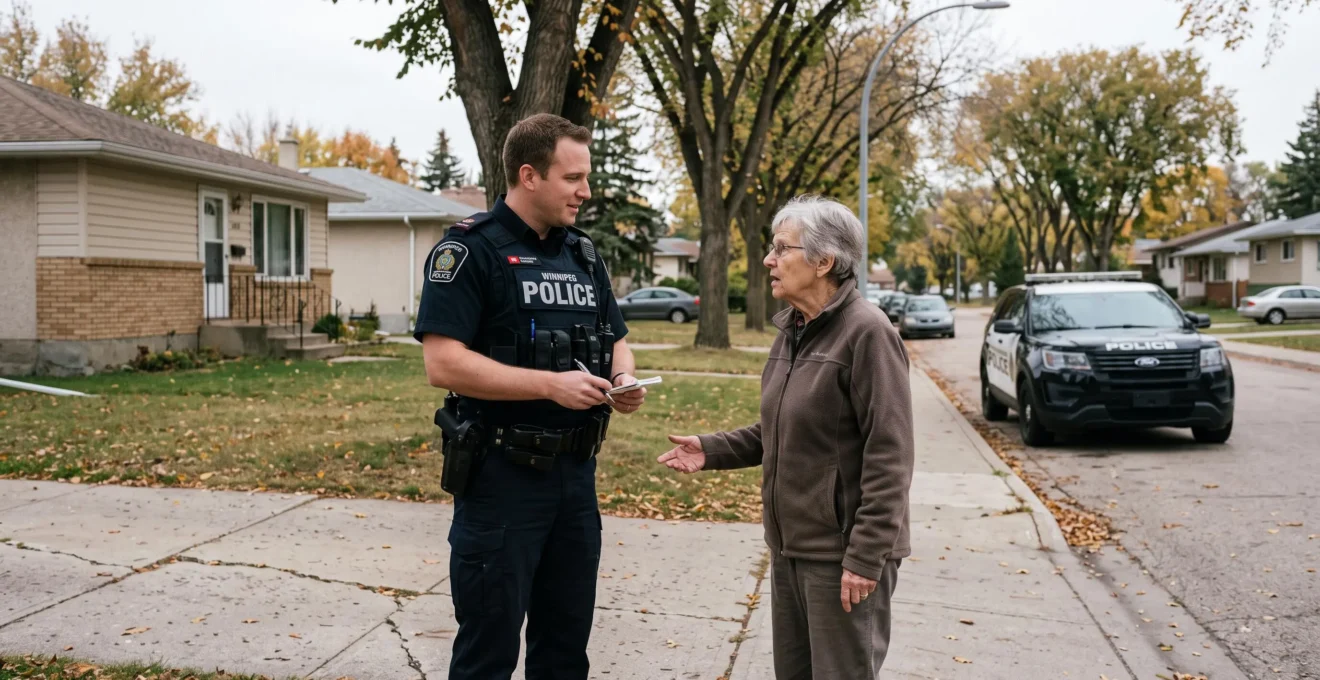
Public safety in Winnipeg involves more than responding to emergencies. The Winnipeg Police Service (WPS) handles criminal incidents, receives reports of suspicious activity, supports crime prevention, and works alongside municipal services and community organizations. Understanding these different responsibilities helps residents choose an appropriate response when something happens in their neighbourhood.
A break-in taking place now, a damaged vehicle discovered in the morning, and an ongoing street maintenance problem may all raise safety concerns. They do not, however, require the same service or level of urgency. Winnipeg provides distinct channels for emergencies, non-emergency police matters, municipal requests, and community support.
Residents also have an important role in providing accurate information, documenting incidents safely, and cooperating through neighbourhood initiatives. Effective participation means knowing when to contact authorities, what details to share, and when observation should stop short of intervention.
Winnipeg public safety: What residents need to know
- Call 911 for crimes in progress or immediate threats to life or property. Call Winnipeg Police at 204-986-6222 for non-emergency police matters.
- Use 311 for municipal concerns such as noise complaints, street maintenance, and property conditions. Use 211 to find community and social support services.
- Neighbourhood Watch supports community awareness through observation, communication, and appropriate reporting rather than confrontation or enforcement.
- Why Do Winnipeg Safety Incidents Require Different Police Responses?
- How Should You Report a Non-Emergency Safety Concern in Winnipeg?
- Police or Another Service: Who Should Handle Common Winnipeg Safety Concerns?
- Reporting Mistakes That Can Make a Winnipeg Safety Incident Harder to Assess
- When Should Winnipeg Residents Use Emergency Rather Than Non-Emergency Police Services?
- Why Can Neighbourhood Watch Improve Safety Without Becoming Vigilantism?
- Which Winnipeg City Service Should Handle Your Neighbourhood Problem?
- How Can Winnipeg Neighbourhood Watch Programs Improve Community Safety?
Why Do Winnipeg Safety Incidents Require Different Police Responses?
Winnipeg safety incidents require different police responses because their urgency, potential consequences, and need for immediate intervention vary. An active threat to someone’s safety requires a different response from a property crime discovered after the offender has left. Police call takers gather information about the circumstances to help determine which resources are needed.
The most important distinction is often whether the incident is happening now. The Winnipeg Police Service identifies crimes in progress and immediate threats to life or property as emergencies. Incidents that are no longer in progress, including certain property crimes, generally belong on non-emergency reporting channels.
Call takers need to understand several practical factors:
- Immediate danger: Is anyone being threatened, injured, or exposed to an active hazard?
- Current offender activity: Is a suspected offender still present, or have they left?
- Time sensitivity: Could a delay affect someone’s safety or the opportunity to intervene?
- Available information: Can the caller identify an accurate location, describe the situation, or provide relevant details?
These factors help explain response differences, but they are not a published WPS priority matrix. The police service’s public guidance does not establish fixed response-time guarantees or disclose every internal dispatch classification.
Consider a hypothetical example involving two homes in the same Winnipeg neighbourhood. At one property, a resident hears someone forcing a door while the occupants are inside. At another, a homeowner returns from work and discovers evidence of an earlier break-in, with nobody present. The first situation involves an immediate threat; the second generally calls for non-emergency reporting unless additional danger emerges.
Police work also extends beyond emergency attendance. Receiving crime reports, conducting investigative follow-up where appropriate, and supporting community crime prevention are distinct activities. A report that does not result in an immediate patrol visit is not necessarily ignored, although submitting information does not guarantee an investigation or officer attendance.
When police response feels slow, residents should distinguish a delayed response from a confirmed lack of action. Actual response depends on circumstances and operational decisions that are not fully visible to the caller. Residents should avoid assuming a specific queue position or response deadline.
The next step is identifying the appropriate reporting channel and giving police information they can assess accurately.
How Should You Report a Non-Emergency Safety Concern in Winnipeg?
To report a non-emergency police concern in Winnipeg, first determine whether the situation is still active or dangerous. For a police matter without immediate danger, call 204-986-6222 or use the Winnipeg Police Service’s online reporting system if the incident qualifies. Prepare factual details about the location, timing, people involved, and available evidence.
The Winnipeg Police Service online crime reporting portal explains which incidents can be submitted electronically. Online reporting is not monitored around the clock and must never replace a 911 call during an emergency.
Online eligibility depends on the specific incident category. Some eligible reports involve theft, property damage, vehicle incidents, fraud, or certain suspicious activities. Several categories require that no suspect be known, and many property reports have a $25,000 eligibility threshold, subject to stated exceptions.
Residents should not assume that every property crime qualifies. Break-ins involving homes, apartments, or businesses are directed to the police non-emergency telephone number when no emergency is occurring. Personal violence, including assault, robbery, and domestic violence, is excluded from online reporting.
A practical reporting sequence is:
- Assess urgency. If anyone is in immediate danger or a crime is in progress, use 911 instead.
- Choose the correct channel. Check the online reporting category or call 204-986-6222.
- Identify the location. Provide the street address, nearby intersection, or recognizable landmark.
- Describe observable facts. Include the time, sequence of events, damage, and any relevant descriptions.
- Preserve the report reference. Keep the official report number or confirmation information for future communication.
Reports should distinguish confirmed observations from estimates. For example, saying that a vehicle was last seen intact at 8 p.m. is more precise than claiming that damage occurred at 8 p.m. when the actual time is unknown.
After submission, the report enters the relevant police reporting process. Police may request further information or pursue investigative follow-up where appropriate. Reporting may also help provide a record of recurring concerns, although the official guidance does not guarantee that every submission will produce a specific investigative action or appear in crime analysis.
If new information becomes available, the WPS portal includes a Supplemental Report option for residents with an official police report number. If the situation becomes immediately dangerous while preparing or filing a report, stop using the non-emergency route and call 911 from a safe location.
Reporting is only one part of the decision. Many everyday neighbourhood complaints are better handled by municipal services or community organizations.
Police or Another Service: Who Should Handle Common Winnipeg Safety Concerns?
Winnipeg residents should contact police for suspected criminal activity, 311 for municipal service problems, and 211 for help locating community and social support services. The appropriate contact depends on what is happening, whether anyone faces immediate danger, and which organization has responsibility. Some incidents may require more than one service as circumstances change.
Choosing the correct service can prevent delays and help residents obtain a response suited to the problem. A noisy property, for example, is not automatically a police emergency. Threats or violence arising from that disturbance, however, change the appropriate response.
The following decision grid identifies useful starting points rather than definitive legal classifications for every situation.
| Safety concern | Recommended starting point | When the response changes |
|---|---|---|
| Routine noise complaint | 311 for municipal complaint guidance | Contact police if threats or suspected criminal activity occur; 911 for immediate danger |
| Abandoned or improperly parked vehicle | 311 for parking and municipal service assessment | Contact police if there is evidence of a crime or an immediate threat |
| Property maintenance or bylaw concern | 311 | Police may be appropriate if separate criminal conduct develops |
| Aggressive panhandling or threatening behaviour | Police non-emergency line for suspected threats without immediate danger; 211 for relevant support resources | Call 911 if someone faces an immediate threat or violence |
| Suspected illicit drug activity | WPS reporting channels, including eligible online information submissions | Call 911 for an active dangerous incident |
| Property damage or vandalism | WPS online reporting if eligible; otherwise police non-emergency line | Call 911 if the crime is in progress or creates immediate danger |
| Person needing non-emergency social support | 211 Manitoba to identify appropriate community services | Call 911 when there is immediate danger or a medical emergency |
A criminal matter concerns conduct potentially requiring police investigation. A municipal bylaw matter concerns local regulations or City responsibilities. A civil dispute, such as a disagreement over property boundaries, may require communication, legal advice, or another dispute-resolution process rather than police enforcement.
These categories can overlap. Consider a hypothetical neighbourhood property that repeatedly generates noise complaints. Residents might initially contact 311. If a later dispute involves credible immediate threats, the appropriate channel changes to 911. The earlier municipal complaint does not eliminate the need to report a new emergency.
Non-police organizations also contribute to public safety. Through 211 Manitoba, residents can find information about community, health, and social services, including mental health-related supports. The availability and suitability of a particular crisis service must be confirmed with the service provider; not every crisis or welfare concern automatically requires police attendance.
When uncertain about a municipal responsibility, 311 can help clarify the relevant service. However, 311 does not replace emergency dispatch or the police non-emergency number.
Once the appropriate reporting channel is identified, accurate documentation becomes the next priority, especially when an incident may require later assessment.
Reporting Mistakes That Can Make a Winnipeg Safety Incident Harder to Assess
Safety reports become harder to assess when residents provide uncertain timelines as established facts, omit relevant context, give inconsistent locations, or alter possible evidence before documenting it. Accurate reporting means separating personal observations from assumptions, recording details promptly, and correcting mistakes when discovered. The goal is a reliable account, not a perfectly worded statement.
Information that seems minor to a witness may still be useful. A vehicle’s direction of travel, a distinguishing feature, or the last known time an item was present can provide context for a reported incident. Winnipeg Police call takers may ask for descriptions of people, vehicles, clothing, licence plates, and locations.
Several common mistakes can reduce the usefulness of a report:
- Changing the scene unnecessarily: Cleaning or moving potentially relevant objects before recording their condition may remove useful details. Safety and necessary medical care always take priority.
- Guessing exact times: An estimated time should be identified as an estimate rather than presented as something witnessed.
- Mixing observations with conclusions: Seeing someone near a damaged vehicle does not establish that the person caused the damage.
- Providing inconsistent locations: Conflicting addresses or intersections can complicate assessment.
- Omitting previous incidents: Relevant earlier reports or repeated observations may help explain the broader concern.
Consistent information can also make it easier to compare potentially related incidents. That does not mean every similar report will be linked during an investigation, but accurate identifiers and timelines reduce avoidable uncertainty.
Five actions to prepare a useful incident report
- Write down the incident location and nearest intersection. Deliverable: one clear location entry.
- Record when the incident was observed and when the affected property was last known to be secure. Deliverable: a short timeline marking estimates.
- Separate what you personally witnessed from information received from others. Deliverable: two clearly distinguished sets of notes.
- Record relevant descriptions and note any photographs or other evidence already available, without putting yourself at risk. Deliverable: an evidence and description inventory.
- Preserve the reporting confirmation and identify details requiring clarification. Deliverable: a report-reference note and correction list.
If a resident later discovers an error, the appropriate response is to provide a correction rather than leave misleading information on file. Where eligible, the WPS Supplemental Report option permits additional information to be submitted using the official report number. Otherwise, residents can contact police through the appropriate channel to ask how the existing report should be updated.
Supporting material should remain authentic. Avoid editing photographs in ways that obscure relevant details, circulating identifying accusations online, or attempting to collect evidence through confrontation. In a dangerous or potentially serious crime scene, follow instructions from emergency personnel.
Even a well-documented report cannot compensate for choosing a slow reporting channel during an active emergency, making the distinction between emergency and non-emergency contact essential.
When Should Winnipeg Residents Use Emergency Rather Than Non-Emergency Police Services?
Winnipeg residents should call 911 when a crime is in progress or someone faces an immediate threat to life or property. The police non-emergency number, 204-986-6222, is intended for police matters that do not require immediate intervention. The deciding factor is the present danger or urgency, not simply how serious the original incident sounds.
The Winnipeg Police Service emergency and non-emergency reporting guidance identifies emergencies including serious crimes in progress, immediate threats, medical emergencies, dangerous fires, and collisions involving serious injuries.
When a caller dials 911, an operator establishes the emergency location, determines which emergency service is needed, and connects the caller with the appropriate agency. Call takers gather details to help determine the response.
A useful decision test involves three questions:
- Is someone facing immediate danger, serious injury, or an urgent threat to safety?
- Is a suspected offender present, or is criminal activity happening now?
- Is the situation actively developing in a way that makes immediate intervention necessary?
An affirmative answer indicating an emergency generally points toward 911. If the incident has ended, the suspect has left, and there is no immediate threat, the non-emergency police channel will often be appropriate.
| Hypothetical situation | Appropriate channel | Reason |
|---|---|---|
| Someone is forcing entry into an occupied home | 911 | Crime in progress and immediate danger |
| A resident discovers an earlier break-in after returning home, with no one present or in danger | Police non-emergency line | The incident is no longer active |
| A confrontation has escalated into immediate threats of violence | 911 | Present threat to personal safety |
| Property damage is discovered the following morning with no ongoing threat | Eligible online reporting or police non-emergency line | No immediate intervention required |
| A person has a serious medical emergency | 911 | Urgent medical assistance is needed |
Using the wrong channel can have consequences in either direction. Routine complaints to 911 consume emergency call-handling resources, while reporting an immediate threat through an online form can delay access to urgent assistance. Online crime reporting is not monitored 24 hours a day.
Residents should not avoid calling 911 solely because they cannot determine every detail of a possible emergency. Emergency operators can ask questions and assess the information provided. Calls should be truthful and made in good faith; deliberately making false reports is a different matter and should not be confused with uncertainty during a genuine emergency.
Some emergencies also begin as non-urgent situations. An argument lasting several hours may become an emergency when immediate violence is threatened. Similarly, a person experiencing a crisis may require 911 if there is an immediate danger to that person or others. The start time alone does not determine which number to call.
Beyond individual incidents, long-term neighbourhood awareness can support prevention, provided residents understand the limits of their role.
Why Can Neighbourhood Watch Improve Safety Without Becoming Vigilantism?
Neighbourhood Watch can support public safety by encouraging residents to observe their surroundings, share relevant information, and report suspicious circumstances through appropriate channels. It remains distinct from vigilantism when participants avoid confrontation, detention, personal investigations, or attempts to enforce the law. Community awareness should complement police responsibilities, not replace them.
Winnipeg’s Neighbourhood Watch is a community-run initiative supported by the Winnipeg Police Service. Its emphasis is on neighbours looking out for one another’s property and communicating concerns. This makes participation different from organizing an informal enforcement group.
The practical benefit comes from consistent, factual observation. Neighbours who communicate about actual incidents may identify repeated concerns or provide information that individual residents would otherwise overlook. Accurate reporting may help police assess related complaints, but the official program material does not establish a measurable Winnipeg crime-reduction rate attributable to Neighbourhood Watch.
To remain responsible and credible, participants should establish practical boundaries:
- Observe and record relevant activity without approaching or pursuing people.
- Describe behaviour rather than making assumptions about individuals based on appearance, identity, or unfamiliarity.
- Share concerns through agreed channels while protecting residents’ personal information.
- Contact police when circumstances justify a police report, using 911 only for emergencies.
- Make clear that volunteers have no special police or enforcement authority through Neighbourhood Watch participation.
Warning signs include volunteers attempting to question suspected offenders, deciding to remove people from public spaces, or circulating unverified accusations. These activities create safety, privacy, and potential legal risks. The program’s public information does not grant participants authority to detain suspects or investigate offences.
The WPS also identifies the Citizens on Patrol Program as a separate initiative involving observation, documentation, and reporting. Residents should not assume the two programs have identical structures or responsibilities.
A further distinction concerns police support. Neighbourhood Watch receives support from WPS, but that does not mean every community group is directly supervised by police. Clear local guidelines remain important, especially because block captains operate independently within their communities.
Community safety also depends on physical conditions such as lighting, street maintenance, and property upkeep, many of which fall within municipal rather than police responsibilities.
Which Winnipeg City Service Should Handle Your Neighbourhood Problem?
For routine neighbourhood infrastructure, property maintenance, waste, parking, and many noise-related concerns, Winnipeg residents should start with 311. The City uses this service to receive municipal requests and direct them to the relevant departments. Police remain responsible for appropriate criminal matters, while 911 is reserved for emergencies requiring immediate assistance.
The City of Winnipeg’s 311 service information confirms that customer service representatives are available 24 hours a day, seven days a week, throughout the year.
Residents can request information or report municipal issues by contacting 311 through the City’s available service channels. Online requests and tracking options are also available, subject to the particular service and required information.
| Problem | Municipal starting point | Important distinction |
|---|---|---|
| Potholes or damaged streets | 311 for street maintenance | Report the precise location and affected roadway |
| Streetlight problems | 311 for guidance on the responsible service | Responsibility can depend on the lighting asset and location |
| Graffiti | 311 to determine applicable municipal services | Ownership and possible criminal damage can affect the appropriate channel |
| Missed garbage collection | 311 for waste collection concerns | Identify the property and the affected collection service |
| Unsightly or poorly maintained property | 311 for property condition concerns | Municipal authority and owner responsibilities may differ |
| Abandoned or improperly parked vehicles | 311 for municipal parking assessment | Evidence of theft or other criminal activity may require police |
| Routine neighbourhood noise | 311 for complaint guidance | Threatening or violent conduct requires separate assessment |
Not every reported problem is a City maintenance responsibility. A damaged fixture on private property, for example, may be the owner’s responsibility, while a comparable issue on municipal infrastructure may fall within a City service. Providing the exact address and explaining whether the problem affects public or private property can help clarify jurisdiction.
When a 311 service request is created, the City provides an approximate completion timeframe and a unique reference number. Residents should retain that number and use it to seek updates. The City’s online tracking options require the applicable identifying information, including the requester’s name and email where specified.
If the expected timeframe passes without completion, residents can contact 311 again using the reference number. Dissatisfied residents may also ask to speak with a supervisor or submit a written complaint. These options support follow-up but do not guarantee a particular outcome or completion date.
Municipal maintenance can complement policing by addressing environmental conditions that residents experience as unsafe. Working streetlights, clearer sightlines, maintained public areas, and prompt removal of hazards can improve the usability and perceived safety of shared spaces. However, the provided City guidance does not establish that a specific maintenance intervention will produce a measurable reduction in crime.
An overdue service request is not automatically a police matter. Reconsider police involvement when new facts indicate suspected criminal conduct, and use 911 when an immediate threat develops.
With clear municipal and police reporting channels, neighbours can organize community safety efforts around realistic responsibilities instead of trying to solve every problem themselves.
Key takeaways for community safety participation
- Start a neighbourhood initiative with a clear observation-and-reporting purpose, not a promise to patrol or enforce rules.
- Use established channels to distinguish police matters, municipal problems, and social support needs.
- Keep participation manageable through agreed communication practices, defined responsibilities, and realistic expectations.
How Can Winnipeg Neighbourhood Watch Programs Improve Community Safety?
Winnipeg Neighbourhood Watch programs can improve community safety practices by helping residents communicate, recognize relevant concerns, and report information responsibly. Residents can start participating by connecting with the Winnipeg Police Service’s program resources and organizing interested neighbours. The strongest practical approach focuses on observation, accurate reporting, and sustainable volunteer cooperation rather than enforcement activity.
The Winnipeg Police Service Neighbourhood Watch program describes a community-run initiative supported by local police. Residents interested in starting a watch can complete the block captain application. The police service uses completed applications to add interested participants to its contact list and provides a mechanism for contacting Neighbourhood Watch officers.
Establishing a useful neighbourhood group begins with a limited, clearly understood purpose. Rather than promising to prevent all crime, neighbours can agree to share relevant observations, look out for nearby properties, and use the correct reporting channels when something happens.
A practical approach can include several stages.
- Connect with the official program. Review the WPS participation information and block captain application before organizing local activities.
- Define a manageable neighbourhood area. Identify which streets or properties interested residents want to include in mutual information-sharing.
- Agree on communication rules. Establish a shared channel, expectations for respectful messages, and safeguards against rumours or disclosure of private information.
- Clarify reporting responsibilities. Remind participants that emergencies belong with 911, non-emergency police matters with WPS, and municipal problems with 311.
- Review participation periodically. Check whether the group remains useful, accessible, and consistent with its original purpose.
A designated volunteer contact can simplify coordination and help residents share official program updates. This is an organizational recommendation, not a requirement that every neighbourhood group must follow. Likewise, participation in a WPS-supported program should not be represented as direct police supervision or special approval of individual volunteers.
The routine can remain simple. A neighbour notices damaged property, records the known details without interfering with the scene, reports the matter through the applicable channel, and shares only appropriate safety information with nearby residents. Others who independently observed relevant facts can make their own accurate reports rather than repeating unverified claims.
Volunteer initiatives may struggle when tasks become too demanding, responsibilities are unclear, or participants expect immediate results. Limiting commitments to practical activities such as maintaining contact information, sharing verified service updates, and reviewing reporting procedures can help make participation sustainable. These are organizational precautions, not findings from a formal evaluation of Winnipeg’s program.
Neighbourhood Watch should also be inclusive. Residents should not need to participate in confrontations, identify strangers, or monitor neighbours’ personal behaviour to contribute. Sharing municipal maintenance concerns, learning emergency procedures, and communicating about genuine incidents are legitimate ways to support a safer environment.
There is an important limit to claims about effectiveness. The WPS describes Neighbourhood Watch as part of community crime prevention, but the supplied official program information does not quantify how much crime the program prevents in Winnipeg. Its clearly documented value lies in providing a structure for neighbour cooperation and appropriate communication with police.
For a practical next step, identify one neighbourhood concern, decide which official service is responsible, and consult the WPS Neighbourhood Watch participation information if neighbours want to organize ongoing cooperation. A useful watch begins with informed residents and clear boundaries, not additional enforcement powers.
Can I report a suspicious situation without knowing whether a crime occurred?
Yes. The Winnipeg Police Service identifies suspicious circumstances as a type of non-emergency police matter. Residents should explain what they directly observed without asserting that someone committed a crime. If the situation involves an immediate threat or an active crime, call 911 instead.
Can Winnipeg residents receive help in another language when calling police?
According to the Winnipeg Police Service’s emergency and non-emergency reporting guidance, interpretation is available through its non-emergency telephone service 24 hours a day, seven days a week, in more than 200 languages and dialects. Residents can call 204-986-6222 for eligible non-emergency police matters.
What should I do if I find new evidence after submitting an online police report?
The WPS online reporting portal provides a Supplemental Report option for adding information to an existing police report when the official report number is available. Residents should check the applicable requirements and use the appropriate police contact channel if their update cannot be submitted through that option.
Does filing a Winnipeg 311 request guarantee that a problem will be fixed by a specific date?
No. When a service request is created, Winnipeg 311 provides an approximate completion timeframe and a reference number, but this does not guarantee a fixed resolution date. Residents can use the reference number to request updates and contact 311 again if the initial timeframe passes without completion.
Are Winnipeg Neighbourhood Watch volunteers authorized to investigate or detain suspects?
No special investigative, detention, or enforcement authority is established by the Winnipeg Neighbourhood Watch program information. The program focuses on neighbours observing property, communicating, and reporting suspicious activity. Participants should avoid confrontation and leave policing responsibilities to the appropriate authorities.