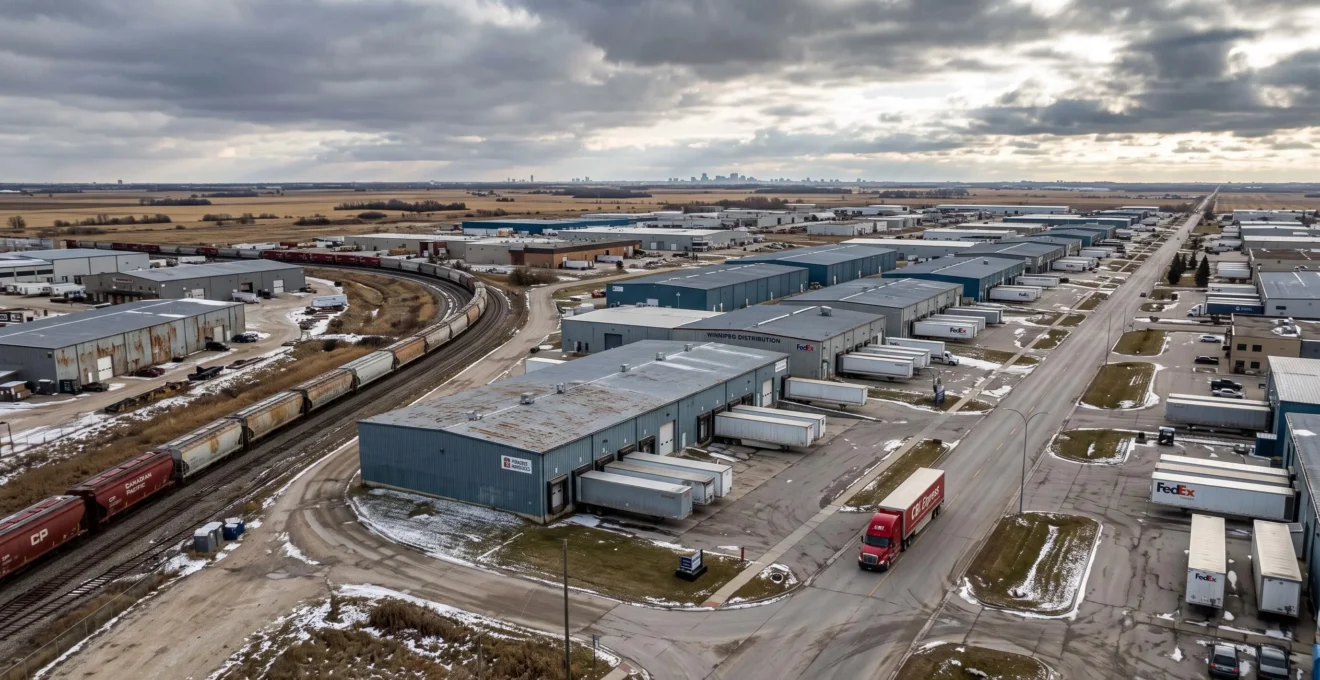
Industrial parks are important to Winnipeg because they provide the land, infrastructure and transportation connections that manufacturing, warehousing and distribution businesses need to operate efficiently. By concentrating industrial activity in designated areas, these parks also support employment, supplier networks and the movement of goods between Winnipeg, other Canadian markets and the United States.
Their economic role extends beyond individual warehouses or factories. Manufacturers need maintenance contractors, specialized equipment and dependable freight services. Distribution centres depend on truck access, loading capacity and connections to wider transportation networks. Industrial parks bring these requirements into locations where infrastructure and neighbouring businesses can support complementary activities.
Winnipeg’s industrial geography includes established urban areas such as St. Boniface Industrial Park and larger transportation-oriented developments near the Perimeter Highway. However, not every park offers the same facilities, labour access, zoning permissions or expansion opportunities. Understanding these differences helps businesses select appropriate sites while giving workers and residents a clearer picture of where industrial employment and commercial activity are concentrated.
Winnipeg industrial parks: Key facts
- Industrial parks concentrate manufacturing, warehousing and distribution facilities, creating opportunities for shared suppliers, skilled labour and freight services.
- Site suitability depends on truck access, utility capacity, zoning, workforce availability, drainage and total occupancy costs—not simply advertised rent.
- Winnipeg’s road, rail and air cargo connections strengthen its distribution role, but individual properties require verification of their actual transportation capabilities.
- Why Do Winnipeg Businesses Cluster Manufacturing and Warehousing in Industrial Parks?
- How Can a Business Assess a Winnipeg Industrial Park Before Choosing a Site?
- Central or Peripheral Industrial Site: Which Fits a Winnipeg Operation Better?
- Industrial Site Selection Mistakes That Can Raise Winnipeg Operating Costs
- When Should a Winnipeg Business Move Into an Industrial Park?
- Road, Rail, or Air: Which Freight Mode Fits Different Winnipeg Logistics Needs?
- How Can You Check Winnipeg Land Use Rules Before Planning a Property Project?
- Why Is Winnipeg a Major Transportation and Logistics Hub for Central Canada?
Why Do Winnipeg Businesses Cluster Manufacturing and Warehousing in Industrial Parks?
Winnipeg businesses cluster manufacturing and warehousing in industrial parks because proximity to suppliers, skilled workers, maintenance contractors and freight carriers can make industrial operations easier to coordinate. Designated industrial locations also provide space and infrastructure suited to commercial vehicles, production facilities and storage. The economic benefits depend on each park’s tenant mix, servicing and transportation access.
Industrial clustering works through shared operating networks. A food processor may require packaging suppliers, refrigeration technicians, cleaning contractors and frequent truck collections. A machinery manufacturer may depend on fabrication subcontractors, equipment maintenance and specialized industrial labour. When relevant services operate nearby, businesses may reduce travel requirements, coordinate urgent repairs more easily and improve access to qualified contractors.
Two distinct factors influence where these clusters develop:
- Cost-driven clustering: businesses seek industrial land, building configurations and servicing arrangements better suited to their requirements than constrained urban properties. Lower overall costs are possible but must be demonstrated through site-specific comparisons.
- Network-driven clustering: companies prioritize access to carriers, third-party logistics providers, warehousing partners and complementary manufacturers, even when a particular property is not the least expensive option.
Winnipeg’s industrial parks illustrate different combinations of these advantages. The City of Winnipeg describes St. Boniface Industrial Park as having oversized roads designed for commercial traffic and access to major transportation routes. Its municipal property information also identifies serviced industrial lots and manufacturing-oriented land uses. These features demonstrate how planned industrial infrastructure can accommodate freight-intensive operations.
At the metropolitan scale, CentrePort Canada illustrates the relationship between industrial land and transportation networks. Its inland port covers approximately 20,000 acres in Winnipeg and the Rural Municipality of Rosser, with road, rail and air cargo connections. The CentrePort Canada official inland port and transportation overview identifies manufacturing, agribusiness, transportation and distribution among the sectors represented.
More than 250 companies
CentrePort Canada reports that more than 250 new companies established operations within its inland port since 2009. This is a cumulative development figure reported by the organization, not a count of current industrial vacancies or a measure of net employment growth.
CentrePort Canada Inc., official inland port overview.
Clustering can also influence employment. Industrial workers may find several potential employers within a manageable geographic area, while businesses gain access to an existing regional labour pool. Freight carriers may find concentrated collection and delivery activity attractive when organizing routes.
These advantages are not automatic. Businesses outside established parks can face longer supplier journeys or less convenient carrier schedules, but a park with limited transit access or intense competition for specialized workers can present its own disadvantages.
The practical value of clustering is therefore determined by the relationship between neighbouring businesses, infrastructure and employees. Evaluating those conditions at the property level is the next step toward identifying a suitable industrial location.
How Can a Business Assess a Winnipeg Industrial Park Before Choosing a Site?
A Winnipeg business should assess an industrial park by verifying freight access, electrical service, drainage, zoning, workforce access and future expansion capacity before making a property commitment. An attractive warehouse or vacant lot may still be unsuitable if trucks cannot manoeuvre safely, utilities cannot support equipment or planned infrastructure improvements remain uncertain.
Start with the physical operation rather than a listing description. Prepare a schedule of vehicle dimensions, shipping frequency, dock requirements, equipment loads, employee shifts and storage needs. These operating requirements provide measurable criteria for comparing properties.
For freight-intensive operations, examine connections to the Perimeter Highway, Brookside Boulevard and the McGillivray corridor where relevant. The effective route includes the final approach to the property, not merely the distance to a major highway.
Electrical capacity needs particular attention. A building advertised as serviced may not have the available three-phase power, transformer capacity or upgrade schedule required for manufacturing machinery. Request confirmation from the relevant utility and obtain a technical assessment where necessary.
Winnipeg’s flat terrain also makes drainage evaluation important. Inspect grading, stormwater infrastructure, access roads and evidence of water accumulation. Review applicable flood and drainage requirements rather than assuming that a serviced industrial property has no water-related risks.
The surrounding tenant mix can reveal operational advantages and constraints. Logistics firms located near fabricators may create subcontracting opportunities, while several businesses drawing on the same specialized workforce could intensify recruitment competition.
Distinguish completed infrastructure from proposed upgrades. A planned road widening, utility extension or transit connection should not influence a financial commitment without confirmation of its approval, funding and anticipated delivery. Seek documentary evidence from the relevant municipality or infrastructure provider.
Five checks to complete before selecting an industrial park
- Test truck access: inspect entrance geometry, loading areas and routes using representative vehicle dimensions. Deliverable: a marked access plan showing any restrictions.
- Verify utility capacity: document equipment demand and request confirmation of available electrical and other essential services. Deliverable: a written servicing requirements and availability summary.
- Review drainage and ground conditions: assess site grading, stormwater features and relevant engineering information. Deliverable: a site-condition risk register.
- Evaluate the surrounding business environment: identify nearby employers, suppliers, carriers and labour connections. Deliverable: a tenant-mix and workforce-access comparison.
- Confirm expansion potential: investigate neighbouring parcels, applicable zoning and infrastructure proposals. Deliverable: a documented expansion-options assessment.
Expansion capacity deserves attention even when immediate requirements are modest. A site that accommodates current operations but has no practical room for additional docks, trailer parking or production equipment may create another relocation requirement as the business grows.
Once the operating requirements and development constraints are understood, the business can assess whether a central Winnipeg location or a more peripheral industrial park provides the stronger overall fit.
Central or Peripheral Industrial Site: Which Fits a Winnipeg Operation Better?
A central Winnipeg industrial site often suits businesses serving local customers or relying on employees from several urban neighbourhoods. A peripheral site near the Perimeter Highway can suit freight-intensive operations needing larger yards, trailer storage and convenient regional highway connections. The better location depends on workforce needs, shipping patterns, property costs and expansion requirements.
The distinction is operational rather than simply geographical. Central and mid-ring industrial properties can place technicians, customers and urban delivery destinations closer together. Peripheral parks may provide more space for modern warehouse configurations, although these features must be checked for individual buildings.
The main trade-offs can be organized into a practical location comparison.
| Decision factor | Central or mid-ring location | Peripheral industrial park |
|---|---|---|
| Labour access | Potentially shorter commutes for workers living in established urban neighbourhoods | May require longer commutes or more reliance on vehicle access |
| Property cost | Varies with building age, condition, land scarcity and servicing | Varies with lot size, new construction, infrastructure and location; not inherently cheaper |
| Truck access | More potential for constrained yards and urban road limitations | Potentially convenient highway connections and purpose-designed truck circulation |
| Expansion | Adjacent land may be limited in established industrial areas | Potential for larger sites, subject to actual parcel availability |
| Customer proximity | Often advantageous for frequent deliveries within Winnipeg | Often advantageous for regional and long-haul distribution |
Consider two hypothetical businesses. A metal fabrication shop serving Winnipeg building contractors may benefit from a central or mid-ring industrial property because service vehicles and customers make frequent local trips. A national distribution centre receiving full truckloads may place greater importance on highway access, trailer staging and warehouse clear height.
Neither choice should be made solely on driving distance to the Perimeter Highway. A fabrication business at an isolated peripheral location could face recruitment and commuting difficulties. Conversely, a large distribution operation within a constrained central property may experience operational delays from inadequate truck circulation and limited outdoor space.
Total cost comparisons should incorporate freight kilometres, employee access and site functionality alongside rent. A more expensive facility can sometimes be economically preferable when it removes operational bottlenecks, although the savings need to be calculated from actual business data.
Choosing the appropriate location category narrows the search, but property-specific oversights can still undermine an otherwise sensible decision. Several of those mistakes become particularly expensive after a lease has been signed.
Industrial Site Selection Mistakes That Can Raise Winnipeg Operating Costs
Winnipeg industrial businesses can incur avoidable costs by underestimating electrical requirements, winter maintenance, truck-route constraints, drainage conditions or lease obligations. Zoning assumptions and inadequate planning for future freight volumes can create additional expenses. These risks are most effectively managed through documented technical, regulatory and financial checks before a purchase or lease becomes binding.
Inadequate power capacity is a significant risk for equipment-intensive facilities. A location may accommodate office and lighting loads while requiring costly upgrades for production machinery, refrigeration or additional processing lines. Confirm the available supply and potential upgrade requirements rather than relying on a generic description of the building as serviced.
Winnipeg’s winters create another operational consideration. Businesses need to determine who is responsible for snow clearing, ice management, snow storage and maintaining access to loading bays. Limited yard space may become more restrictive when snow accumulation reduces usable truck circulation areas.
Heavy-vehicle access must also be assessed against the municipal road network. Winnipeg maintains designated truck routes, with specific rules for accessing destinations on other streets. The City of Winnipeg’s official truck regulations and route guidance explains the route system and directs businesses toward the relevant restrictions.
Route eligibility alone is not enough. A property can be reachable from a designated truck route while still having inadequate turning radii, loading arrangements or trailer parking. Businesses should review the full movement from the highway to the dock, including applicable weight and clearance constraints.
Other expensive oversights include:
- Overlooking ground and drainage conditions: site preparation, foundation requirements or stormwater improvements may increase development expenses.
- Misinterpreting zoning permissions: the property’s industrial designation may not authorize a specific outdoor storage arrangement, noise-producing activity or expansion proposal.
- Comparing rent without operating expenses: a triple-net lease may pass property taxes, insurance and maintenance charges to the tenant, changing the true occupancy cost.
- Ignoring future freight needs: increasing shipment volumes, changing carrier arrangements or possible rail requirements may exceed the site’s capabilities.
A useful financial comparison separates base rent, recoverable operating expenses, utility costs, site improvements, winter services and the likely costs of operational constraints. These components should be documented for each shortlisted property under comparable assumptions.
For example, in a hypothetical lease comparison, a lower advertised rent could become less attractive if the property requires major electrical upgrades and ongoing third-party snow removal. This illustrates why the lowest headline price is not necessarily the lowest operating cost.
Technical due diligence protects against avoidable expenses, but the timing of a relocation matters as well. A suitable site can still create financial pressure when a business commits to more space than it currently needs.
When Should a Winnipeg Business Move Into an Industrial Park?
A Winnipeg business should consider moving into an industrial park when persistent space, loading, vehicle access or production constraints begin limiting operations and a suitable replacement offers measurable advantages. Lease renewal timing, changing workforce geography and evolving freight requirements also matter. Relocation becomes more defensible when projected operational benefits justify higher fixed costs and transition risks.
Growing firms commonly encounter several warning signals. Warehouse aisles may be used for temporary storage, dock appointments may become difficult to schedule, and additional vehicles may exceed available parking or loading capacity. Manufacturers may need more power, production space or specialized servicing than the current building can provide.
These signals should be measured rather than treated as automatic reasons to relocate. A simple capacity-utilization assessment compares actual operating demand with safe and practical facility capacity.
For illustration, a hypothetical warehouse consistently using 90% of its functional storage capacity could face difficulties accommodating seasonal peaks. However, the appropriate threshold depends on inventory turnover, product characteristics, picking methods and available process improvements. High utilization alone does not prove relocation is necessary.
Moving too early creates different risks. A larger industrial facility can increase rent, utilities, maintenance and staffing requirements before shipment volumes or production demand support the additional expense. Businesses should compare the cost of remaining, reconfiguring existing space, outsourcing selected functions and relocating.
Local property availability is another variable. Winnipeg’s industrial real estate market changes with development cycles, tenant demand and construction activity. Established industrial districts may have limited opportunities for large contiguous expansion, while newer industrial nodes can offer alternatives subject to servicing and actual availability.
The timing decision should therefore include current property listings, lease terms, construction or improvement requirements and the schedule for any essential infrastructure. Planned industrial developments should not be treated as immediately occupiable space without confirmation.
A phased transition may be appropriate. A hypothetical manufacturer could retain a smaller urban facility for customer service and local fabrication while shifting bulk storage or regional distribution to an industrial park. This arrangement avoids an all-at-once move but introduces coordination and transportation costs between locations.
The strongest relocation decisions align operational readiness with property suitability and financial capacity. Once those conditions are met, the business must determine which freight connections its new location actually needs.
Road, Rail, or Air: Which Freight Mode Fits Different Winnipeg Logistics Needs?
Road freight generally suits flexible regional deliveries, many cross-border shipments and less-than-truckload movements. Rail is often appropriate for heavier or larger-volume long-distance freight, while air cargo serves urgent or high-value shipments where speed justifies higher transport costs. Intermodal transport can combine rail efficiency with truck access, but service availability and total transit time must be verified.
Winnipeg offers an unusual combination of major railway connections, highways serving Canadian and US markets, and air cargo infrastructure at Winnipeg Richardson International Airport. This range gives industrial businesses several freight strategies, although not every industrial park provides direct access to every mode.
The shipment profile should guide the choice:
- Road freight: useful for regional replenishment, local distribution, flexible pickup schedules and cross-border deliveries where road access is practical.
- Rail freight: suited to qualifying bulk commodities and larger long-distance volumes when terminal access, schedules and handling costs support the business case.
- Air cargo: relevant for urgent replacement parts, time-sensitive products and certain higher-value goods, subject to carrier services and handling requirements.
- Intermodal freight: combines rail transportation over longer distances with truck collection or final delivery, where appropriate terminals and services are available.
Industrial site selection should follow the dominant freight requirement. A truck-primary distributor needs reliable road access and efficient dock operations. A business considering rail should establish whether it needs a direct siding, a nearby transload facility or container services at an intermodal terminal.
Freight costs also interact with inventory requirements. A shift from truck to rail can reduce certain transportation costs under suitable conditions but may introduce longer or less frequent delivery cycles. Businesses may need additional buffer stock, which ties up working capital and occupies warehouse space.
A practical comparison therefore measures transportation charges alongside inventory carrying costs, terminal handling, reliability and scheduling requirements. Focusing exclusively on the quoted freight rate can obscure the total cost of a supply chain.
Hybrid arrangements are often worth evaluating. For example, a hypothetical Winnipeg distributor could receive bulk inventory by rail through a transload provider, then use trucks to replenish customers across Manitoba. This structure separates inbound scale from outbound delivery flexibility without requiring direct rail service at the warehouse.
Infrastructure plans require careful interpretation. CentrePort Canada identifies the CentrePort Canada Rail Park as a development intended to provide direct access to Canadian Pacific Kansas City infrastructure. The existence of this development plan does not establish that every nearby parcel already has operational rail access.
Once transportation needs are clear, businesses still need to verify that the proposed property permits the intended activity. Freight suitability cannot compensate for a land-use restriction that prevents the operation from proceeding.
How Can You Check Winnipeg Land Use Rules Before Planning a Property Project?
To check Winnipeg land-use rules, identify the property’s zoning district, review the applicable development plan and verify whether the intended business activity is permitted or requires additional approval. Loading, parking, setbacks, outdoor storage and existing property agreements must also be examined. Municipal zoning verification is particularly important before signing an unconditional property agreement.
The City’s zoning framework determines which land uses and development standards apply to parcels within its jurisdiction. An industrial designation is a starting point, not confirmation that every manufacturing, storage, processing or transportation activity can operate without conditions.
A practical verification sequence is:
- Identify the legal parcel: obtain the correct civic address and legal description, including any relevant parcel boundaries.
- Confirm zoning and development plan designations: determine which municipal requirements apply to the site and proposed activity.
- Check the proposed use: establish whether the activity is permitted, conditional or requires a change in zoning.
- Review physical development requirements: examine parking, loading, setbacks, lot coverage, building dimensions and relevant outdoor storage provisions.
- Investigate additional approvals: determine whether variances, subdivision approvals, heritage-related permits, site plan review or servicing arrangements apply.
The City of Winnipeg’s development applications and zoning verification procedures explain available zoning documentation and the approval processes for conditional uses, variances, rezoning and other development applications.
The distinction between these mechanisms matters. A permitted use may proceed subject to meeting applicable standards and other required approvals. A conditional use requires additional municipal review. A variance addresses certain departures from development requirements, while rezoning involves changing the applicable zoning framework.
None of these application mechanisms guarantees approval. Required documentation, procedural steps and decision timelines depend on the individual project and the relevant rules.
Older industrial properties can present additional considerations, including heritage designations or previous development agreements. Projects involving land division, significant building changes or infrastructure extensions may require further review. Flood-related requirements and stormwater obligations should be checked where applicable.
A previous tenant’s operations are not proof that a new activity is authorized. A property suitable for conventional warehousing might require additional consideration when used for a different industrial process, particularly where outdoor operations, vehicle movements or building modifications change.
Jurisdiction is equally important. Portions of CentrePort Canada lie within the Rural Municipality of Rosser, so businesses must confirm which planning authority governs the specific parcel rather than automatically applying City of Winnipeg procedures.
Land-use confirmation converts a promising location into a more credible development opportunity. Together with transportation and servicing assessments, it enables businesses to benefit from Winnipeg’s logistics position without overlooking regulatory constraints.
Key takeaways before evaluating Winnipeg’s logistics advantage
- Choose an industrial property around actual shipment patterns and available freight services, rather than assuming proximity to transportation infrastructure guarantees direct access.
- Evaluate occupancy costs, workforce requirements and infrastructure capacity together; a cheaper or larger facility may not provide the strongest operating fit.
- Confirm the relevant planning jurisdiction and approval requirements before making irreversible property or equipment commitments.
Why Is Winnipeg a Major Transportation and Logistics Hub for Central Canada?
Winnipeg functions as a major Central Canadian transportation and logistics hub because its railway networks, east-west highway connections, north-south trade routes and air cargo infrastructure support freight moving between regions. This concentration helps manufacturers and distributors reach multiple markets from one metropolitan area while attracting carriers, warehouses and related industrial services.
The city’s position is particularly important for freight consolidation and interchange. National rail connections link Manitoba with other Canadian regions, while road networks support distribution within the Prairies and cross-border trade with the United States.
Winnipeg has access to Canadian National, Canadian Pacific Kansas City and BNSF railway networks. This contributes to the area’s freight connectivity, although individual businesses must verify the services, terminals and access arrangements available at their selected properties.
The Trans-Canada Highway provides important east-west connectivity, while north-south routes support movement toward the US border. Together, these corridors help position Winnipeg within the broader Mid-Continent Trade and Transportation Corridor connecting Canadian and American markets.
Air cargo infrastructure adds another dimension. Winnipeg Richardson International Airport supports cargo activity, complementing surface freight networks for shipments where air transportation is appropriate.
More than 4,300 cargo flights
CentrePort Canada’s official overview reports more than 4,300 airport cargo flights in 2024. This is a historical activity figure for that reference year, not a verified 2026 total or a guarantee of cargo service frequency for individual businesses.
CentrePort Canada Inc., transportation and infrastructure overview.
This combination of infrastructure helps explain why logistics providers and industrial support businesses are attracted to Winnipeg. The CentrePort overview identifies operators including Bison Transport, Fastfrate Group, FedEx, Purolator, TransX and UPS within its transportation-related business environment.
For manufacturers, a concentration of carriers and third-party logistics providers can broaden the available options for inbound materials and outbound goods. For warehouse operators, proximity to freight services can support different distribution models without requiring the business to operate its own transportation fleet.
The benefits reach employment as well. Industrial parks accommodate production, warehousing, freight handling and equipment operations while creating demand for maintenance, administration, technical services and transportation support. These relationships help explain how industrial land contributes to a metropolitan employment base beyond the direct workforce of individual factories.
Winnipeg’s geographic position does not eliminate operating constraints. Severe winter weather can disrupt schedules, while border procedures, carrier capacity and terminal operations introduce variability. Cross-border shipments require appropriate customs documentation and planning, and delivery performance depends on the actual route and service provider.
Businesses should therefore treat transportation connectivity as an opportunity to evaluate rather than a guaranteed cost or service advantage. Compare carrier quotations, shipment frequencies, inventory requirements and contingency arrangements before determining the value of a particular industrial location.
A useful next step is to shortlist industrial properties, document their freight and utility capabilities, confirm zoning with the appropriate authority and compare their full operating costs. That approach connects Winnipeg’s regional transportation strengths with the specific conditions a business needs to sustain manufacturing, warehousing or distribution activity.
What types of businesses commonly operate in Winnipeg industrial parks?
Winnipeg industrial parks accommodate activities such as manufacturing, food processing, warehousing, freight transportation, equipment services and distribution. The suitability of each activity depends on the property’s zoning, utilities, building specifications and transportation infrastructure.
Do all Winnipeg industrial parks have direct railway access?
No. Regional access to railway networks does not mean that every industrial property has a rail siding or direct rail service. Businesses should confirm whether their proposed site offers direct rail access, requires a transload provider or relies on trucking to reach an intermodal terminal.
Are industrial parks necessarily less expensive than central Winnipeg properties?
No. Occupancy costs depend on rent or purchase price, property taxes, insurance, utilities, maintenance, building suitability and transportation expenses. A peripheral property may provide more space but also introduce longer employee commutes or additional local delivery costs.
How can workers assess access to employment in an industrial park?
Workers can review employer locations, shift schedules, available transit connections, driving routes and parking arrangements. Industrial parks may concentrate potential employers, but accessibility varies significantly between urban industrial districts and more peripheral employment areas.
Does a serviced industrial lot guarantee that a company can begin operating immediately?
No. A serviced lot may have access to infrastructure without having sufficient utility capacity or all approvals required for a particular operation. Businesses still need to confirm zoning, electrical requirements, building permits, site access, drainage and any applicable development conditions before occupation or construction.