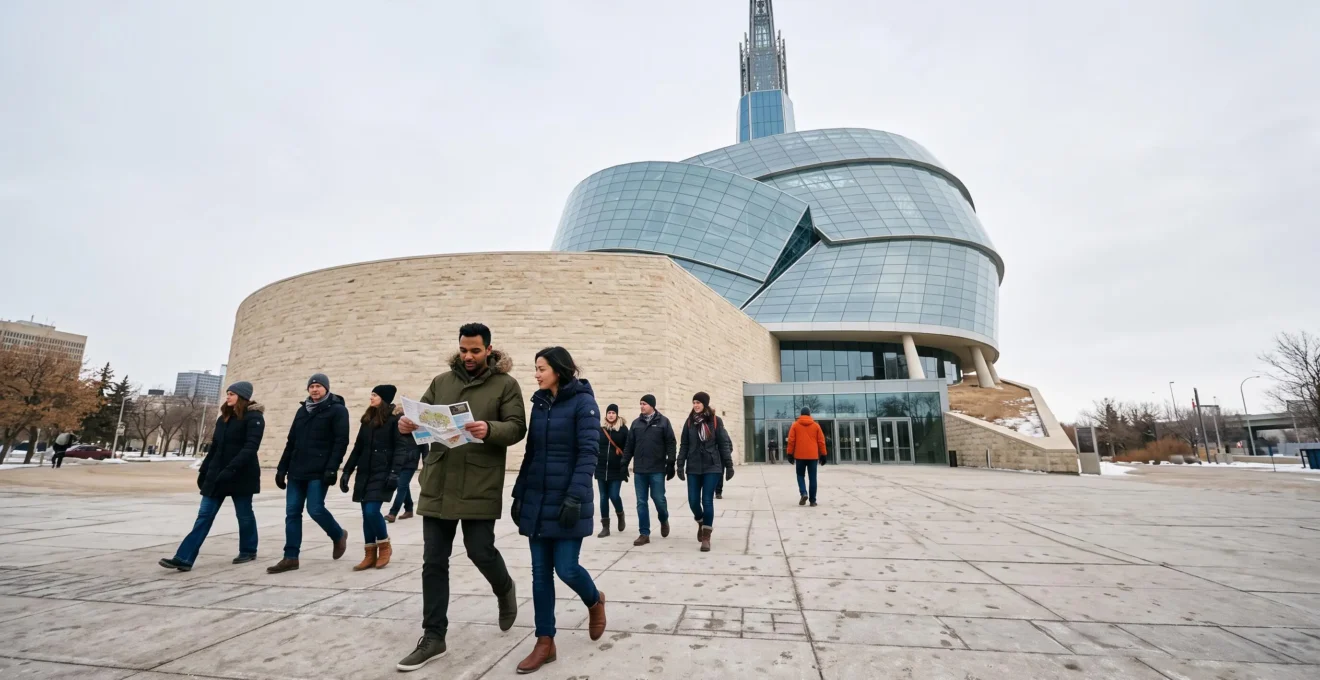
Getting more from a visit to the Canadian Museum for Human Rights is less about seeing everything than about deciding how deeply you want to engage with what you see. The Winnipeg museum combines architecture, multimedia, testimony, historical material and interactive experiences across multiple levels, and many of its galleries address subjects that deserve time rather than hurried observation.
A stronger visit therefore begins before you enter. Think about available time, your interest in particular human rights themes, the needs of children or other members of your group, and what else you hope to do at The Forks. A flexible plan gives difficult material room to register while leaving space for reflection, breaks and unexpected discoveries.
How to make a CMHR visit more meaningful
- Choose depth over trying to complete every gallery in one uninterrupted pass.
- Plan emotional and physical breaks when engaging with demanding subjects.
- Use the museum layout, family guidance and fixed commitments to shape your schedule.
- Leave flexibility if you are combining the museum with other activities at The Forks.
- Why Can a Visit to the Canadian Museum for Human Rights Feel Emotionally Demanding?
- How Can You Plan a Canadian Museum for Human Rights Visit Without Feeling Rushed?
- Broad Overview or Focused Visit: Which Museum Approach Fits Your Time?
- Visit Planning Mistakes That Can Make a Human Rights Museum Trip Overwhelming
- When Is the Best Time to Plan a More Reflective Human Rights Museum Visit?
- How Can You Plan a Half-Day at The Forks Without Rushing Between Stops?
- How Can You Plan a Month of Winnipeg Events Without Missing the Best Variety?
- How Can You Explore The Forks Beyond Its Most Familiar Winnipeg Attractions?
Why Can a Visit to the Canadian Museum for Human Rights Feel Emotionally Demanding?
A visit can feel emotionally demanding because several core galleries deal directly with genocide, residential schools, discrimination and other serious human rights experiences. Other spaces ask visitors to reflect on contemporary issues or their own capacity to contribute to change. Moving through these subjects requires concentration, and different people may need different amounts of time to process them.
The museum describes 10 core galleries presenting stories from Canada and around the world through multimedia, design and interactive presentation. Its official overview of the Canadian Museum for Human Rights galleries shows just how varied that material can be: Indigenous rights, Canadian human rights stories, genocide, contemporary struggles and individual action all appear within the permanent experience.
These subjects do not all create the same kind of engagement. Listening to or reading testimony asks for attention to an individual experience. Exhibits about mass violence place that experience in a wider historical context. Interactive areas can introduce another register entirely by inviting visitors to consider present-day questions or their own responses.
For example, Breaking the Silence addresses the Ukrainian Holodomor, Armenian Genocide, Holocaust, Rwandan Genocide and Srebrenica Genocide. Actions Count includes the Witness Blanket, an installation honouring children forced into Canada’s Indian residential school system. Inspiring Change, by contrast, explicitly encourages reflection on how visitors might contribute to positive social change.
This variety makes emotional pacing useful. Instead of deciding in advance that every gallery deserves equal time, identify themes likely to require slower engagement. Place a pause after particularly demanding material, and use circulation spaces or a quieter architectural area as a change of rhythm before continuing.
Families should be especially deliberate. The museum states that some content can be challenging and that not every exhibit is suitable for children of all ages. Its Canadian Museum for Human Rights guidance for children and families recommends paying attention to children’s reactions and provides age-based suggested pathways.
That does not mean difficult galleries should automatically be avoided. It means the visit can be shaped around readiness. A visitor who wants to read testimony closely may need more time than someone seeking a broad introduction, while a family may choose a shorter route and discuss selected themes afterward.
Once that expectation is clear, the next planning question becomes practical: how much time should you protect so that reflection does not turn into rushing?
How Can You Plan a Canadian Museum for Human Rights Visit Without Feeling Rushed?
Plan around priorities rather than an assumed requirement to see every level. Review the building layout, choose the galleries or themes that matter most, allow time for pauses, and avoid placing another fixed activity immediately after the museum. The goal is to create enough flexibility that an unexpectedly powerful exhibit does not force the rest of the visit off schedule.
The museum’s Canadian Museum for Human Rights visitor planning information confirms that the building is vertically organized. The Main Elevator serves Levels 1 through 7, the Tower Elevator serves Levels 3 through 8, and the Israel Asper Tower of Hope viewing platform is on Level 8.
That layout makes advance choices useful even though there is no need to turn the visit into a rigid route. Decide whether architectural spaces, specific core galleries or the Tower of Hope are essential. This reduces unnecessary movement and makes it easier to adjust if one gallery keeps your attention longer than expected.
The available source material does not establish one official recommended duration for a complete adult visit. A better method is therefore to build your own time estimate. Count the number of priority galleries, decide whether you tend to read labels closely or move quickly, and add a buffer for orientation, transitions, breaks and the possibility of spending longer than planned in one space.
It also helps to separate the museum from the rest of the day’s logistics. The main visitor entrance is at 85 Israel Asper Way, and paid parking is available in several nearby locations. Because the museum sits within The Forks area, it is easy to underestimate how a meal, walk or additional attraction can compress the museum portion of the day.
Build a visit plan in five concrete steps
- Choose two or three priority themes and write them into a short must-see list.
- Review the level layout and note where each priority sits so you have a simple route.
- Set a flexible museum time block and add a written buffer rather than scheduling another fixed commitment immediately afterward.
- Mark one planned pause point for food, seating or quiet reflection before continuing.
- Write one optional item that can be dropped if the museum takes longer than expected.
Another useful distinction is between fixed and flexible parts of the day. If you have a timed commitment, treat it as the anchor. Let browsing, food stops and walking absorb delays rather than using a museum gallery as the part that gets cut short.
With the time block protected, the next choice is whether to use it for a broad overview or a smaller number of galleries explored in greater depth.
Broad Overview or Focused Visit: Which Museum Approach Fits Your Time?
A broad overview suits visitors who want orientation across several themes, while a focused visit suits those who prefer sustained attention to a few galleries. Available time matters, but so do prior knowledge and whether this is your first visit. A shorter deep dive can be more meaningful than a rapid sweep if the chosen subjects deserve close engagement.
A simple decision method starts with three questions: How much time do you genuinely have? How familiar are you with the human rights themes you most want to explore? Is this your only likely visit, or could you return? Those answers help determine whether breadth or depth will produce the better experience.
| Criterion | Broad overview | Focused visit |
|---|---|---|
| Primary goal | Understand the range of themes and spaces | Engage deeply with selected themes |
| Time pressure | Requires disciplined pacing | Allows more time per chosen gallery |
| Prior knowledge | Useful for first orientation | Useful when interests are already clear |
| Return possibility | Helps identify subjects for later visits | Works well when another visit can cover different material |
A focused visit is not an incomplete version of a full visit. Canadian Journeys, for example, is described by the museum as its largest gallery and covers dozens of Canadian human rights stories. Rights Today includes contemporary human rights material designed to encourage critical thinking. Either can reward a slower approach instead of functioning as a box to check on a long route.
For a first visit with limited time, one effective compromise is to sample several themes while selecting two or three for slower attention. That creates enough breadth to understand the museum’s scope without forcing identical pacing in every gallery.
A return-visit strategy can go further. Use the first visit to notice which subjects raise additional questions, then dedicate another visit to those areas rather than trying to resolve every interest in a single day. This is particularly useful when one theme unexpectedly becomes the central experience of the visit.
When time forces a choice, avoid deciding solely by floor number. Compare the value of permanent galleries, temporary material and architectural spaces against your own interests. Someone focused on Canadian history may prioritize differently from a visitor primarily interested in contemporary rights debates or the building itself.
Whichever approach you choose, the plan works best when it also avoids the habits that commonly turn an ambitious museum visit into an exhausting one.
Visit Planning Mistakes That Can Make a Human Rights Museum Trip Overwhelming
The biggest planning mistake is treating the museum as a conventional attraction that must be completed in one continuous sweep. Human rights material often rewards reading, listening and reflection, so a schedule built around maximum coverage can create mental and physical fatigue. Overpacking the rest of the day can intensify that pressure and shorten the museum experience.
Trying to give every gallery equal attention is rarely necessary. Some sections may connect closely with your interests, while others may serve mainly as context. If you force the same pace everywhere, the distinctions between themes can become harder to retain.
Another mistake is arriving without even a basic sense of the building. A few minutes spent reviewing the levels and identifying priorities can prevent the visit from becoming a sequence of improvised decisions. Staff guidance and available visitor information can also help orient a first-time visitor without requiring a minute-by-minute itinerary.
Overloading the same day is equally risky. The museum sits within The Forks, where food, trails and other attractions can make it tempting to plan several major activities back to back. A better approach is to decide which experience is the day’s anchor and which activities are optional additions.
Families face an additional planning issue: assuming the entire museum will suit every child in the same way. The museum’s age-based guidance notes that some content is challenging and provides suggested routes of about 45 minutes for children under seven and about one hour for ages seven to twelve. These are useful planning references, not universal limits for every child.
Parents and caregivers can review likely subjects in advance, watch children’s reactions during the visit and be willing to shorten or redirect the experience. A family visit does not need to mirror an adult-only visit to be worthwhile.
- Avoid completion pressure: leave some galleries for another time if attention is fading.
- Avoid a packed Forks schedule: treat extra stops as flexible rather than compulsory.
- Avoid navigating completely blind: review priorities and building levels before starting.
- Avoid one-size-fits-all family planning: adapt the route to age, reactions and interest.
Once unnecessary pressure is removed, timing becomes less about squeezing the museum into the calendar and more about choosing conditions that support attention and reflection.
When Is the Best Time to Plan a More Reflective Human Rights Museum Visit?
The best time is when you can arrive with enough mental space and without a tightly scheduled obligation immediately afterward. Quieter periods may help, but crowd levels and programming can vary, so there is no single guaranteed hour. The most reliable strategy is to combine practical timing with your own readiness for difficult material.
If a reflective atmosphere matters, consider a period when you are less likely to feel hurried. A weekday morning may be a sensible option to investigate, but it should not be treated as a guaranteed quiet period because current group visits, events and seasonal programming can change conditions.
Season also changes the wider context of a Winnipeg visit. The museum provides a substantial indoor experience, which can make it particularly attractive when outdoor conditions are less inviting. In warmer periods, visitors may also want to spend more time outdoors at The Forks, creating a different trade-off between museum depth and surrounding activities.
Personal readiness matters just as much. If you know that testimony about genocide, residential schools or discrimination will require emotional energy, avoid treating the museum as a short gap between unrelated activities. Leave room afterward for a meal, walk, conversation or quiet period rather than immediately switching to another demanding commitment.
Dates connected with human rights themes may also affect your decision. Instead of assuming what programming will be available, check the museum’s current calendar before visiting. Special programming can add context and opportunities for engagement, while also changing how busy particular spaces feel.
The same principle applies to temporary exhibits. If one is central to your interest, check current availability before fixing your itinerary. If your priority is the permanent galleries, a quieter and more flexible date may matter more than aligning the visit with a specific program.
That approach becomes especially important when the museum is only one part of a half-day at The Forks.
How Can You Plan a Half-Day at The Forks Without Rushing Between Stops?
Build the half-day around one major commitment and let the remaining stops stay flexible. If the museum is the anchor, protect its time first, then add a meal, market browsing or a walk only where they fit naturally. This prevents a compact, walkable area from becoming an unnecessarily compressed checklist of attractions.
The Forks can encourage overplanning because several experiences sit close together. Geographic proximity, however, does not mean every activity deserves equal time. A museum visit can expand because of a gallery that catches your attention; a meal can take longer than expected; weather can change the appeal of outdoor plans.
A practical sequence is to identify what is fixed and what can move. The museum may be the fixed commitment. Market browsing, a riverside walk or an informal food stop can function as flexible pieces that absorb delays without creating stress.
Weather should also influence sequencing. In colder conditions, starting with or prioritizing indoor activities can reduce unnecessary transitions. In more comfortable weather, the riverbank and outdoor spaces can play a larger role. The important point is not to follow a fixed seasonal formula, but to let current conditions decide which parts of the plan remain flexible.
The museum’s position within The Forks also matters when deciding where the half-day begins and ends. If you approach the museum first, you can move into the rest of the site afterward without needing to interrupt the museum to protect another activity. If the museum comes later, leave enough margin so food, walking or browsing cannot consume its time block.
| Part of the visit | Role in the plan | How to handle it |
|---|---|---|
| Museum | Major commitment | Protect the time block and avoid rushing the final galleries |
| Meal or market stop | Flexible support activity | Place before or after the museum according to timing |
| River or site walk | Optional extension | Shorten or expand depending on weather and energy |
This structure works because delays are absorbed by the flexible elements rather than by the experience you most wanted to have. It also leaves space for spontaneous discoveries rather than forcing every minute to deliver a planned attraction.
If Winnipeg is more than a half-day destination, the same principle can be scaled up to a month of events and experiences.
How Can You Plan a Month of Winnipeg Events Without Missing the Best Variety?
Start with a small number of fixed priorities, then leave intentional gaps for recurring or spontaneous experiences. A month becomes easier to manage when major commitments are placed first and museums, neighbourhood activities, food, music and outdoor options are layered around them. Variety comes from protecting flexibility, not from filling every open date in advance.
Winnipeg’s seasonal rhythm should shape the broad structure of the month. Outdoor activities and indoor cultural experiences do not compete in the same way throughout the year, so a useful plan keeps enough open space to respond to weather, temporary programming and changing interests.
Begin by identifying the one or two events or experiences you would most regret missing. Place those on the calendar first. Then add recurring activities and attractions that can move between dates. This reduces the chance that a flexible museum or Forks visit displaces a genuinely time-sensitive event.
Next, preserve several unassigned periods. These are not wasted space. They let you react to a newly discovered restaurant, local performance, market, exhibition or recommendation without dismantling the rest of the month.
The Canadian Museum for Human Rights can also function as more than a one-time box on an itinerary. Even without assuming what temporary exhibitions or evening programs will be available, visitors can check current programming and decide whether a return visit would offer something meaningfully different from the first.
A first visit might emphasize orientation across several galleries. A later visit can focus on a single subject, revisit a gallery that raised questions, or combine a shorter museum session with another Forks activity. Repetition only becomes redundant when the second visit has no new purpose.
A balanced month therefore mixes fixed dates, flexible cultural stops and unscheduled time. This structure is more resilient than a calendar in which every weekend already contains several non-negotiable activities.
That flexibility is particularly valuable at The Forks, where some of the site’s most interesting layers appear only when you move beyond the most obvious stops.
Key takeaways before exploring further
- Treat The Forks as a place to explore slowly, not merely as a collection of attractions.
- Use the area’s Indigenous and archaeological context to deepen what you see inside the museum.
- Let season, weather and personal interests determine which less-obvious spaces deserve time.
How Can You Explore The Forks Beyond Its Most Familiar Winnipeg Attractions?
Go beyond the market-and-museum checklist by treating The Forks as a historic landscape as well as an entertainment district. Walk with attention to the rivers, archaeological context, interpretive elements and quieter spaces between major attractions. The area’s significance becomes clearer when the museum visit and the wider site are understood as connected experiences rather than unrelated stops.
The Forks sits where the Assiniboine River flows into the Red River. Its The Forks history and archaeological record describes archaeological investigations that found evidence of Indigenous activity thousands of years ago, including a 6,000-year-old hearth containing catfish bones and stone-tool flakes.
That evidence adds a different dimension to the visit. Instead of moving directly between the central attractions, spend time noticing how the rivers and surrounding landscape explain why this location mattered long before its current buildings and visitor amenities existed.
A useful “second layer” approach is to explore beyond the most obvious indoor stops. Riverbank paths, open gathering spaces and the architectural fabric around the market can become part of the visit when the goal shifts from collecting attractions to understanding the site.
Season changes what this second layer looks like. Outdoor conditions in January and July are clearly different, so the meaningful “extra” experience will not always be the same. Rather than arriving with a universal list, identify which outdoor spaces and seasonal activities are currently accessible and worthwhile.
The strongest connection is conceptual. The wider Forks site provides archaeological and historical context for long-term Indigenous presence, while the Canadian Museum for Human Rights includes Indigenous Perspectives among its core galleries. Experiencing the surrounding site before or after the museum can therefore create useful context without pretending that one experience substitutes for the other.
A visitor interested primarily in place can begin outdoors and enter the museum with the landscape already in mind. Someone more focused on human rights themes may prefer the reverse: explore the galleries first, then walk outside and notice how the broader site changes the sense of location.
A good next step is simple: choose one museum priority and one Forks experience beyond the obvious attractions, then leave enough unplanned time for the day to develop naturally.
Do you need to see every CMHR gallery on your first visit?
No. A first visit can be designed around a broad overview or a smaller number of priority galleries. Choosing depth is particularly useful when difficult material or interactive exhibits encourage slower reading and reflection.
Is the Canadian Museum for Human Rights suitable for children?
The museum welcomes families, but it states that some content can be challenging and that not every exhibit is suitable for all ages. It provides age-based guidance, including suggested pathways for younger visitors, so parents and caregivers can adapt the experience.
Should you visit The Forks before or after the museum?
Either sequence can work. Exploring The Forks first can provide geographic and historical context, while visiting the museum first may give you themes to reflect on during a later walk around the site. Choose the order that best fits your main priority and available time.
How can you avoid museum fatigue during the visit?
Prioritize a limited number of galleries, pause between demanding sections, avoid scheduling every minute of the day and give yourself permission to leave some material for a future visit. The aim is sustained attention rather than maximum coverage.
What should you check before going to the museum?
Review current visitor information, building access, parking or transportation plans, family guidance when relevant, and any current exhibitions or programming that could affect your priorities. A short preparation step makes it easier to keep the actual visit flexible.