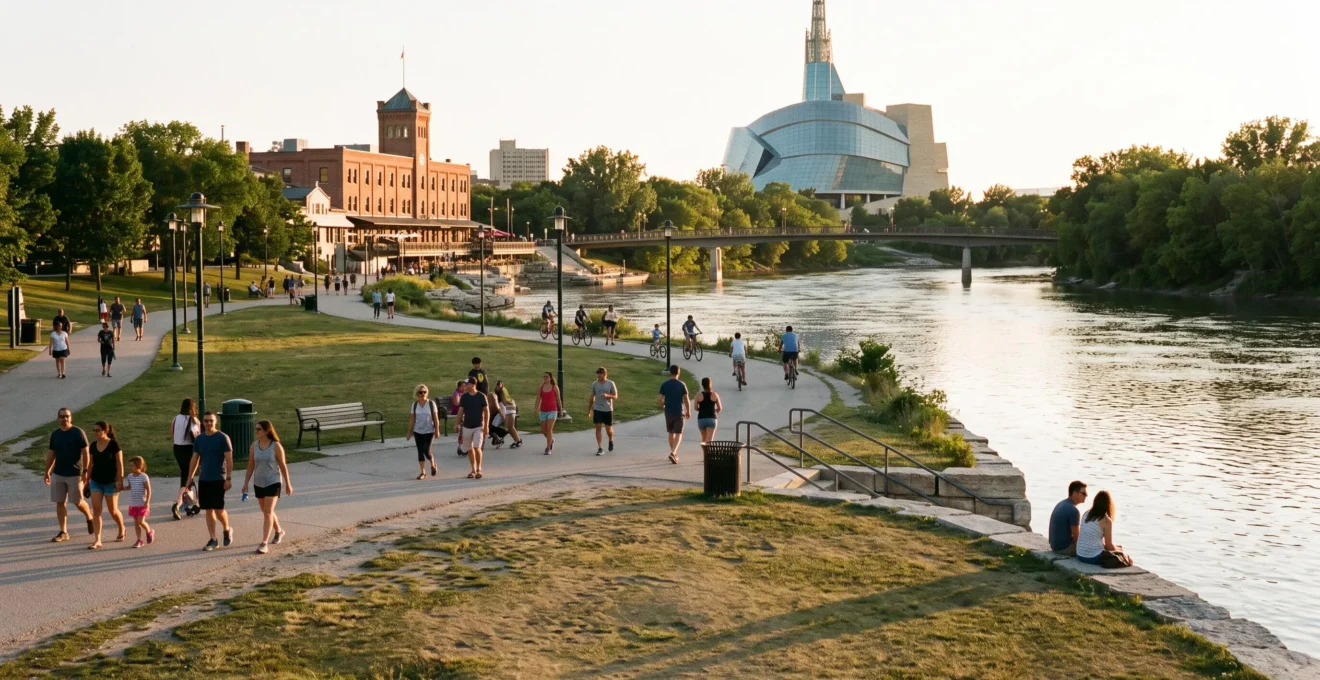
At the meeting point of Winnipeg’s Red and Assiniboine rivers, The Forks is more than a market, a waterfront attraction or a convenient place to meet friends. Its history stretches back at least 6,000 years, yet it remains part of everyday urban life. Visitors can encounter Indigenous history, railway-era architecture, contemporary culture, food and outdoor recreation within the same riverfront district.
The most rewarding way to explore The Forks is to treat it as a living meeting place rather than a collection of attractions to complete. A walk between the rivers, a pause inside the historic Market and an unhurried look at the surrounding public spaces can reveal connections that are easy to overlook on a quick sightseeing stop.
Whether you live in Winnipeg or are visiting for the first time, your experience will depend on how much time you allow, where you begin and what is happening on the day. Seasonal conditions, cultural programming and the pace of the neighbourhood can all change what The Forks feels like.
Exploring The Forks: Essential Insights
- Start with the setting: The junction of the Red and Assiniboine rivers explains why The Forks has been important for thousands of years.
- Choose a manageable route: Combine one main experience with nearby heritage, food or riverfront stops instead of trying to see everything.
- Plan for changing conditions: Market services, outdoor recreation and special events follow different schedules throughout the year.
- Why Has The Forks Remained Important to Winnipeg for Generations?
- How Can You Plan a Half-Day at The Forks Without Rushing Between Stops?
- History or Leisure: Which Way Should You Explore The Forks First?
- Planning Mistakes That Can Limit a Day at The Forks in Winnipeg
- When Should You Visit The Forks for the Experience You Want?
- How Can You Plan a Canadian Museum for Human Rights Visit Without Feeling Rushed?
- How Can You Plan a Safer Bike or Walking Route Across Winnipeg?
- How Can You Make the Most of Winnipeg’s Year-Round Cultural Calendar?
Why Has The Forks Remained Important to Winnipeg for Generations?
The Forks has remained important because its location at the confluence of the Red and Assiniboine rivers made it a natural gathering and transportation point long before Winnipeg became a city. Successive generations used the area for travel, exchange and community life. Today, its historic buildings, public spaces and riverside paths preserve that role in a contemporary urban setting.
According to the Parks Canada history of precontact land use at The Forks, archaeological evidence indicates human activity at this river junction for at least 6,000 years. Remains of campfires along the Assiniboine River point to Indigenous presence as early as 4000 BCE.
By approximately 1000 BCE, Indigenous groups were camping at the site for extended periods and using established transportation and trade routes. Archaeological materials originating from distant regions, including the Lake Superior area and northern Texas, demonstrate the reach of the exchange networks associated with the site.
At least 6,000 years
The documented history of human use at the Red and Assiniboine river confluence, based on archaeological evidence presented by Parks Canada. This represents a minimum established period, not a precise founding date.
Parks Canada, historical interpretation of precontact land use at The Forks.
The site’s significance did not disappear as its activities changed. Indigenous meeting grounds and trade routes were followed by fur-trade activity, railway development and eventually the transformation of former industrial land into a public destination. The different periods are not interchangeable: each reflects distinct communities, economic purposes and relationships with the rivers.
Visitors can begin interpreting these layers by observing three elements:
- The river junction: The physical geography that made gathering, travel and exchange possible.
- Railway-era buildings: Structures whose materials and industrial character recall a later transportation economy.
- Contemporary gathering spaces: Public areas where people continue to meet, celebrate, eat and spend time together.
That combination makes The Forks National Historic Site different from a reconstructed heritage attraction. Its historical meaning comes partly from the fact that people still use the location for everyday purposes.
Inside the Forks Market, the building itself is worth examining. Its exposed brick, structural timbers and industrial character invite visitors to consider how a place once associated with railway activity became a setting for dining, shopping and conversation.
Outside, the rivers provide the clearest connection between the site’s ancient and modern identities. Standing at the confluence offers a geographical explanation for why people repeatedly chose this location, even as transportation systems and urban development changed.
Rather than separating history from recreation, explore the two together. A thoughtful walk through the site can reveal how a longstanding meeting place continues to serve the city, which becomes especially meaningful when planning where to spend a limited amount of time.
How Can You Plan a Half-Day at The Forks Without Rushing Between Stops?
Plan a half-day at The Forks by selecting one main experience and adding two or three nearby stops. A Market visit, riverfront walk and short heritage exploration can fit comfortably into a flexible few-hour outing. Keep activities geographically connected, allow time for unexpected discoveries and avoid treating every landmark as an essential stop.
Although The Forks is walkable, it is not a single building with one entrance. Its visitor areas include indoor markets, shops, outdoor gathering spaces, riverside paths and nearby cultural attractions. Even short transitions require time, particularly when visitors stop for photographs, browse merchandise or encounter an event.
A practical approach is to choose an anchor that matches your interests:
- Food and browsing: Make the Forks Market your principal stop, with a short river walk before or afterward.
- Landscape and history: Begin at the river confluence, explore nearby heritage features and finish with refreshments.
- Indoor culture: Give most of your time to a selected cultural attraction and keep the remainder deliberately light.
Consider this hypothetical half-day itinerary for a visitor who has approximately four hours available. It is a planning example rather than an official tour schedule.
| Time allowance | Experience | Planning purpose |
|---|---|---|
| 45 minutes | River junction and nearby paths | Understand the landscape and historical setting |
| 75 minutes | Forks Market and food break | Browse, eat and enjoy the indoor atmosphere |
| 45 minutes | Public spaces and heritage features | Connect the riverfront with the built environment |
| 75 minutes | Flexible exploration and transitions | Allow for weather, photographs, shopping or rest |
These time allocations are illustrative, not measured walking times. Visitors with mobility requirements, young children or a particular shopping or dining goal may prefer a different balance.
Weather should influence the sequence rather than necessarily changing the entire plan. During pleasant summer conditions, start outdoors and return to the Market for food. In cold weather, establish an indoor base and choose shorter outdoor excursions according to current conditions.
The official visitor information for The Forks lists the Market building’s regular hours as 7:00 AM to 10:00 PM and Johnston Terminal’s as 9:00 AM to 9:00 PM, while noting that tenant schedules and seasonal hours can differ. These published hours should be checked again before visiting rather than treated as guarantees.
One of the simplest improvements is to keep the final part of your itinerary open. If the Market is particularly lively or the weather makes the riverbank inviting, there is no need to rush toward another attraction merely because it appeared in an initial plan.
Once the overall time is settled, the next decision is whether to encounter the historical setting first or begin with the social and recreational side of The Forks.
History or Leisure: Which Way Should You Explore The Forks First?
Start with history if you want to understand why The Forks exists and how its landscape developed. Begin with leisure if food, conversation and a relaxed waterfront atmosphere are your priorities. Neither approach is inherently better: the strongest visit connects both perspectives, using the rivers and heritage features to give the modern Market and public spaces additional meaning.
A history-first visit begins at the meeting of the rivers or at the national historic site. From there, visitors can look for heritage interpretation, consider the area’s transportation history and notice how historic structures have been incorporated into present-day activities.
This approach works particularly well for first-time visitors interested in Winnipeg’s development. Seeing the river junction before entering the Market creates a sense of place that would be less obvious if the first experience were simply choosing somewhere to eat.
A leisure-first visit reverses that order. Starting with refreshments, indoor browsing or a public gathering space allows visitors to settle into the atmosphere before examining its deeper historical context.
The choice can depend on arrival time, energy and weather:
| Consideration | History first | Leisure first |
|---|---|---|
| Primary interest | Heritage, geography and interpretation | Dining, browsing and social atmosphere |
| Typical preferred timing | Morning or a quieter period | Lunch, afternoon or evening |
| Weather | Comfortable conditions for outdoor walking | Convenient when an indoor break is needed |
| Visitor energy | Best when ready for observation and walking | Useful when arriving hungry or seeking a slower start |
| Likely first impression | A historically significant river junction | A contemporary Winnipeg meeting place |
These are practical preferences rather than fixed rules. An early Market visit can be enjoyable, and a late-afternoon heritage walk may be particularly appealing when outdoor conditions are comfortable.
For a combined experience, try a simple loop: begin near the river confluence, follow a manageable stretch of the riverfront, return toward the historic Market building and finish with a meal or drink. The sequence connects geography, architecture and everyday social life without requiring a tightly scheduled tour.
If you have only a very short stop, choose the confluence and a brief look toward the surrounding public spaces. This gives you a sense of why the location mattered historically and why people still gather there. If the weather makes outdoor access uncomfortable, the Market offers an alternative introduction to the district’s present-day life and industrial heritage.
The sequence matters less than the connection between experiences. Leaving time for both historical interpretation and ordinary recreation helps prevent the site from becoming either a purely educational stop or a shopping destination without context.
Planning Mistakes That Can Limit a Day at The Forks in Winnipeg
The most common mistakes at The Forks involve unrealistic timing, unchecked operating schedules and overlooking seasonal events. Visitors may also lose valuable time by treating nearby attractions as one combined stop or assuming driving is always the easiest option. A better plan verifies the day’s activities, groups nearby experiences and leaves room for spontaneous pauses.
Opening hours are an important first check. Even when the Market building is open, individual restaurants, shops and seasonal services may follow different schedules. A visitor arriving specifically for one vendor should confirm that business’s availability rather than relying only on the building’s operating hours.
The same applies to activities beyond the Market. Outdoor recreation can depend on the weather, while scheduled cultural experiences may operate only on particular dates.
Another mistake is allocating one short time block to both The Forks and the Canadian Museum for Human Rights. Although the museum is nearby, it offers an extensive experience of its own. Trying to move quickly through its exhibitions before rushing to lunch and the waterfront can make both visits feel incomplete.
Instead, treat the museum as a principal destination when it is central to your interests, and schedule a lighter Forks experience around it.
Event days also deserve attention. A gathering space that feels quiet during an ordinary weekday may be busy, programmed for performances or affected by event arrangements on another date. Check current event information before finalizing the timing of your visit.
Transport decisions should reflect your starting point. Walking or cycling may be convenient from parts of central Winnipeg, but route conditions, mobility needs, weather and available parking should all influence the choice.
Five Checks Before Visiting The Forks
- Confirm your anchor activity: Write down the one experience you most want to have and its planned time.
- Verify operating information: Record the latest published opening details for any specific Market vendor, attraction or seasonal service you intend to use.
- Review scheduled events: Check the current event calendar and note any programming that may influence crowd levels or access.
- Choose an arrival route: Identify your preferred walking, cycling, transit or driving approach and one practical alternative.
- Protect flexible time: Mark at least one unassigned interval in your itinerary for rest, discovery or unexpected changes.
These checks need not produce a complicated schedule. A short set of verified details can remove uncertainty while preserving the freedom to respond to what is happening on site.
With practical arrangements covered, season and time of day become the next major considerations. They can change the character of the riverfront as much as the attractions you choose.
When Should You Visit The Forks for the Experience You Want?
The best time to visit The Forks depends on whether you prefer active outdoor recreation, winter activities, lively events or quieter exploration. Summer is suited to riverfront walks and outdoor social spaces, while winter brings the possibility of skating and other seasonal experiences. Spring and autumn can offer a calmer atmosphere, although weather conditions require flexibility.
Rather than selecting a month solely because it is popular, begin with the activity that matters most. Someone hoping to enjoy outdoor dining will have different priorities from a visitor interested in Winnipeg’s winter identity or a resident seeking a quiet weekday walk.
Summer encourages movement between indoor and outdoor spaces. Visitors can combine Market browsing with the riverbank, public gathering areas and available seasonal activities. Patios and cultural programming can make the district especially social, although specific offerings and operating dates should always be verified.
Winter changes the relationship between the city and its rivers. During suitable conditions, skating and winter recreation become part of the site’s identity. The Nestaweya River Trail includes sections associated with the Red and Assiniboine rivers, but its availability cannot be assumed throughout the season.
The official The Forks skating trail and park conditions page distinguishes between skating, walking and cross-country skiing conditions. Weather, snowfall and warmer temperatures can cause conditions to change rapidly, so visitors should confirm which activities and sections are currently available.
Spring and autumn offer another kind of visit. Changing light, cooler temperatures and potentially quieter paths can appeal to visitors more interested in walking, photography and historic interpretation than in attending a major event. However, melting snow, rain, ice or changing river conditions may affect the comfort and accessibility of outdoor routes.
Time of day also changes the experience. A morning outing can emphasize observation and a relaxed pace, while late afternoon and evening may feel more socially oriented around dining and gathering spaces. The actual atmosphere depends on the day, weather and scheduled programming.
For visitors deciding between a festival and an ordinary weekday, the choice is primarily between atmosphere and flexibility. A major event may provide performances and a memorable shared experience, but it can also bring crowds and limit opportunities for quiet exploration.
Before setting out, verify the specific experience you want. Look for the latest trail status, seasonal activity schedules, relevant vendor opening times and any ticketing or reservation requirements. Previous years’ offerings should not be treated as confirmation of current availability.
Whatever the season, the strongest itinerary connects the visit’s main purpose with what is realistically available. That consideration becomes particularly important when adding an extensive cultural attraction such as the Canadian Museum for Human Rights.
How Can You Plan a Canadian Museum for Human Rights Visit Without Feeling Rushed?
Plan a Canadian Museum for Human Rights visit as a substantial cultural experience rather than a quick addition to a Forks itinerary. Decide which exhibitions matter most, allow time for movement and reflection, and avoid scheduling another demanding attraction immediately afterward. Pairing the museum with a relaxed meal or riverbank walk can create a more balanced day.
Located at 85 Israel Asper Way beside The Forks, the Canadian Museum for Human Rights has 10 core galleries across seven floors, alongside special exhibitions and significant architectural spaces. Its layout encourages movement upward through the building, making the journey through the galleries part of the visit.
The museum’s Canadian Museum for Human Rights visitor-planning information explains that its content can occupy many hours. Rather than prescribing one ideal visit length, it indicates that staff can recommend highlights and routes based on the time available.
This distinction matters. A visitor interested in understanding several exhibitions in depth may need a very different schedule from someone making an introductory visit focused on selected galleries and the building’s architecture.
The museum’s inclined ramps connect seven levels, while the Israel Asper Tower of Hope viewing platform is on Level 8. Architectural spaces can provide natural opportunities to slow down, look around and reflect on the experience.
For a visit that feels manageable, consider the following approach:
- Review the museum’s current hours, admission arrangements and exhibition information before arrival.
- Identify a small number of galleries or subjects that are especially important to you.
- Ask museum staff about an appropriate route if your available time is limited.
- Include flexible pauses rather than assigning an exact duration to every exhibition.
- Keep the remainder of your Forks itinerary relatively light.
Some exhibitions address difficult human rights experiences. Visitors may need time to process what they encounter, and emotional pacing can be as important as the physical time required to move between galleries.
For that reason, a museum-first day often works well. The museum becomes the focused cultural centre of the outing, followed by food at the Market or an unhurried riverside walk. This is a suggested planning approach, not an official museum requirement.
Visitors with only a short window should prioritize what they can engage with meaningfully instead of attempting to complete every gallery. A return visit may be more rewarding than turning a complex museum into a race through exhibits.
The museum’s position within the riverfront district also makes arrival part of the experience. Walking or cycling approaches can help visitors understand how The Forks connects with neighbouring areas of Winnipeg.
How Can You Plan a Safer Bike or Walking Route Across Winnipeg?
Plan a safer walking or cycling route to The Forks by choosing established connections that match your confidence, mobility and the current conditions. The riverfront district can serve as a central destination for active travel between downtown Winnipeg, Saint-Boniface and nearby paths. Check surface conditions, crossings, lighting and seasonal access rather than relying on one route throughout the year.
The Forks’ position at the junction of two rivers makes it a natural point from which to explore Winnipeg on foot or by bicycle. The surrounding network of bridges, central streets and riverbank paths offers different experiences, ranging from busy urban connections to quieter stretches near the water.
One recognizable connection is the Esplanade Riel pedestrian bridge, which links the downtown riverfront area with Saint-Boniface across the Red River. It can become part of a broader outing that combines The Forks with another Winnipeg neighbourhood.
For someone less confident on a bicycle, a shorter route using familiar central connections may be preferable to an extended riverside ride. More experienced cyclists may enjoy linking several paths, provided they check current access and use appropriate caution at intersections and shared-use areas.
Route selection should account for several practical considerations:
- Surface and weather: Rain, snow, ice and seasonal maintenance can affect the usability of paths.
- Bridges and crossings: Approaches to bridges and road intersections require attention to other users and traffic controls.
- Shared spaces: Walking and cycling routes may be used by people moving at different speeds.
- Visibility: At dusk or after dark, prefer suitable, well-used routes with adequate lighting.
- Access restrictions: River-level paths and winter recreation routes may be affected by changing environmental conditions.
Importantly, a maintained skating route on a frozen river should not be confused with a permanent walking or cycling connection. Seasonal river activities require current operational confirmation, and visitors should never assume that unmarked ice or an unavailable trail is safe to use.
For a simple active-travel outing, consider using The Forks as both the destination and the turning point. Arrive by a suitable downtown route, spend time exploring the riverfront and Market, then return or continue toward another neighbourhood through an established connection.
The journey also strengthens the site’s historical meaning. Reaching the meeting place through Winnipeg’s network of paths and river crossings can help visitors appreciate why access and movement have always been central to its identity, without suggesting that today’s routes are identical to historic Indigenous travel routes.
Once a practical route has been chosen, visitors can consider whether to build their outing around a cultural event or leave the day open for more spontaneous experiences.
Key Takeaways Before Planning Around Events
- Choose one event or cultural experience as the main commitment, then organize nearby activities around it.
- Check whether the experience has a fixed date, admission requirement or limited operating window before arranging travel.
- Leave space for informal discoveries, since Winnipeg’s cultural life also unfolds through everyday public spaces and neighbourhood activity.
How Can You Make the Most of Winnipeg’s Year-Round Cultural Calendar?
Make the most of Winnipeg’s cultural calendar by selecting events that reflect your interests and planning each day around one main activity. The Forks provides a useful starting point because it combines public gathering spaces, Market activity and seasonal programming. Pair scheduled events with nearby experiences, but avoid filling every available hour with performances or festivals.
The Forks’ role as a gathering place continues through its modern cultural activity. Markets, public events, seasonal installations and informal encounters allow visitors to experience a living civic space rather than a historical setting preserved only for observation.
There is an important difference between experiences that can be enjoyed spontaneously and those that require advance planning.
Drop-in activities might include browsing local vendors, spending time in a public space or encountering informal entertainment when available. These experiences can complement almost any itinerary because they do not necessarily depend on a particular event ticket or performance start time.
Fixed-date programming works differently. Festivals, organized performances, special market events and other scheduled activities may require visitors to arrive at a specific time, verify access arrangements or plan around heavier crowds.
Before visiting, review the current events information from The Forks and the schedules of any Winnipeg festivals or cultural organizations you are interested in. Confirm dates directly with the organizers, particularly when planning travel around a specific event.
Geographical grouping is another useful strategy. If your main event is at The Forks, choose nearby food, heritage or riverfront activities for the same outing. If you plan to attend a performance or festival elsewhere in Winnipeg, consider giving that neighbourhood its own dedicated time rather than crossing the city repeatedly.
For example, a hypothetical visitor spending a weekend in Winnipeg could dedicate one afternoon to a scheduled cultural activity at The Forks and an evening to dining nearby. A second day could focus on another neighbourhood or cultural institution. This is an illustrative scheduling method, not a claim that any specific event is taking place on those dates.
Peak festival periods may involve larger crowds, greater demand for accommodation and less flexibility around popular activities. Those possible trade-offs should influence planning, although they vary by event and should not be assumed for every cultural gathering.
The alternative is an ordinary visit without a major event. A quieter Market, time beside the rivers and unscheduled conversations can offer a different view of Winnipeg’s culture. The value of The Forks does not depend on arriving during a festival.
Historical context adds depth to either approach. The same place that has supported gathering and exchange over thousands of years remains an accessible setting for contemporary public life. Seasonal programming changes, but the relationship between place, community and shared experience continues.
For your next visit, choose the experience that interests you most, confirm its current availability and add a manageable amount of time for exploring the surrounding riverfront. That simple approach leaves space for both Winnipeg’s planned cultural activity and the unexpected moments that make a meeting place memorable.
Do you need a guided tour to appreciate the history of The Forks?
No. Independent visitors can begin by observing the Red and Assiniboine river junction, exploring the public spaces and looking for historical interpretation. Reading about the site’s Indigenous history before arrival makes the landscape more meaningful. A guided experience may provide additional context when suitable programming is available, but it is not essential to understanding the site’s historical importance.
Can you enjoy The Forks without spending much money?
Yes. Exploring accessible public spaces, viewing the river confluence and enjoying a walk can form the basis of a visit without making shopping or dining the main activity. Particular attractions, food purchases, parking or programmed activities may involve charges, so check the details of anything you plan to use.
Is The Forks a suitable destination when the weather is poor?
The indoor Market and Johnston Terminal provide alternatives to extended outdoor exploration. However, individual business hours may vary, and weather can affect movement between buildings and access to outdoor spaces. Plan an indoor-focused itinerary and check current operating details if conditions are uncertain.
What should first-time visitors prioritize if they have less than an hour?
Prioritize the river junction for an understanding of the site’s geographical and historical importance, then use any remaining time for a brief look at the Market or surrounding public spaces. This offers a compact introduction to both the longstanding meeting place and its present-day role. Adjust the sequence if weather or accessibility makes indoor exploration preferable.
How can visitors find out whether winter river activities are available?
Consult the current skating trail and park conditions published by The Forks shortly before visiting. Check the status of the specific activity and trail section you intend to use, since skating, walking and cross-country skiing conditions may differ. Do not rely on photographs or announcements from previous winters as evidence of present access.