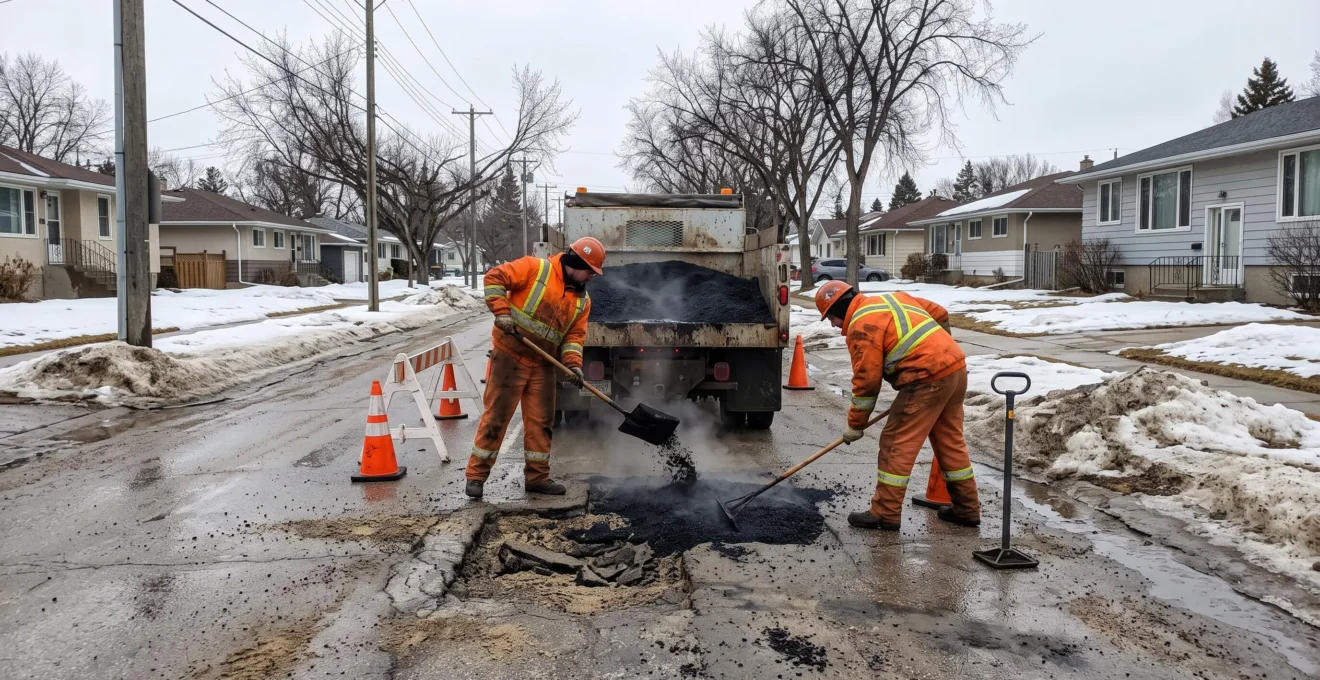
Winnipeg road maintenance responds to seasonal street damage through a combination of pothole patching, pavement inspections, snow clearing, planned resurfacing, and long-term reconstruction. The treatment depends on weather conditions, traffic importance, pavement deterioration, and available infrastructure funding. Immediate safety hazards may receive attention before less urgent defects, while extensive deterioration can require a separate capital renewal project.
Manitoba’s winter conditions make this work particularly challenging. Repeated freezing and thawing allow moisture to penetrate vulnerable pavement, while spring melting reveals cracks, potholes, and weakened road surfaces. Repairing the visible damage quickly helps maintain safe travel, but lasting improvement sometimes requires work beneath the asphalt.
The City of Winnipeg uses temporary cold-mix repairs during unsuitable weather and generally transitions toward longer-lasting hot-asphalt repairs when conditions improve. Meanwhile, a pavement assessment program guides larger renewal decisions. Understanding these different activities helps drivers and residents report hazards effectively, interpret repair schedules, and distinguish routine maintenance from structural rehabilitation.
Winnipeg road maintenance at a glance
- Freeze-thaw cycles and moisture contribute to potholes, especially when existing pavement cracks allow water to reach underlying layers.
- Winnipeg prioritizes dangerous potholes and important traffic routes, using temporary cold mix when conditions prevent more durable asphalt repairs.
- Long-term street condition depends on planned pavement renewal, not simply repeated pothole filling.
- Why Do Winnipeg Roads Develop Potholes After Repeated Freeze-Thaw Cycles?
- How Can You Report Winnipeg Road Damage Clearly and Effectively?
- Pothole Repair or Resurfacing: Which Fix Does a Winnipeg Road Need?
- Road Damage Warning Signs Winnipeg Drivers Should Not Ignore
- When Is the Best Time for Different Types of Winnipeg Road Repair?
- Why Can Delayed Infrastructure Renewal Become More Expensive for Winnipeg?
- Why Are Some Winnipeg Streets Cleared Before Others After a Snowstorm?
- How Does Long-Term Infrastructure Planning Prepare Winnipeg for Future Growth?
Why Do Winnipeg Roads Develop Potholes After Repeated Freeze-Thaw Cycles?
Winnipeg roads develop potholes when water enters pavement cracks, freezes, expands, and gradually weakens the surrounding material. As temperatures rise, melting water and repeated vehicle loading can enlarge these weaknesses until sections of pavement break away. Existing cracks, inadequate drainage, and vulnerable underlying layers can make the damage progressively worse.
The process often begins with a small surface defect. Water from snowmelt or precipitation enters an opening in the asphalt or concrete. When the temperature falls below freezing, the trapped water expands and can widen existing cracks. Subsequent thawing allows additional moisture movement and may leave weakened material beneath the road surface.
Traffic then applies repeated pressure to pavement that has lost some of its support. As deterioration advances, pieces of material loosen and eventually separate, producing a pothole. This explains why a visible opening can represent more substantial deterioration than its surface dimensions suggest.
Winnipeg’s Prairie climate creates repeated opportunities for this process. Temperature changes around the freezing point, winter precipitation, and spring melting all contribute to pavement vulnerability. The City’s March 19, 2026, pothole repair update identifies freeze-thaw cycles, temperature fluctuations, and wet roads from melting snow as factors influencing pothole development.
Local soil and drainage conditions also matter. Moisture-retaining soils can complicate pavement performance where the road foundation is susceptible to water movement, although the extent of this effect depends on the street’s actual subgrade, drainage system, and construction. Winnipeg’s regional soil characteristics alone do not establish the cause of deterioration on an individual street.
A pothole’s size therefore tells only part of the story. A shallow, isolated opening may require localized treatment, whereas recurring holes accompanied by widespread cracking can justify further investigation of the surrounding pavement.
- Surface cracking: creates pathways through which moisture can enter.
- Freeze-thaw movement: can enlarge existing weaknesses.
- Traffic loading: accelerates deterioration where pavement support has weakened.
- Poor drainage: increases the opportunity for prolonged moisture exposure.
Because deterioration can begin beneath an apparently minor defect, identifying and reporting emerging hazards is an important part of seasonal street maintenance.
How Can You Report Winnipeg Road Damage Clearly and Effectively?
Winnipeg residents can report potholes and other street damage through the City’s 311 service, including its online reporting channel. An effective report identifies the exact location, describes the visible hazard, and explains any immediate safety concern. Accurate details help municipal staff identify the problem and assess the appropriate response, although they do not guarantee faster repairs.
Start with the street name, nearest intersection, direction of travel, and lane position. A pothole described as being in the eastbound curb lane just beyond a named intersection is easier to locate than one reported only as being somewhere along a lengthy road.
Describe the visible damage without making unsupported engineering judgments. Useful observations include approximate dimensions, apparent depth, standing water, loose pavement, and whether vehicles must swerve around the defect.
Where the reporting channel permits attachments, a photograph can provide additional context. Images should be taken from a safe location rather than from an active traffic lane.
After submission, retain any service request reference provided by 311. Reported damage can be assessed according to safety severity, location, and operational priorities. The City’s published pothole guidance states that exceptionally large or deep potholes presenting an imminent safety concern receive priority attention.
This distinction matters because reporting a defect does not automatically trigger immediate permanent reconstruction. An urgent hazard might receive a temporary repair first, while a deteriorated street requiring extensive renewal follows a different planning and funding process.
Five steps for a useful Winnipeg road damage report
- Identify the precise location. Record the street, nearest cross-streets, direction of travel, and affected lane. Deliverable: a location description that another person can follow.
- Describe the defect. Note the approximate size, visible depth, cracking, or standing water. Deliverable: a short factual damage description.
- Document the hazard safely. Take a photograph when conditions allow and note the observation date. Deliverable: a dated image or written observation.
- Submit the report through 311. Use an available official reporting channel and describe any immediate danger. Deliverable: a submitted report and reference number, if issued.
- Follow up when necessary. Refer to the previous request if the hole reappears or the reported condition remains dangerous. Deliverable: an updated report documenting the current condition.
If a pothole is marked as repaired but deteriorates again, submit the current condition and refer to the earlier request. A recurring defect may involve surrounding pavement weakness, but recurrence alone does not prove that the underlying base has failed.
Drivers who experience vehicle damage should separately preserve photographs, repair assessments, receipts, and relevant dates. These records may be useful when reviewing available municipal claim procedures. A repair report is not itself a compensation claim, and liability should not be assumed.
Once a defect is identified, the next question is whether localized patching can adequately address it or whether a larger pavement treatment is needed.
Pothole Repair or Resurfacing: Which Fix Does a Winnipeg Road Need?
Winnipeg roads may need temporary cold-mix patching, longer-lasting asphalt repairs, resurfacing, rehabilitation, or reconstruction, depending on the damage. Isolated potholes can often receive localized treatment, whereas widespread cracking, pavement deformation, and structural deterioration may justify more extensive work. The final choice depends on pavement condition, traffic function, expected benefits, construction constraints, and funding.
Cold-mix asphalt is particularly valuable during cold and wet conditions when more durable repair methods are difficult to perform. It allows crews to address a hazard before the normal warm-weather construction season, but it may require replacement or additional repair.
Hot-asphalt patching generally provides a more durable treatment when suitable material and weather conditions are available. Even so, filling a pothole does not necessarily correct underlying drainage or structural defects that may contribute to deterioration.
Resurfacing treats a larger pavement area and can address extensive surface wear where the underlying structure remains suitable for that approach. Reconstruction involves more substantial removal and replacement when pavement components require major renewal.
The following comparison illustrates engineering considerations rather than an automatic municipal decision rule.
| Repair approach | Typical application | Main limitation |
|---|---|---|
| Cold-mix patch | Localized potholes during unsuitable weather | Temporary material may deteriorate or require repeated attention |
| Hot-asphalt patch | Localized repair under suitable paving conditions | Does not necessarily resolve broader pavement weakness |
| Resurfacing or rehabilitation | Widespread surface deterioration where an appropriate larger treatment is feasible | May be insufficient when deeper structural components have failed |
| Reconstruction | Extensive deterioration requiring substantial pavement renewal | Greater cost, construction disruption, and project coordination |
Winnipeg evaluates its pavement network regularly and uses multiple criteria to determine renewal priorities. According to the City’s road construction and pavement-management information, surfaces are evaluated, rated, and prioritized on a two- to three-year cycle.
The selection process considers street classification, pavement condition, age, treatment cost-effectiveness, bus and truck routes, available funding, coordination with other projects, and surrounding development. This means two streets with similar visible deterioration may receive different treatments or construction schedules.
A recurring pothole deserves particular attention. Repeated failure can reflect inadequate repair conditions, water infiltration, continued traffic stress, or weaknesses extending beyond the repaired opening. Determining the actual cause requires assessment rather than an assumption based on appearance alone.
The City’s challenge is to balance quick repairs across a large network against the greater expense and disruption of comprehensive renewal. Maintaining serviceable roads with relatively inexpensive treatments can preserve resources for streets requiring more substantial work.
Visible damage provides useful clues about a pavement’s condition, but drivers should also recognize which warning signs create immediate safety concerns.
Road Damage Warning Signs Winnipeg Drivers Should Not Ignore
Winnipeg drivers should pay attention to deep potholes, interconnected cracking, pavement depressions, deteriorating road edges, and water collecting in damaged areas. These conditions can increase vehicle damage risks or indicate progressive pavement deterioration. Their engineering significance varies, so visual observations should be treated as warning signs rather than definitive diagnoses.
Some defects become especially visible during spring melting, while others remain present throughout summer and autumn. Recognizing the difference between a localized obstacle and extensive pavement distress helps drivers choose safer routes and submit more informative reports.
- Alligator cracking: interconnected cracks resembling small polygons can indicate fatigue-related pavement distress and potentially weakened support.
- Sagging or depressed areas: uneven pavement may reflect settlement, deformation, or deterioration requiring closer examination.
- Standing water: persistent pooling can indicate drainage or surface-grade problems and increase moisture exposure.
- Broken pavement edges: crumbling shoulders or lane boundaries can reduce usable road width and create abrupt changes in surface level.
- Repeated patch deterioration: recurring damage suggests that previous treatment has not provided a lasting solution, although the precise cause remains uncertain without inspection.
A severe pothole impact can damage a tire sidewall, bend a wheel rim, disturb wheel alignment, or affect suspension components. After a substantial impact, motorists should watch for unusual vibrations, steering pull, tire-pressure loss, or abnormal noises.
If a tire is visibly damaged, loses pressure, or the vehicle no longer handles safely, stop at a suitable location and assess whether professional assistance is necessary. Continued driving on a compromised tire or wheel can increase risk.
For documentation, record the incident location, road condition, date, and observed vehicle damage. Photographs and written repair assessments can help establish what happened, although they do not by themselves demonstrate municipal liability.
Road markings, temporary cones, and maintenance vehicles can indicate inspection or repair activity. However, they do not confirm that full resurfacing is scheduled. A short-term patching operation may be unrelated to a future capital reconstruction project.
Where work zones appear, follow temporary signs, respect lane restrictions, and avoid entering areas occupied by maintenance personnel or equipment.
Many of these defects develop in winter or become apparent during spring, but suitable repair methods change significantly with the season.
When Is the Best Time for Different Types of Winnipeg Road Repair?
Winnipeg can perform temporary pothole repairs during cold and wet periods, while longer-lasting asphalt patching and major paving projects generally benefit from warmer, more suitable construction conditions. Spring often exposes significant damage before ideal repair weather arrives. Resurfacing and reconstruction therefore depend on seasonal work windows, project scheduling, and the availability of materials and crews.
During winter, road maintenance concentrates on maintaining safe access and responding to defects that can be addressed with available materials. Cold-mix asphalt offers a practical repair option when conventional hot-asphalt work is constrained.
Spring brings changing temperatures, snowmelt, wet pavement, and the exposure of defects that developed over winter. Crews may need to return to the same pothole when moisture and unsuitable weather prevent temporary repairs from lasting.
Winnipeg’s March 2026 operational guidance explains that crews can typically move toward hot-asphalt repairs by mid-May, weather permitting. This is a seasonal expectation, not a guaranteed transition date for every year or repair location.
| Period | Maintenance focus | Important constraint |
|---|---|---|
| Winter | Snow clearing, safety response, temporary pothole repairs | Cold temperatures, snow, ice, and moisture |
| Spring | Identifying and patching emerging potholes | Wet conditions and unstable temperatures |
| Summer | Hot-asphalt repairs, paving, and larger renewal projects | Construction scheduling, traffic management, and project resources |
| Autumn | Completing scheduled work and addressing remaining defects | Shortening suitable paving windows and changing weather |
Asphalt placement and compaction depend on suitable conditions because the material must be handled and consolidated effectively. Weather affects pavement temperature, moisture conditions, and the amount of time available for successful installation.
Major projects involve additional constraints. Utility coordination, contractor availability, traffic management, engineering design, and approved capital funding can influence when reconstruction begins.
This is why a street may receive individual pothole repairs well before any planned resurfacing. Routine maintenance helps preserve usability while larger work moves through its separate planning process.
Residents seeking an approximate repair date should first distinguish between a reported pothole and an announced construction project. A 311 report can establish that a defect has been reported, but it does not necessarily provide a schedule for comprehensive street renewal.
Seasonal timing also affects municipal costs: maintaining deteriorating pavement until conditions permit larger work can be necessary, but repeatedly postponing suitable renewal may increase the eventual intervention required.
Why Can Delayed Infrastructure Renewal Become More Expensive for Winnipeg?
Delayed road renewal can increase Winnipeg’s future infrastructure costs because pavement deterioration may advance beyond the stage where inexpensive preventive treatments remain effective. Addressing manageable surface damage early can extend pavement service life, while extensive structural deterioration may eventually require more disruptive reconstruction. The financial impact depends on individual road conditions and treatment timing.
Road maintenance is not a single type of expenditure. Preventive work, localized repairs, resurfacing, rehabilitation, and reconstruction address different levels of pavement deterioration.
A street in relatively good condition may benefit from less costly treatments that limit further degradation. Once cracking becomes extensive or structural support deteriorates, those treatments may no longer provide sufficient benefit.
The City’s pavement-management approach specifically recognizes that applying less expensive treatments to good or fair pavement can extend service life before more extensive work becomes necessary.
Consider a hypothetical street where isolated cracking initially allows an appropriate preventive treatment. If deterioration continues without intervention, that same pavement might later require widespread resurfacing or structural rehabilitation. The illustration demonstrates the potential progression, not a guaranteed sequence or a quantified Winnipeg cost estimate.
Deferred maintenance does not create a universal cost multiplier. The increase depends on pavement construction, drainage, traffic loading, condition, inflation, and the specific work ultimately required. Some roads may remain serviceable for extended periods, whereas others deteriorate faster.
The wider consequences can extend beyond direct construction spending. Deteriorated surfaces may increase driving discomfort, vehicle exposure to damaging impacts, and the frequency of reactive maintenance activities. The extent of these effects cannot be calculated for Winnipeg without relevant measurements.
Municipal decision-makers must also balance road investment against other public services and infrastructure commitments. Allocating resources to immediate maintenance can preserve day-to-day safety, but it does not eliminate the need for planned capital renewal.
Residents assessing infrastructure budgets should distinguish funding announcements from completed improvements. An approved allocation demonstrates intended investment, but it does not establish that a particular street has been rebuilt or that its condition has improved.
Similarly, a road-renewal budget should be considered alongside the pavement condition assessments and project priorities used to select work. These provide a clearer indication of how investment is being directed across the network.
Winter maintenance creates another important connection between immediate operating priorities and the long-term condition of Winnipeg’s streets.
Why Are Some Winnipeg Streets Cleared Before Others After a Snowstorm?
Winnipeg clears streets according to an established priority system that places major regional roads first, followed by non-regional bus routes and collector streets, with residential streets receiving a lower priority. The system reflects transportation importance and defined service levels. Residential streets are not necessarily plowed after every snowfall, and major storms can delay lower-priority operations.
Priority 1 streets include major regional roads that carry important volumes of traffic. Priority 2 covers non-regional bus routes and collector streets, while Priority 3 generally covers residential streets.
Under the City’s published service framework, Priority 1 streets have a normal full-plowing target of 36 hours following qualifying snowfall. Priority 2 plowing is normally triggered when accumulation exceeds 5 centimetres, with a 36-hour completion target after an average storm.
Priority 3 residential streets operate differently. Routine plowing is not automatically triggered by every snowfall. Relevant conditions can include significant storms, cumulative snowfall of 10 centimetres or more, significant drifting, or deep rutting.
During major storms, the system gives bus routes advanced attention within Priority 2. Residential plowing does not begin during or immediately after a major storm until Priority 1 and Priority 2 operations are complete.
These classifications and service conditions are described in the City’s street snow-clearing priority guidance. Severe conditions can affect normal completion targets.
Snow clearing also affects how streets experience winter conditions. Snow accumulation, refreezing moisture, deep ruts, and melting cycles influence driving surfaces and can contribute to the moisture exposure associated with pavement deterioration.
However, the presence of snowplows, salt, or sand does not establish that those operations caused a particular pothole. Individual pavement damage depends on multiple factors, including existing defects, drainage, traffic, and pavement structure.
Residents who encounter deep ruts, blocked visibility, or other immediate hazards should describe the safety issue clearly when contacting 311. Include the street location and whether the condition affects vehicle movement, pedestrian access, or visibility at an intersection.
A fire hydrant buried by snow should also be reported through an appropriate municipal channel, particularly where access may be compromised. Residents should not enter unsafe traffic or machinery areas to investigate the problem.
Snow management is one part of maintaining a functioning street network, but sustainable pavement conditions also require infrastructure planning that extends beyond the next winter season.
Key points for understanding future Winnipeg road maintenance
- Road condition assessments help identify when preventive treatment remains useful and when more substantial renewal is justified.
- Municipal budgets must support both immediate maintenance needs and long-term infrastructure replacement.
- Residents can better understand project decisions by examining published renewal priorities, capital budgets, and transportation plans.
How Does Long-Term Infrastructure Planning Prepare Winnipeg for Future Growth?
Winnipeg prepares its road network for future growth through regular pavement assessments, multi-year capital investment, project prioritization, and coordination with broader development needs. This approach helps balance maintenance of aging streets against infrastructure demands from expanding neighbourhoods. Planned renewal aims to preserve road performance before deterioration becomes more extensive and expensive to address.
The City’s pavement-management system evaluates and rates road surfaces on a two- to three-year cycle. The assessments distinguish different pavement conditions and support decisions about preventive treatments, rehabilitation, and reconstruction.
Project selection involves more than identifying the street with the largest visible pothole. Pavement age, road classification, traffic function, treatment effectiveness, and coordination with other infrastructure all influence planning.
Route continuity matters as well. Improving a single damaged block may provide a different transportation benefit from renewing a longer corridor used by buses, trucks, emergency services, or everyday commuters.
Winnipeg faces simultaneous pressures from existing neighbourhoods and new development. Older roads require maintenance and eventual replacement, while expanding areas can add transportation infrastructure that will itself require future maintenance.
Long-term planning must therefore consider both the current condition of existing streets and the ongoing costs associated with the growing road network.
More than $1 billion
Road-renewal investment identified over the following six years in Winnipeg’s 2026 multi-year budget update. This is a planned allocation across the road network, not a guarantee of renewal for any individual street.
City of Winnipeg, 2026 multi-year budget update.
The same budget update identifies an additional $4 million for mill-and-fill work within the six-year road-renewal investment. It also identifies $45.3 million for the Road Safety Improvement Program over six years and more than $60 million for the Pedestrian and Cycling Program over that period.
These allocations illustrate how road-related planning extends beyond pothole repairs. Pavement rehabilitation, road safety, and active transportation all require consideration within the City’s wider infrastructure priorities.
For residents, the practical value of these plans lies in distinguishing approved investment from scheduled construction. A capital allocation may cover multiple projects over several years, and the presence of a road in poor condition does not establish its place in an upcoming construction season.
Useful questions to ask when reviewing municipal road planning include:
- Has the street been identified in an available road-renewal or construction program?
- Is the proposed work routine maintenance, resurfacing, rehabilitation, or reconstruction?
- Does the project require coordination with underground utilities or other infrastructure?
- What construction period is identified, and is the schedule subject to change?
- How does the project fit within published budget allocations and network priorities?
Residents can use Winnipeg’s published road construction information, capital budget materials, council decisions, and applicable public engagement opportunities to understand or comment on these priorities.
A documented safety defect should still be reported through 311 rather than waiting for long-term renewal planning. Reporting a hazard and advocating for a capital project serve different purposes.
Residents seeking action can document immediate hazards, review published road-renewal plans, and communicate specific concerns through available municipal channels. This separates urgent safety reporting from the longer process of influencing street renewal priorities.
Does reporting a pothole to Winnipeg 311 guarantee an immediate repair?
No. Reporting identifies a defect for municipal consideration, but repairs are prioritized according to factors such as hazard severity, location, and operational conditions. Very large or deep potholes presenting imminent safety concerns receive priority attention. Other repairs may depend on crew availability, weather, and existing maintenance priorities.
Why does a pothole sometimes reappear shortly after being filled?
Temporary cold-mix repairs can deteriorate under wet conditions, traffic loading, and further temperature changes. A pothole may also return when surrounding pavement remains damaged. Winnipeg acknowledges that crews sometimes need to repair the same pothole repeatedly during unsuitable weather. Recurrence does not automatically establish that the road foundation has failed.
Can Winnipeg permanently repair potholes during winter?
Winter conditions can prevent crews from using longer-lasting hot-asphalt repair methods. Winnipeg uses cold-mix asphalt for temporary repairs during cold and wet periods and typically transitions toward hot asphalt by mid-May, weather permitting. The appropriate method depends on actual conditions rather than the calendar alone.
Why can a residential street remain unplowed after nearby main roads are cleared?
Winnipeg follows a street priority system. Major regional routes are Priority 1, non-regional bus routes and collector streets are Priority 2, and residential streets are Priority 3. Residential plowing is subject to specified snow and road conditions and generally follows higher-priority operations during major storms.
How can residents find out whether their Winnipeg street is scheduled for reconstruction?
Residents can consult the City’s published road construction information, capital budgets, and applicable road-renewal project announcements. These resources help distinguish scheduled work from general maintenance. Where a street does not appear in available plans, that absence should not be interpreted as proof that it will never receive renewal; future project selection depends on assessments, priorities, and funding.