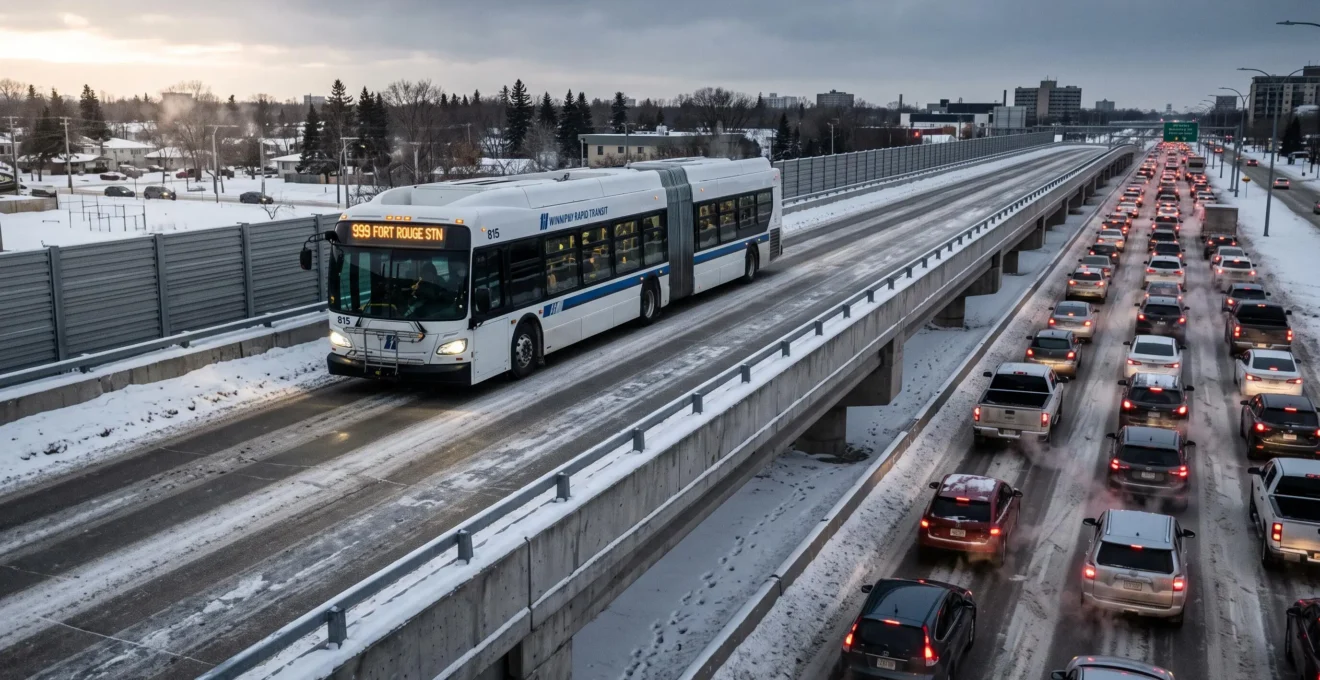
Winnipeg rapid transit corridors change how riders travel by separating important portions of bus journeys from regular traffic and connecting those faster segments to neighbourhood routes. The biggest advantage is not necessarily a higher maximum speed. It is the possibility of making everyday trips more consistent, especially when congestion would otherwise delay buses.
The Southwest Transitway demonstrates this approach. Its dedicated roadway allows buses to bypass congested sections of Pembina Highway while serving southwest Winnipeg, including the University of Manitoba. But a faster corridor does not automatically produce a faster door-to-door commute. Walking distance, service frequency, transfers and conditions outside the transitway still matter.
Winnipeg’s Primary Transit Network, launched in June 2025, makes these connections increasingly important. Riders may need to compare a familiar direct bus with a journey that combines a primary route and a feeder service. Understanding where dedicated infrastructure helps—and where the remaining journey creates delays—is the practical starting point for choosing a better trip.
Winnipeg rapid transit: what matters most for riders
- Dedicated bus corridors reduce exposure to ordinary road congestion, improving the potential for reliable travel times.
- A rapid transit journey is only as useful as its complete combination of access, waiting, riding and transfers.
- Winnipeg’s redesigned transit network makes it worthwhile to compare familiar direct routes with primary-and-feeder connections.
- Why Can Rapid Transit Corridors Make Winnipeg Trips More Reliable?
- How Can Winnipeg Riders Use Rapid Transit With Connecting Routes More Efficiently?
- Direct Bus or Rapid Transit Transfer: Which Trip Works Better in Winnipeg?
- Rapid Transit Design Mistakes That Can Limit Benefits for Winnipeg Riders
- When Does Using Winnipeg Rapid Transit Save Enough Time to Change Your Commute?
- Why Can One Winnipeg Transit Project Affect Trips Across the Wider Network?
- How Can a First-Time Rider Plan a Winnipeg Transit Trip With Transfers?
- Which Winnipeg Transit Projects Can Make Daily Travel More Reliable?
Why Can Rapid Transit Corridors Make Winnipeg Trips More Reliable?
Rapid transit corridors can make Winnipeg trips more reliable because buses travelling on dedicated infrastructure avoid many delays caused by congestion on ordinary streets. This reduces one important source of travel-time variation, particularly during busy periods. However, the advantage applies most directly to the separated portion of the journey, not automatically to every connecting route or destination.
Winnipeg’s Southwest Transitway provides a practical example. Its physically separated bus roadway bypasses several congested sections of Pembina Highway, allowing buses to operate without competing directly with general traffic along those portions of the corridor. According to Winnipeg Transit’s Southwest Transitway project information, the completed infrastructure extends approximately 11 kilometres from Downtown toward southwest neighbourhoods, including the University of Manitoba.
The original project documentation reported historical travel-time savings of four to eight minutes for Stage 1 journeys between central Downtown and the University of Manitoba, with greater savings during peak periods. It also anticipated another five to eight minutes from Stage 2, depending on the departure period. Those additional figures were planning projections, not independently verified measurements of current performance.
Reliability is also affected by service frequency. A corridor with frequent, consistent departures can reduce the consequences of missing one bus. Conversely, even a relatively fast corridor feels inconvenient when the next suitable service is a long time away. A genuine turn-up-and-go experience therefore depends on actual headways throughout the day, not infrastructure alone.
It is useful to distinguish two levels of performance:
- Corridor reliability: How consistently a bus travels along the dedicated roadway.
- Door-to-door reliability: How predictably a passenger completes walking, waiting, riding and connecting segments.
This distinction becomes particularly important during Winnipeg winters. Avoiding regular traffic queues can limit one source of unpredictable waiting in extreme cold. Nevertheless, snow, ice, vehicle problems and incidents can still disrupt dedicated infrastructure. A separated roadway is not a guarantee of uninterrupted winter operation.
For a rider whose biggest delay occurs before reaching the transitway, improving the feeder connection may matter more than additional corridor speed. Identifying the least predictable part of the complete journey is therefore the best way to understand where reliability improvements will be noticeable.
Once those sources of delay are separated, riders can begin designing journeys around the transitway’s strongest segments rather than assuming the fastest-looking bus is always the best option.
How Can Winnipeg Riders Use Rapid Transit With Connecting Routes More Efficiently?
Winnipeg riders can use rapid transit more efficiently by treating the primary corridor as the central segment of a wider journey and combining it with neighbourhood feeder routes when appropriate. The best connection is not necessarily the one with the shortest bus ride. It is the combination that minimizes total travel time, waiting uncertainty and access difficulties.
This network-based approach became particularly relevant when Winnipeg introduced its redesigned Primary Transit Network and feeder routes on June 29, 2025. The City of Winnipeg’s Primary Transit Network launch announcement explains the spine-and-feeder model: primary routes form the main network, while feeder services link neighbourhoods to those routes.
For passengers, the change encourages a different question. Instead of asking only which bus travels closest to a destination, consider whether a primary route can cover the busiest part of the journey while a shorter connection handles the remaining distance.
This can also work for trips that never enter Downtown. The usefulness of the corridor depends on the actual geography of the journey, the location of transfer points and whether travelling along the primary route provides a meaningful advantage over alternatives.
To compare alternatives, calculate the complete trip rather than looking only at the bus timetable. Include the walk to the first stop, initial wait, time aboard each bus, walking between transfer stops, connection wait and final walk. A journey with a faster main segment can still lose its advantage if the feeder service is poorly timed.
Access arrangements also influence route choices. The Southwest Transitway project documentation identifies park-and-ride facilities at Chevrier, Clarence and McGillivray, along with station features such as weather protection and bicycle storage. These facilities create additional ways to reach the corridor, although riders should verify current access arrangements and available capacity before relying on them.
One common inefficiency is continuing to use an old route simply because it is familiar. Following a major network redesign, journey planners may reveal combinations that did not previously exist or were less useful under the former timetable.
That does not mean every extra connection improves a trip. Transfer frequency and coordination determine whether the corridor functions as an effective network spine or merely adds another waiting stage.
The next decision is whether those connections offer enough benefit to justify transferring instead of remaining aboard a single bus.
Direct Bus or Rapid Transit Transfer: Which Trip Works Better in Winnipeg?
A direct bus is usually the better choice when it provides a comparable arrival time without requiring a transfer. A rapid transit journey with a connection becomes more attractive when time saved on the primary corridor exceeds the additional walking and waiting involved. The result depends on departure time, service frequency, congestion and the passenger’s comfort requirements.
A direct trip avoids the uncertainty of a second boarding. That can be particularly valuable when the connecting route runs infrequently or when a passenger has limited mobility, luggage or a difficult outdoor transfer.
However, a bus operating mainly in mixed traffic may lose time during congestion. A corridor-based journey can avoid part of that exposure, especially when the passenger reaches a suitable rapid transit service without a lengthy wait.
The following decision grid highlights the trade-offs.
| Comparison factor | Direct bus | Rapid transit plus transfer |
|---|---|---|
| Total journey time | One continuous ride may be preferable when delays are limited. | A faster corridor segment may compensate for transfer time. |
| Schedule dependency | Depends mainly on reaching one suitable departure. | Depends on the frequency and coordination of multiple services. |
| Missed-connection risk | No intermediate connection to miss. | A late first bus can increase the second-leg wait. |
| Winter comfort | Avoids an additional outdoor transfer. | Comfort depends on station shelter, exposure and waiting time. |
| Congestion exposure | May remain in mixed traffic for much of the journey. | Can avoid congestion on a dedicated transitway segment. |
| Disruption tolerance | May be simpler but remains exposed to road delays. | Can offer alternatives, but multiple legs introduce additional dependencies. |
Departure time can reverse the preferred choice. During a congested commute, avoiding regular traffic may produce substantial benefits. During a quieter period, a direct bus could arrive sooner because the traffic advantage is smaller and the transfer introduces unnecessary waiting.
Consider a purely hypothetical comparison: a direct journey takes 42 minutes, while a rapid transit alternative involves 23 minutes aboard buses, eight minutes waiting for a connection and seven minutes of additional walking. The connected journey takes 38 minutes overall, saving four minutes. These figures illustrate the calculation and are not measurements of Winnipeg Transit services.
That modest saving might be worthwhile when departures are frequent and connections comfortable. It may not justify an exposed winter transfer or a meaningful risk of missing the second bus.
For a dependable assessment, compare both journeys on several actual travel days, ideally across one or two weeks at the times normally used. Record when you leave, when you arrive, transfer waits and any unusual delays. Observed door-to-door performance is more informative than advertised in-vehicle speed alone.
If the connected option repeatedly performs poorly, the cause may lie in corridor design, stop placement or service patterns rather than in the passenger’s planning.
Rapid Transit Design Mistakes That Can Limit Benefits for Winnipeg Riders
Rapid transit corridors deliver fewer benefits when dedicated infrastructure covers too little of the journey, stations are poorly connected to destinations, buses operate infrequently or transfers require excessive walking. These design weaknesses can offset travel-time savings achieved on the corridor itself. Effective rapid transit therefore requires coordinated infrastructure, service frequency and accessible connections.
The first limitation is partial traffic separation. A bus might travel efficiently through a dedicated corridor and then encounter congestion when it returns to regular streets. If that mixed-traffic segment accounts for much of the journey, the overall reliability improvement will be limited.
This is relevant to Winnipeg because dedicated rapid transit infrastructure and rapid transit service are not identical. A route may be designated as rapid transit without operating on a physically separated roadway throughout its full length.
A second weakness is inadequate station access. A stop can be well designed for bus operations yet inconvenient for passengers if the surrounding walking routes are indirect, crossings are difficult or destinations remain far away. The same problem arises when feeder stops are separated from the primary boarding area by long or confusing pedestrian movements.
Station accessibility should be evaluated in practical terms: how easily someone can reach the correct platform, whether the route is understandable and what happens to the walking experience during snow or icy conditions.
Service design creates a third limitation. A fast route with long intervals between departures may save minutes aboard the bus while imposing a lengthy wait beforehand. Increasing corridor speeds cannot remove waiting caused by infrequent service.
Transfer arrangements present a related challenge. When connecting services are not coordinated or frequent enough, passengers can lose the time gained on the dedicated section. An especially inconvenient interchange may also discourage riders from considering the corridor in the first place.
These are general planning risks, not evidence that every Winnipeg rapid transit station or route suffers from them. The appropriate test is to examine the specific trip and identify which part of the network creates the largest obstacle.
Good corridor design consequently requires more than a separated road. It requires stations positioned near useful destinations, comfortable and legible transfers, reliable service patterns and workable pedestrian access.
For an individual commuter, the question then becomes whether the improvements available on their particular route are large and consistent enough to justify changing travel habits.
When Does Using Winnipeg Rapid Transit Save Enough Time to Change Your Commute?
Using Winnipeg rapid transit is worth changing your commute when the combined benefits of shorter travel time, greater predictability and better travel conditions outweigh any additional walking or transfers. There is no universal minimum saving. A small daily improvement can be valuable to a frequent commuter, while a longer but more dependable journey may suit someone with strict arrival requirements.
The most useful starting point is to measure the current commute from the moment you leave your origin until you reach your destination. Do the same for the proposed alternative, including every connection and walking segment.
Comparing average journey times alone is insufficient. A route that takes slightly longer on a typical day may still be preferable if it produces fewer unusually late arrivals. This distinction matters for passengers who must clock in at work, collect children at a fixed time or reach an appointment.
For example, consider a hypothetical commute that usually takes 35 minutes but occasionally requires 65 minutes. An alternative that takes approximately 40 minutes on most days might feel more dependable. This example illustrates a decision principle, not a documented Winnipeg route comparison.
Non-time benefits can also influence the choice. Avoiding parking expenses, having opportunities to read while travelling, reducing stressful driving and limiting time spent outdoors waiting in extreme cold may matter even when the measured time saving is small. Conversely, a difficult transfer can outweigh an otherwise attractive timetable.
Five steps to decide whether to switch your commute
- Record your current journey: Log departure and arrival times on several normal travel days, producing a baseline of actual door-to-door durations.
- Identify an alternative: Use a current journey planner to save a primary-route or transitway-based itinerary, including all transfer locations.
- Measure every connection: Record walking and waiting time separately, producing a complete travel-time breakdown for the alternative.
- Compare consistency: Note late arrivals and major variations over several comparable trips, producing a short reliability comparison.
- Make a practical decision: Write down the preferred route, its main advantage and a backup journey for disruptions.
Reassessment is particularly useful after a route restructuring, a service-frequency adjustment, a workplace move or repeated unexpected delays. A new infrastructure phase can also change the balance, but its benefits should be evaluated only after the relevant service is operating.
The purpose of the comparison is not to find the fastest possible journey under ideal conditions. It is to identify the trip that best fits the passenger’s normal departure times, practical constraints and tolerance for uncertainty.
Yet a change to one corridor can also affect passengers who never use it directly, because transit routes and vehicle resources operate within a connected citywide system.
Why Can One Winnipeg Transit Project Affect Trips Across the Wider Network?
One Winnipeg Transit project can affect trips across the city because bus routes, transfers, operating resources and passenger flows are interconnected. A new corridor or major network redesign may change how neighbourhood services connect to primary routes, alter direct travel options and redistribute service. Consequently, riders who never use the new infrastructure can still experience changes to their journeys.
The June 2025 Primary Transit Network launch illustrates the importance of these systemwide effects. Winnipeg moved to a structure in which primary routes serve as the network’s main connections and feeder routes provide neighbourhood access.
That change matters beyond the dedicated Southwest Transitway. A passenger who previously used a particular direct service may need to evaluate a different itinerary under the redesigned network. Another passenger may gain a more convenient connection to destinations that were previously awkward to reach.
The benefits and disadvantages can occur simultaneously. Better coordination between routes may expand travel opportunities, while an added transfer can increase inconvenience for some journeys. The existence of a redesigned network does not prove that every passenger’s journey became faster.
Changes to infrastructure may also make it possible to reorganize operating resources. For example, a more efficient primary corridor could create opportunities to adjust local service. Whether such an adjustment actually produces improved frequency depends on operational decisions, available funding and implemented timetables.
Similarly, shifting some passengers from private vehicles to transit could theoretically reduce congestion on shared roads. However, lower congestion should not be treated as a documented outcome of an individual Winnipeg project without supporting traffic measurements.
Construction introduces another type of impact. Temporary detours, relocated stops and altered pedestrian access can make trips less convenient before the intended infrastructure becomes operational. These short-term conditions should be distinguished from permanent route restructuring and the project’s eventual service pattern.
Passengers can manage the uncertainty by reviewing official route-change announcements before major implementation dates. The useful questions are straightforward: Is my usual route changing? Will the boarding location move? Is my connection still available? Does a current journey planner show a better alternative?
For riders unfamiliar with the network, the next challenge is putting those changes into practice by planning a complete trip with transfers.
How Can a First-Time Rider Plan a Winnipeg Transit Trip With Transfers?
A first-time Winnipeg Transit rider can plan a trip with transfers by checking the full itinerary in an up-to-date journey planner, confirming the correct transfer stop, allowing extra connection time and identifying a backup departure. It also helps to understand fare-transfer validity and review the physical transfer location before making a time-sensitive journey.
The City of Winnipeg identified Navigo and the Transit app as journey-planning tools when the redesigned Primary Transit Network launched. These tools provide a starting point for examining the current route combination, planned boarding locations and possible departure times.
Begin by entering the actual origin, destination and intended departure or arrival time. Review the entire proposed journey, not just the first bus. Note the route designation, direction of travel, stop location and transfer point.
At the connection, confirm which stop serves the next bus. A transfer point may have several boarding positions, and the correct route direction matters as much as the route number or name. Real-time arrival information, where available, can help assess whether the planned connection remains practical.
Fare rules are another essential consideration. According to the City of Winnipeg’s announcement on the 90-minute transfer window, transfer validity increased from 75 to 90 minutes effective October 6, 2025. Passengers paying a fare can request a transfer from the operator when boarding, and the validity period begins when the transfer is issued. The announcement states that transfers can be used on regular bus routes, including On-Request service, before expiration.
90 minutes
Transfer validity introduced on October 6, 2025, measured from the time the transfer is issued. This period does not guarantee that a connecting bus will arrive or that a particular trip can be completed within that time.
City of Winnipeg, October 2025 transfer-policy announcement.
Winter conditions deserve special attention. A station may offer weather protection without providing a heated indoor waiting area. Riders should therefore confirm the actual shelter available at their intended transfer point rather than assuming all rapid transit facilities offer the same level of comfort.
For an unfamiliar connection, a practice journey outside a time-sensitive commute can help. Locate the boarding positions, walk the transfer path and determine whether crossing a street or changing levels is necessary. This can reduce uncertainty before relying on the connection for work or school.
Finally, save an earlier or later suitable departure as a backup. A missed bus does not necessarily require abandoning the journey, but knowing the alternative beforehand makes a transfer-based itinerary easier to manage.
With those basics established, riders can evaluate which existing or proposed rapid transit developments are most likely to improve their future journeys.
Key takeaways before evaluating upcoming projects
- Check whether a project improves the segments responsible for delays on your actual journey, rather than judging it by corridor length alone.
- Separate infrastructure already operating from proposals awaiting design, funding or approval.
- Review relevant route and station changes at major implementation milestones, when they can materially affect travel choices.
Which Winnipeg Transit Projects Can Make Daily Travel More Reliable?
Winnipeg projects most likely to improve daily travel reliability are those that expand dedicated transit infrastructure, strengthen important connections and make primary routes more dependable. The Southwest Transitway already provides separated bus infrastructure, while the citywide Primary Transit Network is operating under its redesigned structure. Further dedicated corridors remain part of long-term planning rather than completed routes.
Winnipeg City Council approved the Transit Master Plan in 2021, establishing a 25-year vision for transit services and infrastructure. The City of Winnipeg’s Transit Master Plan proposes six rapid transit corridors forming three connected lines.
The distinction between existing services and dedicated infrastructure is essential. The City’s planning information identifies BLUE, FX2 and FX3 as rapid transit routes, but notes that only BLUE uses dedicated rapid transit infrastructure along part of its route. Three rapid transit services do not mean Winnipeg currently has three fully separated transitway corridors.
The Southwest Transitway was developed in stages. Stage 1 was completed in 2012, and Stage 2 opened on April 12, 2020. Together, they established the dedicated corridor linking Downtown with the southwest part of the city.
The City’s current planning framework identifies Downtown rapid transit infrastructure as the first priority for expansion. Design and engagement for Downtown corridors are identified as continuing through 2028, while construction remains subject to funding and Council approval. No confirmed construction timeline should be inferred from those planning activities.
Further expansion, including connections that would support travel across additional parts of Winnipeg, forms part of the longer-term corridor vision. However, proposed east-west connectivity and other extensions should not be described as operating dedicated transitways before construction and service implementation are confirmed.
The city also identifies continued Primary Transit Network infrastructure work, service adjustments and potential frequency improvements as components of ongoing development, subject to the relevant resources and approvals.
For passengers, the important distinction is between three kinds of improvement: a service change that affects today’s timetable, dedicated infrastructure that is already operational, and a proposed development that may influence future travel.
A useful project assessment starts with three questions. Does the planned corridor serve an important portion of the journey? Will local routes connect conveniently to it? Are the proposed stations close enough to everyday destinations to justify the added access time?
Tracking only the one or two developments that could materially affect a regular commute is usually more useful than following every project announcement. Official milestone updates, route maps and journey-planning information provide the practical details needed when changes are implemented.
Before changing a regular journey, check the current Winnipeg Transit route planner, identify which corridor sections are in service and compare the full trip—including any feeder connection—with the existing alternative.
Does every Winnipeg rapid transit route use a dedicated busway?
No. The City’s Transit Master Plan identifies BLUE, FX2 and FX3 as rapid transit routes, but specifies that only BLUE uses dedicated rapid transit infrastructure along part of its route. Other rapid transit services should not be assumed to operate on separated roadways throughout their journeys.
Can rapid transit eliminate delays caused by Winnipeg winter weather?
No. Dedicated infrastructure can reduce delays associated with ordinary road congestion, but snow, ice, operational incidents and problems on connecting routes can still affect service. Winter travel reliability depends on the complete journey, not just the transitway segment.
Do all rapid transit stations in Winnipeg provide heated waiting areas?
Heated waiting areas should not be assumed at every station. Southwest Transitway project documentation identifies weather-protection features, but this does not establish that every station offers heated indoor accommodation. Check the facilities at the specific stop or transfer location before travelling.
Is the 90-minute Winnipeg Transit transfer period a guaranteed connection time?
No. The 90-minute period introduced in October 2025 describes how long an issued transfer remains valid. It does not guarantee a bus connection, reserve a seat or establish that an entire journey must be completed within 90 minutes. Actual connecting-service schedules still need to be checked.
Will all six proposed Winnipeg rapid transit corridors be completed on a confirmed schedule?
No confirmed completion schedule applies to the entire proposed six-corridor network. The Transit Master Plan presents a long-term development vision, with expansion dependent on design, funding and municipal approvals. Riders should distinguish approved or operational infrastructure from projects that remain in planning.