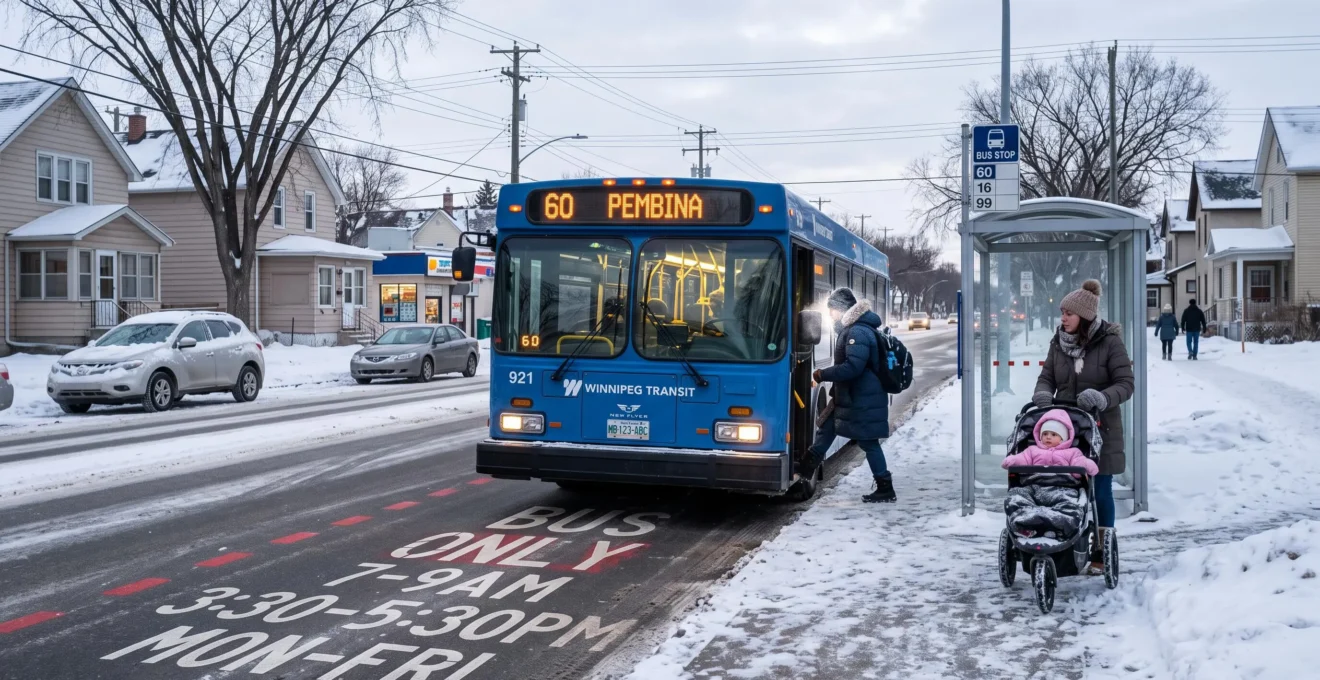
A transit investment can shorten a bus journey without making the entire trip more dependable. For Winnipeg riders, the meaningful test is whether buses arrive predictably, transfers work and services remain useful during winter, evenings and weekends.
Winnipeg’s Transit Master Plan provides a framework for these improvements. Approved in 2021, it outlines a 25-year vision combining a redesigned bus network with longer-term rapid transit infrastructure. The Primary Transit Network launched in 2025, while further infrastructure and service improvements remain subject to implementation schedules, funding and municipal approvals.
The strongest opportunities include dedicated transit corridors, effective connections between primary and feeder routes, more dependable frequencies and accessible transfer facilities. Yet their benefits differ by neighbourhood and travel pattern. A faster downtown corridor may help one passenger while an additional transfer makes another passenger’s journey less convenient.
Understanding these differences makes it easier to assess which Winnipeg transit projects are likely to improve actual daily mobility rather than simply produce impressive infrastructure.
What Winnipeg riders should know
- Network design matters: Changes to major corridors can affect connecting routes, transfers and journeys far beyond the construction area.
- Reliability requires more than infrastructure: Service frequency, signal priority, winter maintenance and accessible connections determine whether investments improve daily trips.
- Project status matters: Winnipeg’s redesigned primary network is operating, but proposed downtown rapid transit infrastructure still requires further approvals and construction funding.
- Why Can One Winnipeg Transit Project Affect Trips Across the Wider Network?
- How Can You Judge Whether a Winnipeg Transit Project Will Improve Your Trip?
- Faster Trips or Better Coverage: Which Transit Improvement Helps Winnipeg Riders More?
- Transit Project Design Mistakes That Can Limit Benefits for Winnipeg Riders
- When Do Winnipeg Transit Projects Start Improving the Rider Experience?
- Why Does Reliability Matter More Than Speed for Many Winnipeg Transit Riders?
- Rapid Transit Design Mistakes That Can Limit Benefits for Winnipeg Riders
- How Can Winnipeg’s Public Transit System Better Serve Everyday Trips?
Why Can One Winnipeg Transit Project Affect Trips Across the Wider Network?
One Winnipeg transit project can change journeys throughout the network because bus routes, passenger connections and operating schedules depend on one another. Introducing a rapid transit corridor may require feeder routes to be reorganized, transfer locations to change and service capacity to be redistributed. Even riders who never board the new line can experience different journey times.
A rapid transit corridor is not simply an isolated stretch of faster roadway. It becomes part of a wider system connecting residential neighbourhoods, employment areas, institutions and existing routes. When buses are redirected toward a high-capacity corridor, some passengers gain more dependable connections while others may lose a convenient direct service.
Winnipeg’s Southwest Transitway illustrates this network effect. When the BLUE rapid transit line entered service in April 2020, the municipality simultaneously introduced community feeder routes and modified existing services. The corridor connected downtown Winnipeg with the University of Manitoba and St. Norbert, while neighbourhood routes linked surrounding areas to the rapid transit service.
Real example: Southwest Transitway restructuring
The April 2020 changes introduced feeder routes serving neighbourhoods including Linden Woods, Bridgwater and Waverley Heights. Existing routes such as 23, 29, 47, 60 and 65 were also identified for modification.
The City of Winnipeg’s April 2020 Southwest Transitway service announcement documents the coordinated implementation. It establishes that surrounding routes changed, but does not demonstrate that every passenger experienced a shorter or more reliable journey.
Reliability can also propagate across connecting services. A bus delayed in mixed traffic may cause passengers to miss a subsequent departure. That missed connection can have a greater impact on total travel time than the original delay, particularly when the next bus operates infrequently.
Dedicated lanes and traffic signal priority can reduce exposure to these delays. Their benefits are greatest when connecting services are also dependable and passengers have enough time to transfer.
However, a spine-and-feeder design introduces trade-offs. Replacing a long direct route with a connection to a frequent trunk service may improve network efficiency without improving every individual journey. Riders must consider walking distances, waiting time and the number of transfers required.
For Winnipeg residents, the central question is whether the complete journey becomes more dependable. That requires examining both the upgraded service and every connection supporting it.
How Can You Judge Whether a Winnipeg Transit Project Will Improve Your Trip?
Judge a Winnipeg transit project by comparing your complete journey before and after the proposed changes. Include walking, waiting, transfers and time spent aboard buses, rather than concentrating on advertised vehicle speed. A meaningful improvement should make your regular trip shorter, more predictable, easier to complete or some combination of these outcomes.
Start with the journeys you actually make. A route improvement between downtown and a major destination may have little practical value if your regular trip runs between two suburban neighbourhoods.
Record the origin, destination, travel direction and approximate departure time for each recurring journey. Include weekday peak periods, evenings and weekends where relevant, since a service improvement operating only during commuter hours may not help someone travelling outside those periods.
The next step is to compare door-to-door travel time. A useful measurement includes:
- Walking time from the starting point to the first stop.
- Waiting time before the first bus arrives.
- Time spent travelling on each service.
- Walking and waiting required during transfers.
- Final walking time from the last stop to the destination.
Consider an explicitly hypothetical comparison. An existing direct service takes 45 minutes door to door. A proposed rapid transit connection reduces time aboard buses but adds a transfer and a longer walk, producing a 48-minute total journey. The new service is faster on its main corridor, yet the individual trip has become longer.
Reliability deserves a separate comparison. A journey that usually takes 40 minutes but regularly requires extra contingency time may be less convenient than a slightly longer journey with predictable arrivals.
Project design can provide useful clues. Dedicated rights-of-way reduce exposure to general congestion. Traffic signal priority can limit intersection delays. Frequent, all-day service reduces the consequences of missing a departure. New shelters or improved signage can enhance comfort and accessibility without necessarily reducing travel-time variability.
For route-level details, consult the Primary Transit Network Service Implementation Plan. It describes the city’s approach to primary and feeder services, transfer locations and accessibility. Because that document reflects pre-launch planning, current schedules are necessary to establish what actually operates.
Five steps to evaluate a Winnipeg transit project
- Document your regular journey: Write down your origin, destination, travel days and usual departure time. Deliverable: a trip profile.
- Record existing conditions: Note total travel time, walking distance, waiting periods and transfers over several comparable trips. Deliverable: a baseline journey log.
- Examine the proposed network: Compare route alignments, stop locations and expected service periods using official planning information. Deliverable: a before-and-after route comparison.
- Identify reliability risks: Mark connections involving long waits, congested corridors or difficult winter walking conditions. Deliverable: a list of potential delay points.
- Verify operating arrangements: Check published schedules and confirmed service changes rather than relying solely on project illustrations. Deliverable: an evidence-based assessment of whether your journey improves.
Any comparison should identify which details are confirmed and which remain proposals. An infrastructure announcement alone cannot establish the frequency or dependability of future service.
Faster Trips or Better Coverage: Which Transit Improvement Helps Winnipeg Riders More?
Faster, more frequent service generally offers the greatest benefit to riders already travelling along established transit corridors, while expanded coverage matters most to residents whose destinations are poorly served. Winnipeg needs both, but the balance depends on passenger demand, neighbourhood development and available operating resources. Increasing geographic coverage without adding enough service capacity can create longer waits.
The distinction is important because different transit improvements solve different problems. A dedicated lane helps buses avoid congestion on an existing route. A new feeder service can bring previously difficult-to-reach areas into the network. Neither intervention automatically solves the other problem.
For residents using busy corridors, consistent frequency may be especially valuable. Shorter scheduled intervals reduce the amount of time passengers spend waiting and make transfers less dependent on a single departure.
In developing neighbourhoods such as Bridgwater, the immediate priority may instead be reaching useful destinations without excessive walking or complicated connections. Additional coverage can make transit a practical option even when it does not deliver rapid journey times.
Winnipeg’s climate further complicates the choice. During severe winter weather, a long wait at an exposed stop carries a substantial comfort burden. Frequent service, protected waiting areas and dependable arrival times become especially important.
The principal trade-offs can be summarized as follows:
| Decision factor | Speed and frequency improvements | Coverage expansion |
|---|---|---|
| Primary objective | Improve service on established travel corridors | Connect additional neighbourhoods and destinations |
| Likely beneficiaries | Existing riders on busy routes | Residents facing limited transit access |
| Main passenger benefit | Reduced waiting and more dependable travel | More places accessible by public transit |
| Principal risk | Areas outside upgraded corridors remain underserved | Resources spread too thinly across additional routes |
| Critical operating requirement | Enough buses and drivers to sustain frequency | Enough service to make new connections genuinely usable |
Operating budgets determine how far improvements can extend. If the same fleet and staffing resources must serve additional routes, spreading service over a wider area can reduce the frequency available on existing lines. Conversely, concentrating resources exclusively on high-demand corridors can leave some communities without adequate access.
A balanced approach prioritizes frequent trunk services where demand supports them, alongside feeder connections that provide reasonable access to the network. Local geography, pedestrian access and travel patterns should influence each decision.
For individual riders, the most useful investment is the one that removes their main barrier to travelling: excessive waiting, unreliable connections, slow movement through traffic or the absence of a practical route.
Transit Project Design Mistakes That Can Limit Benefits for Winnipeg Riders
Transit projects can deliver disappointing results when physical infrastructure, operating schedules and passenger access are designed separately. A dedicated corridor with infrequent buses may leave waiting times unchanged, while an efficient route with inconvenient transfers can make complete journeys harder. In Winnipeg, winter accessibility and off-peak service are especially important parts of successful project design.
The first common mistake is treating infrastructure as a substitute for service frequency. Dedicated lanes can make buses faster and less vulnerable to traffic delays, but passengers receive limited benefits if departures are too widely spaced for their needs.
Another problem is optimizing a network almost entirely around the morning commute into downtown. Transit also supports shopping, education, medical appointments, evening employment and cross-town journeys. A corridor designed exclusively for one direction or time period may overlook these everyday needs.
Transfer design presents a further challenge. Winnipeg’s primary network relies on connections between major routes and neighbourhood services. These connections must work in practice, not merely appear close together on a map.
A transfer may be difficult when connecting stops are separated by a wide intersection, pedestrian crossings are poorly positioned or passengers must walk along uncleared winter pathways. Travellers with mobility limitations, strollers or heavy bags may face additional obstacles.
The Primary Transit Network implementation documentation explicitly identified opportunities to position bus stops closer to pedestrian crossings and improve accessibility at interchange points. These considerations are essential because the practical usefulness of a redesigned network depends on how comfortably passengers can complete transfers.
First- and last-mile access also affects potential ridership. A station may serve a large geographic area on paper, yet attract fewer passengers if walking routes are indirect, crossings are inconvenient or winter maintenance is inadequate.
Projects should therefore consider the entire route between a passenger’s doorstep and the boarding platform. Accessible sidewalks, understandable wayfinding, comfortable shelters and dependable connecting buses contribute directly to the passenger experience.
Finally, service plans should account for the operating resources needed after construction. Without enough vehicles, drivers and maintenance capacity, the expected benefits of improved infrastructure may not be fully realized.
Good transit infrastructure creates an opportunity for better service. Its lasting value depends on whether the whole network can use that opportunity effectively.
When Do Winnipeg Transit Projects Start Improving the Rider Experience?
Winnipeg transit projects begin improving passenger journeys when infrastructure, operating services and connecting routes work together, not necessarily when construction finishes. Planning, consultation and construction can take years, and some projects initially disrupt existing trips. Benefits may emerge gradually as schedules change, transfers improve and the wider network adapts to new facilities.
Most major transit investments move through several distinct stages: planning, design, municipal approval, funding, construction, testing and service implementation. Each stage may affect passengers differently.
During construction, temporary detours, closed stops and traffic restrictions can make existing services less convenient. Once facilities open, passengers may still need time to understand new routes and connections. Further service adjustments may follow as operating conditions become clearer.
This can create a temporary decline followed by gradual improvement rather than an immediate, uniform benefit. Such a pattern is possible, not inevitable, and its extent depends on how construction and service changes are managed.
Winnipeg’s Transit Master Plan provides useful checkpoints for understanding the difference between completed, ongoing and proposed changes.
2025
The year Winnipeg’s Primary Transit Network launched. Its introduction marked a major service-network change, not completion of every planned infrastructure improvement.
City of Winnipeg, Transit Master Plan implementation information.
Primary Transit Network infrastructure improvements are scheduled to continue through 2027. Separately, the proposed downtown rapid transit corridors remain at an earlier project stage.
According to the City of Winnipeg’s Rapid Transit – Downtown project page, preliminary design and engagement are planned through 2028, with a preliminary design and construction cost estimate targeted for summer 2028.
That milestone must not be confused with an opening date. The city’s project documentation identifies a 7 $ million preliminary design budget but states that construction funding has not been secured. Detailed construction and passenger-service timelines therefore remain undetermined.
The distinction matters when comparing project announcements. A confirmed route implementation can be evaluated through published schedules. A corridor still undergoing preliminary design can only be assessed through its intended configuration, unresolved alternatives and funding conditions.
Passengers can track progress through municipal project updates, City Council decisions, capital budget documents and official service announcements. These records help establish whether promised benefits have advanced from planning to operational reality.
Early ridership or travel-time observations should also be interpreted carefully. An infrastructure phase may be operating before all associated feeder connections, service frequencies or network adjustments are in place.
For riders, the most meaningful milestone is not the publication of a construction schedule but the point when a regular journey becomes consistently easier to complete.
Why Does Reliability Matter More Than Speed for Many Winnipeg Transit Riders?
Reliability often matters more than average speed because passengers must plan around uncertainty. A journey that consistently takes 40 minutes can be easier to manage than one averaging 30 minutes but occasionally requiring 50. In Winnipeg, winter conditions, mixed-traffic congestion and transfer delays can make predictable arrival times especially valuable.
Average travel time and travel-time variability describe different aspects of performance. Average time indicates the typical duration across a set of journeys. Variability indicates how much individual trips differ from that average.
Passengers are affected by both, but unpredictability creates additional planning costs. Someone who cannot risk arriving late for work may leave substantially earlier than the timetable suggests. A caregiver coordinating school pickup or a worker changing shifts may face similar constraints.
For example, consider two hypothetical transit options:
| Measure | Option A | Option B |
|---|---|---|
| Average journey time | 30 minutes | 40 minutes |
| Illustrative journey range | 25–50 minutes | 38–42 minutes |
| Planning challenge | Allow considerable contingency time | Plan around a narrower arrival window |
| Potential rider preference | Suitable when flexibility is high | Useful when arrival time is critical |
These figures are illustrative rather than measurements of actual Winnipeg Transit routes. They demonstrate why a faster average journey is not automatically the more dependable choice.
Winnipeg’s seasonal conditions reinforce the importance of consistency. Snow accumulation, difficult road surfaces and traffic incidents can affect buses operating in general traffic. When congestion or adverse conditions produce delays, passengers connecting to another route may experience consequences beyond the delayed segment.
Reliable transfers are therefore a significant part of network performance. A modest improvement in the punctuality of a frequent trunk route can make a connecting service more useful, provided its timetable and walking arrangements support the connection.
Dedicated transit lanes reduce some exposure to ordinary traffic congestion. Signal priority can make intersection passage more consistent. Boarding arrangements and active schedule monitoring can also contribute to more dependable operations when they are appropriate to the service design.
However, their actual effectiveness depends on implementation and operating conditions. Without route-specific performance data, it would be inappropriate to assign a precise reliability improvement or claim that a particular measure always offers the greatest return on investment.
Riders evaluating projects should therefore ask whether they reduce unusually long journeys, missed connections and the need for extra departure-time buffers, rather than simply comparing advertised maximum speeds.
A network becomes more useful when passengers can trust their arrival time, especially for trips that cannot easily be postponed or rescheduled.
Rapid Transit Design Mistakes That Can Limit Benefits for Winnipeg Riders
Rapid transit investments can underperform when corridor alignment, station spacing or future expansion needs are poorly matched to actual travel demand. A new line may offer impressive infrastructure yet bypass congested destinations, create inconvenient transfers or prove difficult to extend. Because these facilities can shape the network for decades, early design decisions have lasting consequences.
The first major decision is where the rapid transit corridor should run. Building dedicated infrastructure where existing buses already move relatively freely may provide smaller travel-time benefits than investing in a corridor where congestion causes persistent delays.
Corridor selection also influences which neighbourhoods receive convenient service. A fast route serving destinations that require difficult feeder connections may deliver less door-to-door benefit than its operating speed suggests.
Station spacing introduces another trade-off. Closely spaced stations improve local access but require additional stopping time. Widely separated stations can support faster movement while increasing walking distances and dependence on feeder services.
Winnipeg’s Primary Transit Network planning distinguishes service types partly through stop spacing. Its published design parameters included minimum spacing of 700 metres for Rapid and Frequent Express lines, 350 metres for Frequent lines and 200 metres for Direct, Community and Connector services. These are planning parameters, not confirmation that every operating stop follows those distances.
A rapid transit corridor should also accommodate future network development. Stations, interchange points and reserved rights-of-way need to be considered alongside potential neighbourhood growth and route extensions.
Otherwise, decisions made during initial construction may make future improvements more difficult or expensive.
The choice between bus rapid transit and rail presents a related strategic question. Bus rapid transit allows vehicles to use dedicated sections and continue onto ordinary streets, offering network flexibility. Rail can provide different capacity and operational characteristics, but the appropriate choice depends on demand, costs, engineering conditions and long-term objectives.
Winnipeg’s proposed downtown rapid transit project illustrates the importance of preserving options. The municipal design process considers dedicated on-street transit facilities on parts of Main Street and Portage Avenue, an elevated transit-only connection between Harkness Station and Portage Avenue, and Union Station as a central hub.
The project is also being designed with the possibility of future conversion to light rail. This does not mean a conversion has been approved or scheduled.
Construction funding remains unsecured, and preliminary design has not settled every alignment or station arrangement. Consequently, the project should be discussed as a proposal under development rather than a completed reliability improvement.
The best corridor is not necessarily the most visually prominent or technically elaborate. Its value depends on serving real travel demand, supporting workable transfers and allowing the network to evolve.
Key takeaways for assessing Winnipeg transit investment
- Assess complete journeys rather than isolated corridors: reliable feeder connections and accessible stations determine whether a project benefits everyday travel.
- Separate committed service improvements from proposed infrastructure: planning milestones and construction funding have different implications for passengers.
- Give sustained operations the same attention as capital investment: even well-designed facilities need adequate buses, drivers and service frequency.
How Can Winnipeg’s Public Transit System Better Serve Everyday Trips?
Winnipeg’s public transit system can better serve everyday travel by combining dependable all-day primary routes with accessible neighbourhood connections, comfortable transfer facilities and service hours that reflect diverse schedules. Rapid transit infrastructure can support those improvements, but consistent operating funding and practical network integration are equally necessary to make ordinary journeys more reliable.
Effective public transit must serve more than the traditional commute into downtown. Residents also travel between neighbourhoods for education, shopping, healthcare, recreation and employment at different times of day.
Improving these journeys requires a network that offers understandable routes and reasonable connections in both directions. Primary services should provide a dependable foundation, while feeder routes allow passengers to reach destinations outside major corridors.
Winnipeg’s redesigned network represents an important structural step toward that model. The City of Winnipeg’s Transit Master Plan describes a system built around primary lines supported by neighbourhood connections, with further frequency, service-hour and route improvements dependent on funding and Council approval.
That distinction between network design and actual service delivery is crucial. A route can be well positioned geographically while remaining impractical if buses operate too infrequently or stop running before passengers finish work.
Winter-resilient infrastructure should also be treated as a core part of service quality. Accessible platforms, properly maintained walking connections, shelters and clear passenger information can determine whether a transfer is manageable during severe weather.
For many riders, relatively modest operational changes may produce meaningful benefits alongside larger capital projects. Examples include adjusting schedules to support dependable connections, targeting recurrent delay locations and improving access between stops.
These measures should be evaluated using observed passenger outcomes rather than assuming that every operational adjustment will work equally well.
Sustained funding is central to the process. Capital budgets can pay for corridors and stations, but ongoing transit service requires vehicles, drivers, maintenance and operational capacity. Without those resources, new infrastructure may not deliver the intended frequency or consistency.
Residents reviewing proposals can ask three practical questions: Which recurring journeys improve? What operating service will support the infrastructure? How will passenger outcomes be measured after implementation?
Useful performance measures include actual door-to-door travel times, schedule adherence, missed connections, service availability and accessibility at transfer locations. Comparing results across different neighbourhoods and travel periods can reveal whether improvements are broadly useful or concentrated in a limited set of journeys.
The City of Winnipeg‘s Transit Master Plan establishes the long-term planning context, including proposed rapid transit corridors and staged network development. It does not, by itself, establish that the planned investments have achieved quantified reliability gains.
Choose one journey you make regularly, document its present travel time and transfer difficulties, then compare that baseline with confirmed future schedules and completed improvements. The most successful Winnipeg transit projects will ultimately be those that make daily journeys not merely faster in ideal conditions, but consistently easier to plan and complete.
Is Winnipeg’s new Primary Transit Network already operating?
Yes. Winnipeg’s Primary Transit Network launched in 2025. However, the launch of the redesigned route network does not mean every planned transit infrastructure improvement is complete. Additional upgrades, service refinements and extensions are separate implementation steps, some of which depend on municipal approvals and funding.
Does Winnipeg have a confirmed opening date for new downtown rapid transit infrastructure?
No confirmed passenger-service opening date is established in the supplied municipal project documentation. Preliminary design and engagement are planned through 2028, while construction funding has not been secured. The summer 2028 target concerns preliminary design and cost estimation, not completion of the rapid transit corridor.
Can a new rapid transit line make some passengers’ trips longer?
Yes. A redesigned network may replace certain direct routes with feeder connections to a rapid transit service. Although buses may travel faster along the main corridor, extra walking, waiting or transferring can increase total journey time for particular origin-destination pairs. Outcomes must be assessed individually rather than assumed to improve universally.
Which transit improvements are most useful during Winnipeg winters?
Dependable service frequency, protected waiting areas, accessible and maintained pedestrian connections, and measures that reduce congestion-related delays can be especially useful in winter. Their relative importance depends on the journey and the passenger’s needs. Faster buses provide limited practical benefits if reaching the stop or making a connection remains difficult.
How can residents tell whether a transit improvement has actually worked?
Compare consistent before-and-after measures, including complete journey duration, waiting time, missed transfers and travel-time variability. Use current published schedules alongside observations from comparable travel days and periods. Planning documents establish intended outcomes, but evidence of actual improvement requires operational performance or observed journey data.