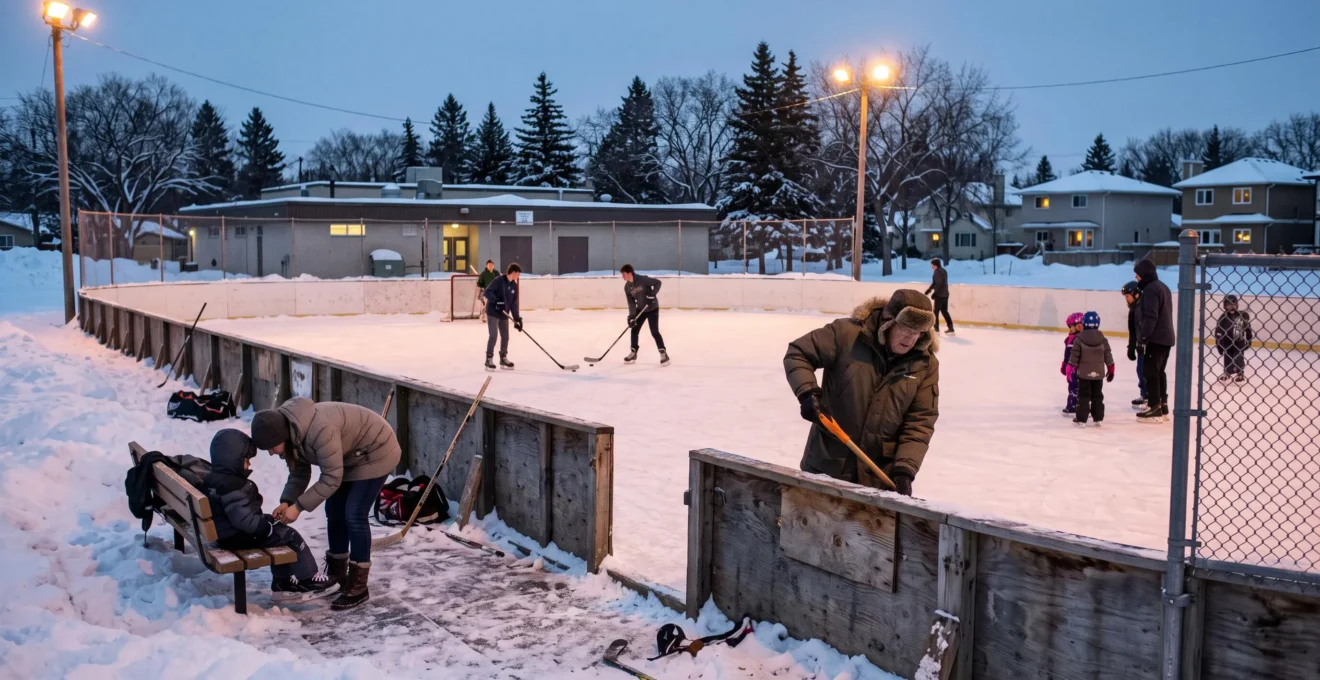
A neighbourhood hockey game, a Saturday soccer practice, or an evening spent maintaining an outdoor rink can do more than bring people together for recreation. In Winnipeg, these activities create recurring opportunities for residents to meet, develop trust, share responsibilities, and contribute to local institutions.
That connection matters because Winnipeg’s community sports system relies heavily on neighbourhood participation. The city has 63 independent community centres operating 81 recreation facilities, with volunteer boards responsible for much of their management. Their continued operation depends on people contributing time, skills, and local knowledge.
Community sport does not automatically produce stronger neighbourhoods. Programs must be accessible, welcoming, enjoyable, and sustainable. When those conditions are present, playing, coaching, volunteering, and organizing recreation can help transform everyday encounters into longer-lasting community relationships.
Understanding how these connections develop also helps residents decide where their involvement can make the greatest difference.
How community sports support Winnipeg neighbourhoods
- Regular participation builds familiarity: Shared practices, games, and recreation activities give neighbours opportunities to develop relationships over time.
- Volunteers sustain local institutions: Coaching, administration, facility upkeep, and board service help community programs continue across seasons.
- Access and enjoyment determine inclusion: Affordable, welcoming programs with manageable commitments are better positioned to retain participants and attract new contributors.
- Why Can Local Sports Build Stronger Community Connections in Winnipeg?
- How Can Winnipeg Residents Get Involved in Community Sports Without Joining a Team?
- Playing, Coaching, or Volunteering: Which Community Sports Role Fits You?
- Participation Barriers That Can Weaken Winnipeg Community Sports Programs
- When Should Winnipeg Sports Programs Recruit New Community Volunteers?
- Why Does Enjoyment Matter So Much in Winnipeg Youth Sports?
- How Can You Compare Winnipeg Recreation Facilities Before Choosing One?
- Which Winnipeg Sports and Recreation Facilities Best Fit Your Activity Needs?
Why Can Local Sports Build Stronger Community Connections in Winnipeg?
Local sports can strengthen Winnipeg neighbourhood connections because they bring the same residents together repeatedly in familiar places. Regular practices, recreational games, and community centre activities provide opportunities for conversations, mutual assistance, and shared responsibilities. Over time, these interactions can help neighbours establish relationships that extend beyond the rink, field, or gymnasium.
Repeated contact matters more than a single sporting event. At a weekly hockey practice, parents may begin by exchanging greetings, then coordinate transportation, share equipment information, or help organize a fundraiser. Adult recreational leagues can similarly bring residents together who might otherwise have little reason to interact.
Geographic proximity strengthens this possibility. When participants live near the same facility, the people they meet during recreation may also be the people they encounter at schools, shops, neighbourhood events, and public meetings.
Winnipeg’s community centre model provides a particularly important setting for these relationships. According to the City of Winnipeg information on Community Centres, volunteer boards oversee responsibilities that include programs, staffing, facility operations, fundraising, and budgets.
63 community centres · 81 recreation facilities
The City of Winnipeg identifies 63 independent community centres operating 81 recreation facilities. Volunteer boards help manage the institutions supporting neighbourhood recreation.
City of Winnipeg, Community Centres.
These centres are therefore more than places to play. Their meeting rooms, shared spaces, programs, and volunteer committees can create opportunities for wider community participation. That does not establish that every centre serves every civic function, but it shows how recreation facilities can support neighbourhood organization beyond individual sports.
Winnipeg’s long winters add another dimension. Outdoor hockey rinks, curling activities, and indoor recreation can provide recurring social routines during months when casual outdoor gatherings are less comfortable. The relationships formed during a winter program may continue into spring activities and neighbourhood projects.
Research supports the potential connection, with important limitations. A scoping review of sport and social cohesion examined 40 studies and reported broad support for a positive relationship between sport participation and social cohesion. However, the researchers also identified inconsistencies in how cohesion was defined and measured. The findings should not be interpreted as proof that any individual Winnipeg program causes stronger neighbourhood relationships.
There is also a risk of exclusion. A league that recruits only through existing friendships may build strong internal relationships while remaining difficult for newcomers to enter. Open invitations, accessible registration information, and welcoming activities are necessary if those benefits are to reach the wider neighbourhood.
Building those connections does not require everyone to become an athlete. Many of the relationships that sustain Winnipeg’s recreation system begin with volunteering and other contributions away from the playing surface.
How Can Winnipeg Residents Get Involved in Community Sports Without Joining a Team?
Winnipeg residents can contribute to community sports without joining a team by helping with events, maintaining facilities, handling administration, supporting coaches, or serving on community centre boards. The simplest starting point is usually to contact a nearby community centre, explain the skills and time available, and ask which activities need assistance during the current season.
Because community centres operate through independent local organizations, volunteer opportunities are often coordinated directly by individual centres or associated sports programs rather than through one citywide recruitment office.
Potential roles include scorekeeping, tournament registration, canteen shifts, fundraising, equipment coordination, refereeing, and transportation coordination. Hockey and soccer programs may also need help communicating schedules and organizing seasonal registration.
Specialist skills can be just as useful as sporting experience. A resident comfortable with bookkeeping might help a volunteer treasurer. Someone experienced in communications could update program notices or registration instructions. Others may contribute grant-writing, maintenance, or event-planning skills.
These roles can be particularly suitable for adults who want to support recreation but have no interest in coaching or competitive sports.
Seasonal participation is another practical option. Winnipeg’s outdoor rinks may need maintenance support during suitable winter conditions, while tournaments and fundraising events can create short-term opportunities. City leisure facilities may also have program-support opportunities, although their staffing and volunteer arrangements should be checked separately from those of independent community centres.
Timing an offer can make it more useful. A centre preparing fall registration may need administrative support, while a winter sports program may need game-day volunteers or facility assistance. Spring maintenance and end-of-season events can create different openings.
These are planning examples rather than a universal schedule. Each centre and sport may operate on a different calendar.
A practical first contact should identify a specific contribution: availability for two tournament shifts, help preparing registration materials, or support with a defined maintenance task. Asking about immediate needs helps avoid offering assistance that the organization cannot currently coordinate.
A limited commitment also provides an opportunity to learn how the organization operates before accepting additional responsibilities. That experience can help residents choose between playing, coaching, volunteering, or combining several roles.
Playing, Coaching, or Volunteering: Which Community Sports Role Fits You?
Playing is usually the best fit for residents seeking exercise and peer relationships, coaching suits those interested in supporting athlete development, and volunteering fits people who prefer organizational or practical contributions. The right choice depends on available time, physical ability, preferred responsibilities, and whether the resident wants to participate directly or help others participate.
Each role strengthens neighbourhood recreation differently. Players support leagues through participation and develop relationships with teammates. Coaches help create safe, supportive learning environments. Volunteers and board members maintain the administrative structures that allow programs to operate across seasons.
Before committing, compare the roles using practical criteria. The following estimates are illustrative planning ranges, not documented Winnipeg-wide averages; actual requirements vary by organization, sport, and season.
| Criteria | Playing | Coaching | Volunteering |
|---|---|---|---|
| Illustrative weekly commitment | 1–3 hours | 3–6 hours including preparation | 1–4 hours, potentially more for board positions |
| Typical commitment period | League season or drop-in sessions | Usually a full team season | Single event, seasonal assignment, or continuing role |
| Training and requirements | Activity rules and registration requirements | Sport-specific training, screening, and possible certification | Role-specific orientation, with screening where applicable |
| Physical demands | Depends on the activity and participation level | Usually moderate, depending on coaching duties | Ranges from desk work to physical maintenance |
| Community contribution | Peer relationships and sustained participation | Youth development and supportive team culture | Program continuity, access, and facility operations |
Coaching deserves particular consideration because it combines sport knowledge with responsibility for participants’ experiences and well-being. Requirements vary by sport and level. Residents considering this path can consult Sport Manitoba’s National Coaching Certification Program for information about recognized training and available workshops.
Some NCCP training can be completed online or through short workshops, but individual leagues may have additional requirements. Prospective coaches should confirm expectations before accepting a position.
Combining roles can broaden community involvement. Someone might play in an adult recreational league while occasionally helping with fundraising or sitting on a community centre committee. Such combinations connect personal recreation with the work required to support other participants.
However, greater involvement is not always better. Accepting a head-coaching position or significant board responsibility during registration season without understanding the full workload can create problems later.
A gradual approach is often more sustainable: help at an event, become an assistant coach, observe a committee meeting, or support a defined administrative project before taking responsibility for an entire program.
The available evidence does not establish that governance vacancies are universally harder to fill than player positions. Nevertheless, Winnipeg’s volunteer-led community centre structure makes administrative continuity an important concern regardless of roster sizes.
Even well-matched volunteers and enthusiastic players cannot sustain neighbourhood programs if significant parts of the community face barriers to getting involved.
Participation Barriers That Can Weaken Winnipeg Community Sports Programs
Community sports programs become less inclusive and potentially less sustainable when cost, transportation, facility access, cultural barriers, or volunteer shortages prevent residents from participating. In Winnipeg, these challenges can affect neighbourhoods differently because facilities are geographically dispersed, winter conditions influence travel, and programs depend on varying combinations of registration revenue and volunteer support.
Registration and equipment costs are two distinct obstacles. A family may manage a program fee but struggle to obtain skates, protective equipment, or other sport-specific supplies. Conversely, a household with access to second-hand equipment may still find league registration unaffordable.
Subsidized registration, equipment-sharing arrangements, and no-cost recreational opportunities can help reduce these barriers where available. Families should confirm which assistance options exist for their particular program rather than assume every facility offers the same support.
Transportation creates another challenge in a spread-out city. A program may be geographically close but difficult to reach without a vehicle, particularly when practices finish late or transit connections are inconvenient.
Winter conditions can compound this problem through weather-related delays, reduced comfort at outdoor facilities, and additional travel preparation. Accessibility should therefore be assessed using the actual journey and seasonal schedule, not distance alone.
Language and cultural fit also affect participation. Newcomer families may be unfamiliar with local registration systems or expectations around parent volunteering. Indigenous families and other groups may encounter programs that do not sufficiently reflect their communities or address their practical concerns.
Clear communication, meaningful outreach, and opportunities for families to provide feedback can make programs easier to navigate. Inclusive engagement requires listening to residents rather than assuming their needs are identical.
These barriers may also reinforce one another. If participation becomes concentrated among families with greater resources and flexibility, a program can lose opportunities to recruit participants, organizers, and volunteers from across its neighbourhood. Over time, that concentration may weaken its community reach.
A less visible risk is dependence on a small number of volunteers. A team may have enough interested children yet still struggle to operate if nobody can coordinate registration, coaching, scheduling, or facility access.
Five actions to assess your community sports program
- Review participation costs: Record registration fees, equipment expectations, and any confirmed subsidy options in a one-page cost summary.
- Test practical access: Check an actual route at program time and create a short travel-access note covering transit, parking, and winter conditions.
- Assess communications: Review registration instructions and newcomer information, then produce a list of unclear steps or missing guidance.
- Map volunteer responsibilities: Identify who manages coaching, scheduling, finances, and registration, producing a simple responsibility chart.
- Gather participant feedback: Ask families and prospective participants about obstacles, including those who have stopped attending, and summarize recurring concerns in an action log.
The purpose of this assessment is not to label a centre as successful or unsuccessful. It is to identify barriers early enough for organizers to discuss realistic improvements before participation or volunteer capacity deteriorates.
Many improvements require people willing to carry them forward. That makes volunteer recruitment and succession planning central to maintaining accessible neighbourhood sports.
When Should Winnipeg Sports Programs Recruit New Community Volunteers?
Winnipeg sports programs should recruit volunteers throughout the year, with targeted efforts before registration, ahead of season starts, and before existing coordinators leave their positions. End-of-season gatherings and annual general meetings can also provide opportunities to identify future contributors. Recruiting early allows new volunteers to learn responsibilities before they become essential to program operations.
Late summer can be a useful recruitment period for fall registration and upcoming winter activities. Depending on the sport, organizers may need administrative assistance, coaches, schedulers, or event volunteers before practices begin.
Winter operations can create different needs, including tournament staffing, canteen support, rink maintenance, and scheduling assistance. Spring may bring facility upkeep and preparation for outdoor activities.
These are common planning windows rather than verified dates for every Winnipeg centre. Individual organizations should build recruitment plans around their published calendars and actual operational responsibilities.
Recruiting only after someone resigns creates avoidable pressure. When an experienced volunteer leaves suddenly, other organizers may have to absorb tasks they have not been trained to perform.
An end-of-season event can be a useful recruitment opportunity because families already understand the program and may be more willing to consider a defined role. Parents whose children are completing their final eligible season can also help organizers identify positions likely to become vacant.
Annual general meetings remain important for governance recruitment, but relying exclusively on them may overlook residents unfamiliar with board structures or unable to attend at the scheduled time.
Direct invitations are often more informative than generic volunteer appeals. Asking someone to help coordinate two registration evenings explains the time commitment and responsibility more clearly than simply announcing that volunteers are needed.
Programs can also strengthen continuity by identifying successors for important roles. A basic succession review could record the current registrar, program coordinator, ice scheduler, treasurer, and other essential contributors, along with a potential deputy for each function.
The objective is not to guarantee uninterrupted operations. It is to reduce dependence on undocumented knowledge held by one person.
Emergency recruitment and long-term recruitment serve different purposes. Filling an immediate coaching vacancy may keep a current season operating; inviting residents into smaller tasks can build familiarity and confidence for future leadership.
Continuity also depends on families wanting to return. For youth sports, the quality of the participant experience is therefore closely connected to the strength of the future volunteer community.
Why Does Enjoyment Matter So Much in Winnipeg Youth Sports?
Enjoyment matters in Winnipeg youth sports because children who have positive experiences are more likely to want to continue participating. Supportive coaching, friendships, achievable challenges, and opportunities to improve can encourage that interest. Continued participation also gives families and volunteers more chances to develop the relationships that sustain neighbourhood recreation programs.
A strong program needs more than initial registration numbers. It needs children who remain interested throughout the season and families who feel that their involvement is worthwhile.
Research provides evidence for this connection. A 2022 systematic review of persistent participation in youth sport examined factors associated with young athletes’ intentions to continue.
The analysis reported a correlation of 0.45 between sport enjoyment and persistent participation intention, with a 95% confidence interval of 0.42 to 0.49. This represents an association, not proof that enjoyment alone determines whether a child returns the following season.
r = 0.45
The 2022 meta-analysis found a positive correlation between sport enjoyment and young athletes’ intention to continue participating. The research was international, not specific to Winnipeg, and does not establish causation.
Predictors of Persistent Participation in Youth Sport, Frontiers in Psychology, 2022.
Enjoyment is not the same as avoiding challenges. Young athletes may find satisfaction in learning a difficult skill, contributing to a team, or improving after an unsuccessful game. A developmentally appropriate program can combine effort, structure, and competition with a sense of progress and belonging.
Problems can arise when winning becomes the main measure of success. Children who receive limited playing time, feel continually compared with stronger athletes, or cannot see a realistic opportunity to improve may become less interested in returning.
Community sports programs serving broad neighbourhood populations should consider the experiences of developing and less experienced players, not only those pursuing highly competitive pathways.
Coaches and parents can look for early signs that an experience is becoming less positive. These might include declining practice attendance, persistent reluctance to participate, or a pattern of departures during transitions to more competitive age groups.
None of these observations is definitive. School commitments, family circumstances, injuries, transportation, and changing interests can also affect attendance and retention.
Rather than assume the reason, organizers can ask young participants what they enjoy, what they find difficult, and what would make practices more engaging.
Over a longer period, positive experiences may also influence whether former participants consider returning as coaches, officials, or volunteers. That is a plausible pathway for developing future community leadership, although the supplied research does not measure this outcome specifically in Winnipeg.
Program quality is only part of that experience. Families also need recreation facilities they can access consistently, making the choice of location and organization an important practical decision.
How Can You Compare Winnipeg Recreation Facilities Before Choosing One?
Winnipeg recreation facilities can be compared by examining travel time, available activities, program costs, registration requirements, accessibility, hours, and facility conditions. Families should also distinguish City-operated leisure facilities from independent community centres because management and programming arrangements differ. The best option is one that participants can use regularly without creating unreasonable financial or logistical demands.
Begin with the practical journey. A centre that appears conveniently located on a map may be difficult to reach at the required time, particularly during winter or when public transit connections are limited.
Next, confirm that the facility actually offers the desired program for the relevant age group and ability level. A community centre with a gymnasium may not offer the same activities as another centre with similar physical space.
Cost comparisons should look beyond a single advertised fee. Registration costs, equipment, optional memberships, rentals, and recurring expenses may affect the total household commitment.
Governance is another useful distinction. Winnipeg’s independent community centres have volunteer boards overseeing their operations, while municipal leisure services follow different administrative arrangements. Program availability and registration procedures should be checked with the responsible operator.
Some programs may have geographic eligibility rules, catchment-related registration arrangements, or membership conditions. These vary and should not be assumed to apply uniformly to all community centres.
The following comparison framework helps families identify what to verify before committing.
| Factor | What to check | Why it matters |
|---|---|---|
| Location and transportation | Actual travel time, transit connections, winter access, parking | Determines whether regular attendance is realistic |
| Activities and age groups | Current schedule, skill levels, program capacity | Helps confirm that the activity suits the participant |
| Costs | Registration, membership conditions, equipment, available assistance | Clarifies the full participation commitment |
| Access arrangements | Drop-in rules, advance registration, eligibility, waitlists | Prevents assumptions about immediate availability |
| Facility conditions | Accessibility, supervision, maintenance, amenities | Affects comfort and usability |
| Community involvement | Volunteer opportunities, events, local program organization | Shows how families might contribute beyond participation |
Drop-in recreation and registered programs should be evaluated separately. Drop-in access can offer flexibility, while registered programs may provide a recurring schedule and a more consistent group of participants. Neither arrangement guarantees immediate admission or availability.
Websites provide a useful starting point, but an in-person visit can answer questions that published schedules cannot. Visiting at the intended activity time helps reveal crowding, supervision arrangements, accessibility, and the practical condition of entrances and surrounding areas.
For winter activities, ask how weather interruptions, outdoor ice conditions, and maintenance announcements are communicated. For popular programs, confirm whether places are available or whether a waiting list applies.
Finally, consider the social setting. A nearby centre where a household can attend regularly, meet neighbours, and occasionally volunteer may offer greater long-term community involvement than a facility that is attractive but difficult to use consistently.
Once these criteria are clear, the next decision is matching a particular activity to the type of facility and seasonal conditions best suited to it.
Key takeaways before choosing a facility
- Start with an activity and realistic weekly travel arrangements, not a facility’s reputation alone.
- Check seasonal availability and admission requirements before assuming a program or space is accessible.
- Consider where regular participation could also lead to lasting neighbourhood relationships and manageable volunteer involvement.
Which Winnipeg Sports and Recreation Facilities Best Fit Your Activity Needs?
The most suitable Winnipeg recreation facility depends on the activity, participants’ needs, season, budget, and accessibility requirements. Arenas and outdoor rinks suit skating and hockey, gymnasiums support indoor team sports, and pools or leisure centres offer other forms of recreation. Community fit matters too: a convenient, welcoming facility makes ongoing participation and local involvement more realistic.
Instead of starting with a list of popular locations, identify the kind of space the activity actually requires. Winnipeg offers different facility categories serving organized leagues, casual recreation, individual fitness, and family activities.
| Activity need | Facility type to explore | Important consideration |
|---|---|---|
| Hockey and skating | Indoor arenas and outdoor community rinks | Ice schedules, weather, maintenance, registration |
| Curling | Curling clubs | League formats, experience level, seasonal availability |
| Soccer | Outdoor fields and indoor soccer facilities | Season, field allocations, program eligibility |
| Basketball and other court sports | Community centre and leisure facility gymnasiums | Scheduled use, equipment, drop-in rules |
| Swimming and fitness | Municipal pools and fitness or leisure centres | Admission, lessons, accessibility, program hours |
| Walking and informal outdoor activity | Parks, trails, and outdoor recreation spaces | Seasonal conditions, lighting, accessibility |
| Adapted or specialized recreation | Facilities offering suitable specialized programming | Confirmed accommodations, schedules, and registration |
A useful selection process begins with the person participating. An adult seeking informal fitness, a family enrolling a young child, and a community team arranging regular practices may require very different facilities.
Next, filter options by season. Winnipeg’s long winters make indoor alternatives important for activities otherwise dependent on outdoor fields or courts. Conversely, outdoor rinks can offer opportunities when suitable weather and maintenance allow.
Seasonal availability should never be assumed. An outdoor rink may be unavailable because of ice conditions, even when the surrounding park remains accessible. Indoor spaces may be committed to registered programs during times when casual visitors would prefer to attend.
The third step is confirming access and affordability. Ask about registration, available sessions, age requirements, accessibility features, costs, and any equipment expectations. This is especially important when considering facilities that operate under different organizations.
Participants looking for adaptive recreation, culturally responsive programming, women-only sessions, or age-specific activities should ask operators which options are actually available. Such services cannot be assumed to exist at every location, and schedules may change.
Finally, evaluate the community experience. A family might reasonably choose an indoor soccer facility during winter and a nearby community centre for spring or summer recreation. The best arrangement may involve more than one facility rather than forcing every activity into a single location.
The wider neighbourhood benefit develops through continuity. Returning to the same centre, becoming familiar with staff and volunteers, and helping with occasional community tasks can turn recreation into meaningful local participation.
Choose one realistic activity, check its current availability with the responsible facility, and consider one manageable way to contribute beyond attendance. That combination offers a practical starting point for strengthening both personal connections and neighbourhood recreation.
Do Winnipeg community centres all offer the same sports programs?
No. Winnipeg’s independent community centres operate different facilities and organize programming according to their spaces, resources, volunteers, and local arrangements. Residents should contact the individual centre to confirm available activities, eligibility, fees, and current registration opportunities.
Can someone volunteer at a Winnipeg community centre without previous sports experience?
Yes. Many potential contributions involve administration, events, fundraising, communications, or facility upkeep rather than athletic instruction. The centre can explain which opportunities are available and whether orientation, screening, or specific skills are required.
Are outdoor community rinks in Winnipeg available throughout winter?
Not necessarily. Outdoor ice availability depends on weather, maintenance, and local operating arrangements. Residents should verify rink conditions and access information with the responsible community centre before travelling.
How can families support a youth sports program if they have limited free time?
Families can ask about short, specific tasks such as helping at one tournament, assisting with registration, contributing professional skills, or sharing program information. A small, reliable commitment can be more useful than accepting an ongoing responsibility that cannot be maintained.
What should a resident do if a local sports program feels unwelcoming?
Residents can raise specific concerns with the program coordinator or community centre board, ask about available participation options, and explore alternative programs where necessary. Organizers can use this feedback to review communication, accessibility, volunteer practices, and opportunities for new residents to become involved.