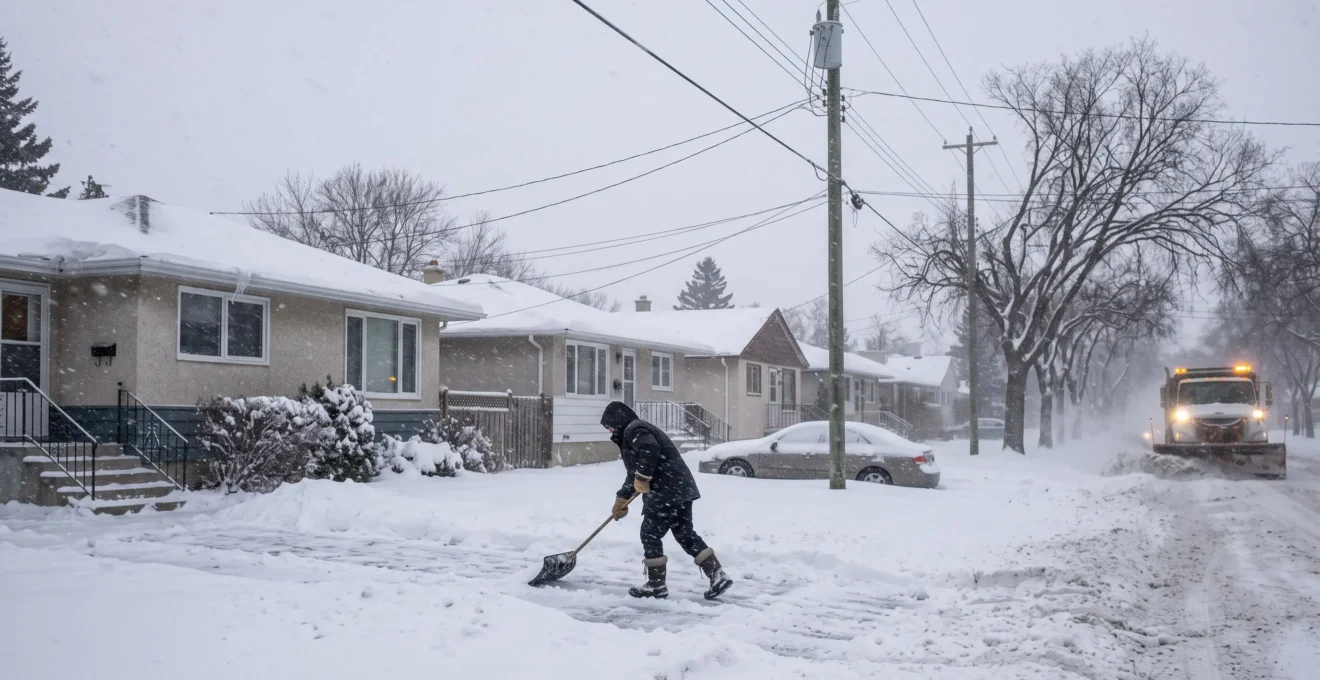
Heavy snowfall can change daily life in Winnipeg long before a street becomes completely blocked. A vehicle buried in a driveway, an uncleared back lane, reduced visibility or a delayed bus can turn an ordinary commute into a difficult journey. Preparing early means protecting access to essential supplies, checking the safety of your home and making travel decisions before conditions deteriorate.
The most useful preparation begins before a snowfall warning becomes urgent. Households should maintain winter emergency supplies, prepare vehicles for prolonged delays, monitor official weather alerts and understand how municipal snow clearing affects their neighbourhood. Just as importantly, residents need a realistic plan for postponing non-essential travel.
Winnipeg’s street priority system means that major roads and residential streets can recover at different speeds. Planning around those differences helps households manage work, caregiving, appointments and property access without assuming that every road will become usable at once.
Winnipeg heavy snowfall preparation at a glance
- Prepare before accumulation begins: maintain emergency supplies, check vehicle equipment, protect ventilation openings and complete essential errands early.
- Make travel decisions using current conditions: combine official warnings, road reports, parking restrictions and the necessity of each journey.
- Plan for uneven snow clearing: regional streets generally receive attention before residential streets, while sidewalks and back lanes may follow separate schedules.
- Why Can Two Winnipeg Snowfalls of Similar Depth Cause Very Different Disruptions?
- How Can You Prepare Your Winnipeg Home and Vehicle Before Heavy Snow?
- Stay Home or Travel: How Should Winnipeg Residents Decide During Heavy Snow?
- Heavy Snow Mistakes That Can Make a Winnipeg Winter Day More Difficult
- When Should Winnipeg Residents Prepare for a Forecast Heavy Snowfall?
- Why Are Some Winnipeg Streets Cleared Before Others After a Snowstorm?
- When Is Leaving Earlier Worth It for a Winnipeg Peak-Hour Commute?
- How Do Winnipeg Snow Clearing Operations Restore Streets After Major Snowfall?
Why Can Two Winnipeg Snowfalls of Similar Depth Cause Very Different Disruptions?
Two Winnipeg snowstorms producing the same measured snowfall can cause very different disruptions because snow weight, wind, timing and existing road conditions matter as much as depth. Wet snow creates heavier loads and greater shovelling effort, while drifting snow can block individual streets or driveways even when official accumulation totals appear moderate.
Snow depth alone does not describe the difficulty of removing snow. Dry, fluffy snow and wet, compact snow behave differently under a shovel, vehicle tire or snowplow. Moisture-rich snow can become especially difficult to move when it compacts or freezes. Lighter snow may be easier to shovel, but strong winds can redistribute it into deep drifts.
For buildings, snow weight deserves particular attention. The National Research Council guidance on roof snow loads explains that structural loading depends on snow weight rather than depth alone. Roof geometry also influences accumulation, particularly around valleys, dormers and other areas where snow collects unevenly.
That does not mean a particular depth automatically makes a Winnipeg roof unsafe. Building design, age, local accumulation and snow density all affect the situation. Residents concerned about substantial accumulation should seek an assessment from a qualified professional rather than climbing onto a slippery roof.
Wind adds another complication. Snowfall measured at a weather station may not reflect the depth against a fence, along a driveway or inside a back lane. A property exposed to prevailing winds may experience substantial drifting while a nearby sheltered property remains more accessible.
The timing of precipitation also shapes the disruption:
- Overnight snowfall: vehicles and streets may already be buried when residents begin their morning routines.
- Morning commute snowfall: traffic can compact fresh snow before clearing operations restore road surfaces.
- Snowfall with strong winds: drifting can repeatedly cover areas that have already been cleared.
- Snowfall followed by freezing: compacted surfaces, driveway entrances and intersections may become harder to clear.
Consider two hypothetical Winnipeg households receiving identical snowfall totals. One lives near a major cleared route with a sheltered driveway. The other relies on a wind-exposed residential back lane. Their ability to leave home may differ substantially despite the same forecast accumulation.
Assess personal exposure through four questions: What priority is your street? Does wind typically create drifts at your driveway? Must you use a back lane? Can important journeys be postponed?
The practical response is to prepare for the conditions your household may experience, not simply the centimetres predicted for the city. That starts with getting the home and vehicle ready before snowfall intensifies.
How Can You Prepare Your Winnipeg Home and Vehicle Before Heavy Snow?
Prepare your Winnipeg home and vehicle by checking emergency supplies, heating and ventilation safety, vehicle equipment and access routes before heavy snow arrives. Complete essential errands early, keep snow-removal tools accessible, move vehicles where they will not obstruct clearing operations and establish a household plan for travel delays or temporary isolation.
Preparation is most effective when divided into tasks that can be completed well in advance and final adjustments made shortly before snowfall. The Government of Canada winter storm preparedness guidance recommends maintaining emergency supplies, developing a household emergency plan, monitoring warnings and preparing vehicles for hazardous winter conditions.
Start with household essentials. Check food, drinking water, medication, flashlights, batteries and any necessary supplies for children, older adults or pets. Consider how the household would remain safe during a prolonged power interruption. Backup heating equipment must be suitable for its intended use and operated according to safety instructions; fuel-burning equipment must never be improvised for indoor heating.
Next, prepare the vehicle. Winter tires, sufficient fuel, windshield washer fluid and a working snow brush are important, but they do not replace emergency supplies for an unexpected roadside delay.
A practical winter vehicle kit can include warm blankets, extra clothing, a flashlight, a compact shovel, a first-aid kit, jumper cables, non-perishable snacks and water. Keep equipment secured and accessible. Check that your phone is charged and that another household member knows your intended journey when travel is necessary.
Home protection requires more than clearing the driveway. Snow-blocked exhaust vents can create a carbon monoxide hazard where fuel-burning appliances discharge outdoors. Identify furnace and other relevant exhaust outlets before the storm and check that snow has not obstructed them. Never operate combustion appliances in an unsafe or unventilated space.
Inspect roof edges and eavestroughs from a safe location, but do not attempt hazardous roof clearing. Large accumulations or signs of structural concern warrant professional attention.
Five checks to complete before Winnipeg’s next major snowfall
- Check household essentials: review food, medication, water and lighting supplies; produce a written list of shortages and resolve important gaps.
- Prepare winter vehicle equipment: inspect tires, fuel, washer fluid, snow brush and emergency kit; confirm the required items are present.
- Identify exterior ventilation outlets: locate accessible exhaust vents and confirm they are unobstructed; record which openings will need monitoring.
- Protect property access: place shovels and traction materials where they remain reachable; identify a safe parking position for each vehicle.
- Adjust household commitments: review appointments, deliveries and caregiving needs; create a short plan identifying what can be completed early or postponed.
A household that has supplies, accessible equipment and flexible arrangements is better positioned to remain home safely when travel becomes hazardous. The next decision is whether leaving home is necessary at all.
Stay Home or Travel: How Should Winnipeg Residents Decide During Heavy Snow?
Winnipeg residents should postpone non-essential travel when heavy snowfall creates unsafe road conditions, particularly during poor visibility, significant drifting or official travel advisories. Necessary journeys require a separate assessment of road access, available transportation, the traveller’s circumstances and whether the destination remains reachable. Extra travel time cannot make an unsafe trip safe.
Begin by separating the importance of the destination from the urgency of leaving. Grocery shopping that can wait presents a different decision from essential caregiving or a medical appointment that cannot easily be rescheduled. Even for important commitments, contacting the destination may reveal a safer alternative.
Read several warning signals together rather than relying exclusively on snowfall totals:
- Environment Canada forecasts, watches and warnings indicate developing weather hazards.
- Manitoba road-condition information helps assess provincial highways, particularly for travel outside Winnipeg.
- City of Winnipeg snow clearing notices identify municipal operations and applicable parking restrictions.
- Winnipeg Transit service alerts can reveal detours, delays or disruptions affecting the intended journey.
- School, workplace and service closures may change whether the trip remains necessary.
For motorists, the Manitoba winter driving guidance advises checking conditions before departure, allowing extra travel time and delaying or cancelling journeys when travel is not recommended. It also advises finding a safe place to stop or turning back if conditions deteriorate while driving.
Public transit offers a different balance of risks. Choosing a bus avoids the responsibility of driving a personal vehicle through snow-covered streets, but buses can experience delays, blocked routes and service changes. Waiting outdoors in severe cold or blowing snow introduces additional exposure.
Before choosing transit, consider shelter availability, expected waiting time, transfer requirements and whether the trip can be shortened. A journey requiring several exposed connections may be less practical than one direct service, even if neither requires driving.
A useful decision table separates flexible activities from those requiring additional planning.
| Trip situation | Practical response | What to verify |
|---|---|---|
| Routine shopping or leisure | Postpone when conditions are hazardous | Whether supplies already at home are sufficient |
| Regular work commute | Consider remote work, schedule adjustment or safe alternatives | Road and transit status, workplace requirements |
| Essential caregiving | Coordinate an alternative or safer travel arrangement | Urgency, access and support available at the destination |
| Medical appointment | Contact the provider about urgency and rescheduling options | Whether the appointment can safely be delayed |
Conditions can also deteriorate after departure. If visibility worsens or routes become difficult, identify a safe place to wait instead of automatically continuing. A suitable sheltered destination may be preferable to attempting the remaining journey during the storm’s most hazardous period.
When a journey is unavoidable, leaving should be based on verified conditions and a realistic safety margin. Avoiding a preventable trip can be more effective than trying to overcome worsening roads through determination alone.
Heavy Snow Mistakes That Can Make a Winnipeg Winter Day More Difficult
Common heavy-snow mistakes include waiting until snow becomes compacted, overexerting yourself while shovelling, leaving vehicles where parking restrictions apply and attempting to drive without clearing visibility surfaces. These decisions can increase physical strain, obstruct municipal snowplows, delay household access and expose other road users to avoidable hazards.
One serious mistake is treating shovelling as a task that must be completed in one continuous effort. Heavy, wet snow requires substantial physical exertion, particularly in cold weather. People with cardiovascular risk factors or physical limitations should exercise additional caution and seek appropriate assistance when needed.
Pushing snow when practical rather than repeatedly lifting it can reduce the effort required. Work in manageable sections, take breaks and avoid throwing heavy loads with twisting movements. Stop if you experience concerning symptoms such as chest pain, severe breathlessness or dizziness, and seek urgent medical help when appropriate.
Another mistake is choosing a convenient parking spot without checking winter restrictions. Vehicles left on designated routes during an applicable ban can interfere with clearing operations and may face enforcement measures. Parking near intersections, constricted street sections or difficult back-lane entrances can also make movement more challenging.
Before a storm, identify where each vehicle can legally remain and how it will be accessed after plowing. Remember that a cleared street can still have a substantial ridge of deposited snow across a driveway entrance.
Snow placement matters too. Pushing private-property snow into a cleared travel lane can recreate hazards for motorists and interfere with subsequent plowing. Avoid obstructing fire hydrants, emergency exits, pedestrian access or visible drainage openings. Follow applicable municipal snow-disposal requirements.
Several smaller omissions can combine into a much larger problem:
- Ignoring fresh accumulation: snow compressed by vehicles or foot traffic may become harder to remove after freezing.
- Clearing only a narrow windshield patch: remaining snow and ice can obstruct visibility, while roof snow may shift during driving.
- Failing to monitor exhaust vents: drifting can block previously clear openings.
- Assuming a plow has finished: additional passes may deposit fresh snow along the driveway entrance.
- Underestimating physical limitations: a large clearing job may require assistance rather than additional exertion.
These mistakes are often consequences of rushed decisions rather than a complete lack of preparation. Completing small tasks before accumulation increases gives households more control over how the following day unfolds.
The easiest way to prevent many of these difficulties is to establish a preparation timeline well before the storm, while weather forecasts still leave room to adjust household plans.
When Should Winnipeg Residents Prepare for a Forecast Heavy Snowfall?
Winnipeg households should maintain basic winter preparedness throughout the season and begin specific storm preparations as soon as a credible forecast indicates potentially disruptive snowfall. Several days before the event, secure supplies and adjust commitments. When warnings become more specific, check routes, parking arrangements and equipment. Reserve the final hours for essential adjustments.
Winter preparedness works best as an ongoing household routine. Flashlights, emergency supplies, winter driving equipment and snow-removal tools should not require extensive shopping whenever snowfall is predicted. Maintaining these basics reduces pressure when forecasts change quickly.
A practical sequence uses three preparation windows. These are planning recommendations, not official warning thresholds.
| Preparation window | Main objective | Recommended actions |
|---|---|---|
| Several days beforehand | Resolve tasks that require access or advance arrangements | Review supplies, medications, appointments, heating plans and vehicle maintenance |
| When watches or warnings are issued | Adapt plans to the evolving forecast | Monitor alerts, check routes, rearrange essential journeys and confirm parking options |
| Final hours before snowfall | Preserve safe access and household readiness | Position vehicles, secure loose items, charge devices and keep clearing tools accessible |
Forecasts are not guarantees of identical conditions across Winnipeg. Storm tracks, precipitation type, wind direction and the timing of a change between rain, freezing precipitation and snow can affect the final outcome. A household should avoid making critical preparations dependent on a single predicted snowfall total remaining unchanged.
Front-load actions that become difficult once snow starts accumulating. Buying essential medication, arranging transportation or servicing a vehicle is generally easier before roads deteriorate. During the final hours, attention is better directed toward immediate safety and access rather than additional non-essential errands.
Waiting can also make everyday services less convenient. Shops, fuel stations and maintenance providers may become busier ahead of significant weather, although congestion and shortages should not be assumed for every storm. The stronger reason to prepare early is reducing dependence on last-minute travel.
Forecast uncertainty should lead to flexible decisions, not to ignoring warnings. If a predicted storm weakens, most basic preparation remains useful throughout the winter. If conditions worsen, the household has already addressed its most important needs.
Even thorough preparation cannot determine when municipal crews will reach a particular street. Understanding Winnipeg’s clearing priorities provides a more realistic picture of when normal access may return.
Why Are Some Winnipeg Streets Cleared Before Others After a Snowstorm?
Winnipeg streets are cleared according to municipal priority classifications rather than simply the amount of snow visible at each address. Major regional roads generally receive the highest priority, followed by non-regional bus routes and collector streets, while residential streets are assessed under separate criteria. This system helps restore essential movement before complete neighbourhood access.
The City of Winnipeg divides municipal streets into three main snow-clearing categories. The classifications reflect the role of each street within the transportation network and help determine operational priorities.
The distinction matters because a nearby major road may be plowed while a residential street still has substantial accumulation. That difference does not necessarily mean a service request was overlooked.
The City of Winnipeg street snow-clearing priorities describe three classifications and their corresponding operational standards. Residents can use this information to understand why access may recover at different speeds across the city.
| Classification | Typical streets | Clearing considerations |
|---|---|---|
| Priority 1 (P1) | Major regional roads | Highest street priority; plowing standard of within 36 hours after a snowfall event ends, subject to extreme conditions |
| Priority 2 (P2) | Non-regional bus routes and collector streets | Plowing normally begins when accumulation exceeds 5 cm; bus routes receive advanced attention during major storms |
| Priority 3 (P3) | Residential streets | Plowed when applicable conditions warrant, including significant snowfall, accumulated snow or substantial drifting and rutting |
The City’s published criteria include cumulative snowfall of 10 cm or more among the circumstances relevant to P3 clearing. This should not be interpreted as a guarantee that every residential street will be plowed immediately upon reaching that depth.
During major storms, P3 operations follow completion of the higher-priority P1 and P2 work. Severe weather may also extend normal operational timelines.
36 hours
The published Priority 1 plowing standard refers to the period after a snow event ends. Extreme conditions can extend completion times, and the standard does not predict the exact clearing time for any individual street.
City of Winnipeg street snow-clearing service standards.
Parking restrictions introduce another consideration. Priority 1 streets are designated winter routes and are subject to restrictions when the applicable Winter Route Parking Ban is in effect. Residents should verify the current ban and move vehicles as required rather than assuming a restriction applies continuously in the same way.
Back lanes and sidewalks also operate on their own maintenance priorities. A cleared front street does not automatically mean the rear access lane or nearby walking route has been cleared.
These classifications can support planning, but they cannot provide an exact departure time for an individual property. That uncertainty becomes especially relevant when deciding whether to leave earlier for a peak-hour commute.
When Is Leaving Earlier Worth It for a Winnipeg Peak-Hour Commute?
Leaving earlier can help during a Winnipeg winter commute when roads remain passable and the main problem is predictable congestion or slower travel. It is less useful when severe weather, road closures, unplowed access routes or widespread transit interruptions prevent normal movement. The decision should reflect actual conditions, route exposure and whether additional time improves safety.
Overnight snowfall can produce a particularly difficult morning departure. Cars may be parked behind accumulated snow, back lanes may require clearing and roads can contain compacted snow or uneven ruts. Intersections may also be harder to navigate when visibility is reduced.
A departure buffer can help when the route is open but likely to move more slowly than usual. However, departing earlier is not a substitute for safe road conditions. Beginning a journey before visibility improves or before critical routes receive attention may create additional risk.
To decide whether an early departure is worthwhile, consider four factors:
- Journey length: a longer trip provides more opportunities for delays to accumulate.
- Route composition: travel involving residential streets, back lanes and less accessible intersections may be limited before reaching major roads.
- Transportation mode: driving and transit have different sources of delay, including parking access, congestion, service interruptions and transfers.
- Schedule flexibility: a workplace that accepts adjusted arrival times may remove the need to travel during the most difficult period.
Consider a hypothetical commuter who normally drives from a residential neighbourhood to a workplace along a major route. Leaving earlier could help if the driveway and connecting streets are usable and peak-period traffic is expected to be slow. It provides little benefit if the residential access street remains impassable.
For transit passengers, a similar distinction applies. Leaving earlier may compensate for an occasional missed connection or slower journey. It may not resolve a system-wide disruption affecting multiple buses or routes.
Maintaining a personal winter travel record can make future decisions more practical. Note ordinary door-to-door travel time, snowfall conditions, route changes and actual delays. Over a season, these observations can reveal which journeys benefit from additional time and which are better postponed.
Travel buffers should remain flexible rather than becoming a fixed expectation to leave earlier regardless of weather. Check current service information before committing to the trip and reassess if conditions worsen.
Once snowfall ends, commuting conditions may continue changing as plows widen streets and maintenance crews address accumulated snow. Knowing the recovery process helps determine when routine travel can reasonably resume.
Key takeaways before travelling after a major snowstorm
- A road can be passable without being fully restored; compacted snow, reduced lane width and driveway windrows may remain.
- Municipal priority determines which routes receive attention first, while back lanes and sidewalks may recover on different schedules.
- Continue checking road conditions after snowfall stops because drifting, refreezing and further clearing operations can change accessibility.
How Do Winnipeg Snow Clearing Operations Restore Streets After Major Snowfall?
Winnipeg restores street access after major snowfall through prioritized plowing, repeated clearing where conditions require it and subsequent maintenance to address remaining snow, ice and reduced traction. Major roads and bus routes generally receive attention before residential streets. Plowing often moves snow toward curbs, so a street may reopen while driveway windrows and other access difficulties remain.
Snow removal is not a single operation that instantly returns every street to bare pavement. Crews must respond to storm conditions, traffic needs, available equipment and the different service requirements of Winnipeg’s road network.
The first major objective is to maintain or restore movement along important transportation corridors. Higher-priority roads support access across the city and enable emergency services, transit and essential travel to operate more effectively.
During significant snowfall, repeated plowing may be necessary because snow continues accumulating or blowing back onto cleared surfaces. Strong winds and poor visibility can also make clearing work more difficult.
As operations progress, plows may widen usable road space and push accumulated snow toward the curb. This produces windrows, the ridges of snow commonly left along roadway edges and sometimes across driveway entrances.
A windrow does not mean snow has disappeared from the transportation system. It means the material has been displaced to create usable travel space. Residents may still need to address access to their own property while avoiding unsafe removal methods or prohibited snow disposal.
Different maintenance activities serve different purposes:
- Plowing: moves accumulated snow away from portions of the road needed for travel.
- Grading: helps reshape compacted snow surfaces and address problematic unevenness.
- Sanding and salting: may be used where appropriate to improve traction or manage icy surfaces.
- Snow hauling: can remove accumulated snow from selected locations when operationally necessary, rather than merely moving it beside the roadway.
- Back-lane and sidewalk maintenance: addresses separate routes that may not be restored simultaneously with nearby streets.
The precise order, scope and timing of these tasks depend on municipal decisions and conditions. Residents should not assume every street receives every type of treatment after each storm.
Winnipeg’s municipal service standards explain that back lanes are generally maintained as compacted snow surfaces. Clearing is based on inspections and relevant conditions, with operations that may overlap higher-priority street work without matching the timing of the corresponding front street.
After the storm, warming and refreezing can alter road conditions again. Compacted snow may become uneven, ruts may harden and icy ridges can persist even where vehicles are already moving. Additional maintenance may therefore remain necessary long after snowfall has stopped.
Residents can follow official City of Winnipeg snow-clearing information, maps and parking ban notices to understand municipal activity. They should also check current rules governing their own property access and applicable sidewalk or snow-disposal obligations rather than assuming all adjacent clearing is handled by the City.
Before resuming regular travel, verify that the entire route is usable. A clear regional road offers limited benefit if the driveway, back lane or residential connection remains blocked.
After a significant snowstorm, review household supplies, restore safe access where possible and reassess travel plans using current official updates. Completing those steps also leaves the household better prepared for the next snowfall.
Should I clear snow from my driveway while it is still falling?
Clearing manageable amounts of fresh snow during a prolonged storm can reduce the effort required later, especially before accumulation becomes compacted or freezes. However, personal safety comes first. Avoid shovelling during dangerous visibility or wind conditions, pace physical exertion and do not enter the path of working snowplows. Further clearing may still be required after plows create a windrow at the driveway entrance.
How can Winnipeg residents find out whether a snow route parking ban applies?
Residents should consult current City of Winnipeg parking ban notices and official municipal information before leaving a vehicle on a designated winter route. Restrictions depend on the applicable ban and street designation. Checking before a forecast storm and again before parking helps avoid confusion when conditions or municipal notices change.
What should I do if my car becomes stuck during a snowstorm?
Assess whether the vehicle is in immediate danger and avoid entering moving traffic to free it. Contact roadside assistance or emergency services as appropriate to the situation. If remaining inside a vehicle with the engine running, ensure the exhaust outlet is unobstructed by snow because blocked exhaust can create a dangerous carbon monoxide exposure. If the location is unsafe, follow emergency service instructions.
Does a cleared Winnipeg road mean nearby sidewalks and back lanes are also ready?
No. Winnipeg uses different service priorities and operating arrangements for streets, sidewalks and back lanes. A regional street may be cleared while a residential back lane remains covered with compacted snow. Before travelling, check the actual access needed from your property to the main road or transit stop, rather than judging conditions from one cleared street.
Is it safe to remove deep snow from a roof without professional help?
Climbing onto a snow-covered or icy roof creates significant fall hazards. Snow depth alone is not enough to determine structural risk, because snow density, roof configuration and building design also matter. Where accumulation raises safety concerns, seek advice from a qualified, insured professional instead of attempting hazardous roof clearing yourself.