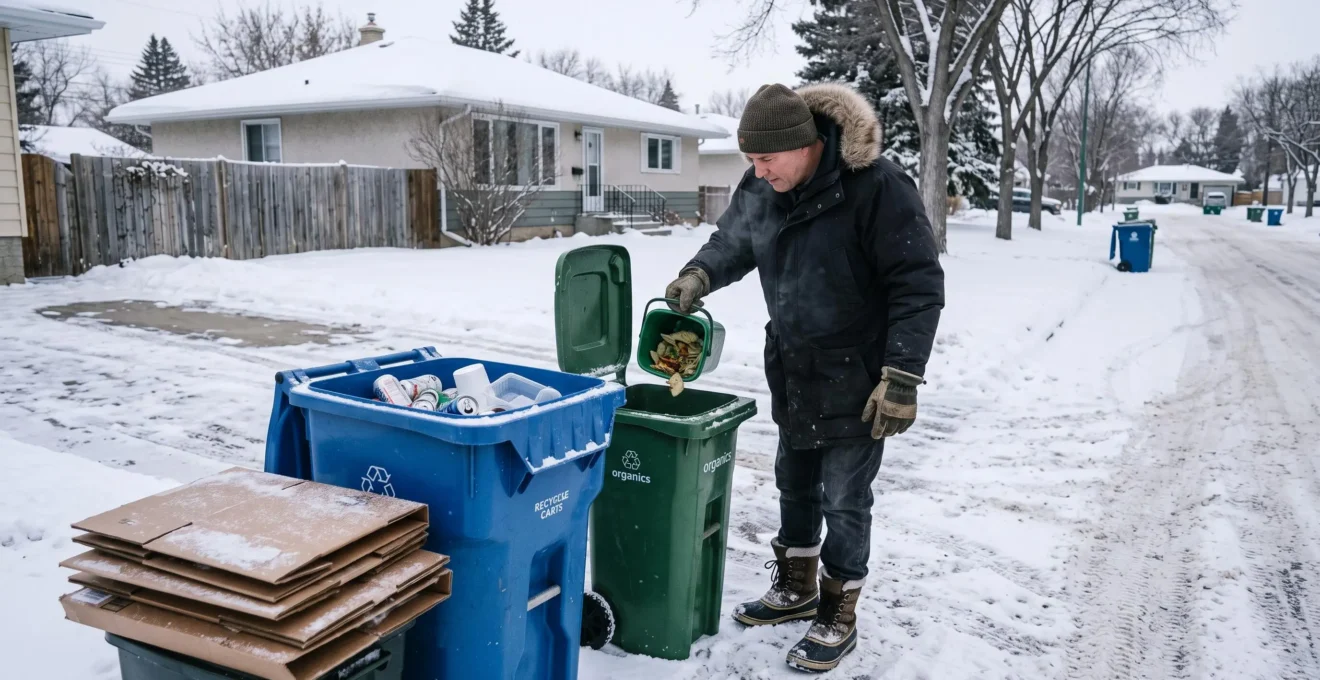
Winnipeg households can get more value from recycling and composting programs by separating accepted materials correctly, keeping contaminants out of collection streams, and using the appropriate municipal service for each type of waste. A few consistent household habits can make a meaningful difference without requiring expensive equipment or complicated routines.
Recycling and food-waste diversion operate through different systems. Winnipeg’s blue-cart program collects eligible recyclable materials, while municipal food-waste drop-off stations provide an organics diversion option. Residents should not assume that every household currently has municipal curbside food-waste collection or that all products labelled compostable are accepted.
Understanding these distinctions helps prevent avoidable sorting mistakes. It also makes collection schedules, depot visits, and service requests easier to manage, especially during Winnipeg’s winter months or when household circumstances change.
Winnipeg recycling and composting essentials
- Place accepted recyclables loose in the blue cart, with containers empty and rinsed. Never bag recyclable materials.
- Use municipal food-waste drop-off stations for accepted organics rather than assuming curbside compost collection is available.
- Check uncertain materials through Recyclepedia and use Winnipeg’s 311 services for collection problems, depot information, and municipal requests.
- Why Does Recycling Contamination Matter for Winnipeg Households?
- How Can a Winnipeg Household Make Waste Sorting Easier Every Day?
- Recycle or Compost: How Should Winnipeg Households Sort Common Materials?
- Recycling Mistakes That Can Undermine Winnipeg Waste Diversion Efforts
- When Should Winnipeg Residents Recheck Their Recycling and Composting Routine?
- Which Winnipeg Municipal Services Matter Most in Everyday City Life?
- How Can You Find the Right Winnipeg Municipal Service for a Local Problem?
- How Can You File a Winnipeg Service Request That Is Easier to Assess?
Why Does Recycling Contamination Matter for Winnipeg Households?
Recycling contamination matters because unacceptable materials can disrupt sorting equipment, create hazards for workers, and reduce the market value of recovered recyclables. Winnipeg’s recycling system depends on collecting materials that can be separated and processed effectively. When households place unsuitable items in blue carts, the consequences extend beyond the individual container.
After collection, eligible residential recyclables are transported to a Materials Recovery Facility owned by GFL Environmental Inc. Machines perform most sorting, while employees handle approximately 10 percent of sorting work, according to the City’s description of the system. Recovered materials are subsequently sold through brokers to manufacturers that use them in new products.
The City of Winnipeg‘s explanation of how recycling works identifies three reasons to keep unacceptable items out: protecting equipment, protecting workers, and improving the value of sorted recyclables.
Contamination creates different problems depending on the material:
- Bagged recyclables: plastic bags interfere with the intended loose-material collection and sorting process.
- Hoses and electrical cords: flexible, elongated objects can become entangled in mechanical sorting equipment.
- Food residue and liquids: contamination can reduce the usefulness of affected paper and cardboard.
- Electronics and batteries: these require separate handling rather than placement in regular recycling carts.
An incorrectly sorted item does not automatically mean that an entire truckload will be rejected. The actual consequences depend on the material, contamination level, processing equipment, and facility procedures. Nevertheless, preventing contaminants at the household level is preferable to relying on facility workers to remove them later.
Organics diversion presents a related challenge. Winnipeg’s food-waste drop-off program excludes certain products marketed as compostable, including food-service containers and utensils. A compostable label alone does not establish compatibility with the local system. Different organics programs can have different material restrictions.
Better sorting protects the practical value of municipal waste services. Cleaner inputs support material recovery and can help avoid unnecessary processing difficulties, although the available municipal information does not quantify contamination-related cost savings for individual households.
The most effective starting point is preventing mistakes before materials enter the cart, rather than trying to correct them on collection morning.
How Can a Winnipeg Household Make Waste Sorting Easier Every Day?
Winnipeg households can simplify waste sorting by keeping recycling, food-waste collection, and garbage containers close to where waste is generated. A clearly organized station, shared household rules, and a small container for uncertain items reduce the need to make rushed decisions. The method should reflect the waste services actually available at the property.
Start with a three-part kitchen station. One container holds accepted recyclables, another collects food scraps intended for a suitable composting or drop-off system, and a third holds ordinary garbage. The organics container can be a small countertop pail, even if the household must transport its contents to a drop-off location rather than use municipal curbside collection.
Use a practical three-way decision:
- Can this item be accepted in Winnipeg’s recycling program? If yes, empty and prepare it as required.
- Is it accepted by the food-waste diversion program the household actually uses? If yes, place it in the designated organics container.
- If neither applies, check whether the item belongs in regular garbage or requires special handling.
When uncertain, avoid guessing. A small designated container can temporarily hold dry items for later classification. Residents can resolve these questions together using the City’s Recyclepedia information rather than placing questionable materials in the blue cart.
Practical obstacles also deserve attention. Flattening cardboard saves cart space, while checking container capacity before collection day prevents overflowing bins. Winnipeg’s cart collection rules do not permit additional material piled on or beside an overflowing cart for regular pickup.
In winter, choose an indoor collection point that is easy to access. Keep outdoor carts accessible and remove snow from their lids and underneath them before collection. Households using food-waste drop-off stations can consider storing suitable scraps in the freezer until their next depot visit.
Residents of larger multi-unit buildings should confirm their property’s arrangements with building management. Municipal cart service rules for eligible smaller properties do not automatically describe the collection system used by every apartment complex.
A short weekly check is usually more sustainable than reorganizing the entire system occasionally. Empty kitchen containers, identify accumulated uncertain items, and check whether the outdoor cart has sufficient space.
Once the setup is familiar, the next challenge is recognizing which common household materials belong in each stream.
Recycle or Compost: How Should Winnipeg Households Sort Common Materials?
Winnipeg households should sort materials according to local acceptance rules, not simply whether an item is theoretically recyclable or biodegradable. Paper, cardboard, rigid plastic packaging, and empty, rinsed containers are generally accepted in blue carts. Eligible food scraps can enter the municipal food-waste drop-off system, while hazardous items and certain other materials require separate disposal arrangements.
The simplest approach is to distinguish the item’s physical material from the collection program’s actual requirements. A material may be capable of recycling or composting somewhere without being accepted in Winnipeg’s particular program.
The following decision grid provides a starting point for common household items. Ambiguous packaging should still be checked individually.
| Material | Recommended stream | Important condition |
|---|---|---|
| Clean paper and cardboard | Blue recycling cart | Keep loose and free of significant food contamination. |
| Rigid plastic packaging | Blue recycling cart | Confirm acceptance; a recycling symbol alone is insufficient. |
| Empty glass bottles and jars | Blue recycling cart | Empty and rinse first. |
| Empty metal food and beverage containers | Blue recycling cart | Empty and rinse first. |
| Accepted household food scraps | Food-waste drop-off program | Follow the drop-off program’s accepted-materials rules. |
| Compostable-labelled cups and utensils | Not accepted at municipal food-waste drop-off stations | Do not assume compostable labelling means local acceptance. |
| Plastic bags and film | Not loose blue-cart recyclables | Check the appropriate alternative disposal option. |
| Electronics and household hazardous materials | Designated drop-off or special handling | Never place restricted materials in ordinary household carts. |
According to Winnipeg’s official cart collection rules, accepted recyclable materials include paper, cardboard, rigid plastic packaging, and empty, rinsed glass, plastic, and metal containers. Residents must leave recyclables loose rather than enclosing them in plastic bags.
Food waste requires a separate approach. Winnipeg operates food-waste drop-off stations in partnership with Compost Winnipeg, including locations at the Brady, Pacific, and Panet 4R Winnipeg Depots. This is not equivalent to a universal municipal curbside Green Cart food-waste service.
The City of Winnipeg’s food-waste drop-off instructions exclude plastic bags, coffee cups, glass, metal, and compostable food-service containers, cups, straws, and utensils. Newspaper, paper bags, and BPI-certified compostable bags are permitted as kitchen-pail liners for transporting food waste under the published program instructions.
Take particular care with pizza boxes, greasy cardboard, coated paper cups, bioplastics, and packaging labelled biodegradable. None should be classified solely from its name. A lightly used cardboard box and a box heavily contaminated with food can present different recycling considerations.
Pet waste and particular meat scraps also require explicit verification against the receiving program’s rules. Acceptance for private composting, home composting, and municipal drop-off services should never be treated as interchangeable.
Sorting correctly becomes easier when residents understand not only where materials belong but also why certain familiar disposal shortcuts cause problems.
Recycling Mistakes That Can Undermine Winnipeg Waste Diversion Efforts
The recycling mistakes most worth correcting in Winnipeg are placing recyclables inside plastic bags, including items that interfere with sorting machinery, leaving food or liquid contamination in containers, and depositing materials that require special collection. These habits can reduce processing efficiency, introduce workplace hazards, or make recovered materials harder to market.
Bagging recyclables is a particularly straightforward mistake to prevent. Winnipeg instructs residents to place accepted recycling materials loose in their blue carts. Even a bag labelled recyclable does not override that requirement.
Other high-impact problems deserve individual attention:
- Tangled materials: garden hoses, cables, and similar objects can interfere with sorting machinery and should not be placed in regular recycling carts.
- Food residue: leftover food and liquids can contaminate paper products and other collected materials. Empty and rinse eligible containers.
- Wish-cycling: placing unsuitable objects in the cart in the hope they can be recycled shifts the sorting problem to the processing facility.
- Hazardous materials: batteries, electronics, automotive fluids, and restricted chemicals require appropriate alternative handling.
Composting contamination differs in an important way. While recycling problems frequently involve unsuitable packaging or material preparation, organics problems often involve placing products into a processing system that has not approved them. Compostable-labelled plastic tableware is a relevant example under Winnipeg’s drop-off rules.
A five-minute household bin audit can reveal errors that have become automatic. Rather than inspecting every item, focus first on bags, food residue, long flexible objects, and unfamiliar packaging.
Complete a five-step Winnipeg recycling check
- Inspect the blue cart for plastic bags containing recyclables. Remove them and leave accepted materials loose. Deliverable: no bagged recyclables remain.
- Identify hoses, cables, electronics, batteries, or other unsuitable objects. Set them aside for appropriate disposal. Deliverable: a separate collection of items requiring verification or special handling.
- Check eligible food and beverage containers for leftover contents. Empty and rinse them when needed. Deliverable: containers are prepared for blue-cart collection.
- Review questionable packaging through the City’s current recycling guidance or Recyclepedia. Deliverable: a short household sorting reference for commonly confusing items.
- Confirm the cart is not overflowing and can be placed out correctly. Deliverable: a collection-ready cart with no excess material piled beside it.
A household that repeats this process occasionally can identify its own recurring errors without relying on assumptions about what a recycling facility will accept.
Sorting rules and household purchasing habits can change, however, so even a well-organized system benefits from periodic review.
When Should Winnipeg Residents Recheck Their Recycling and Composting Routine?
Winnipeg residents should recheck their waste-sorting routine whenever municipal rules change, they move to a different property, or they begin using unfamiliar packaging or disposal services. A yearly review is also a sensible household habit. Collection arrangements and accepted materials should be verified against current City guidance rather than relying indefinitely on older instructions.
Several events make a review especially useful:
- Moving home: determine whether the new address receives cart service or uses another collection arrangement.
- New packaging: verify unfamiliar containers, films, coated paper, and compostable-labelled products.
- Seasonal changes: check yard-waste arrangements and collection information when relevant.
- Program announcements: review official changes to accepted materials, collection procedures, or food-waste services.
- Changes in household occupancy: explain the established sorting rules to new residents or family members.
Winnipeg’s standard cart collection service generally covers single-family residences and properties containing seven dwelling units or fewer, subject to the City’s stated exceptions. Residents in other housing arrangements should verify their actual service rather than assuming identical cart eligibility.
For households receiving standard cart collection, the City’s published guidance provides weekly recycling and garbage collection and requires carts to be set out by 7 a.m. on collection day. Collection schedules should still be verified for the specific address.
A routine review need not be complicated. Confirm the collection day, inspect the condition of each cart, revisit confusing materials, and determine whether the household’s food-waste arrangements remain suitable.
When checking composting services, distinguish the existing municipal drop-off program from any future city-wide curbside system. The City’s food-waste information describes drop-off service continuing until a Green Cart curbside program is introduced, but the source information does not establish a confirmed implementation date.
For practical household continuity, keep a brief sorting guide in the kitchen. Update it when a rule is confirmed to have changed, and explain the change to everyone who handles waste.
Maintaining the routine also requires knowing which municipal services support waste collection and where to find assistance when an issue arises.
Which Winnipeg Municipal Services Matter Most in Everyday City Life?
The municipal services most relevant to everyday Winnipeg household life include waste collection, water services, transportation, road maintenance, snow clearing, and property-related services. Recycling and composting connect with this broader system because residents must coordinate collection schedules, depot access, property conditions, and service requests to manage household waste effectively.
Some municipal services require regular attention, while others become relevant only when a problem occurs.
| Service | Typical household interaction | Useful preparation |
|---|---|---|
| Recycling and garbage collection | Weekly for properties receiving standard cart service | Check collection days and cart placement requirements. |
| Food-waste drop-off | As needed, depending on household participation | Identify an available drop-off location and accepted materials. |
| Water and wastewater | Regular household use; service contact when needed | Know the appropriate municipal service contact. |
| Transit and roads | Depending on travel requirements | Consult current route and road information. |
| Snow clearing and street maintenance | Seasonally or when conditions require attention | Use municipal information and reporting channels. |
| Property and by-law services | Occasionally | Identify the relevant rules and reporting process. |
Waste collection itself involves several connected services. A household might need its collection-day schedule, information about excess recycling, access to a depot, or a process for reporting a damaged cart. These are distinct questions, even though they all concern household waste.
For example, a full blue cart does not automatically justify leaving additional bags or cardboard beside it. Winnipeg’s cart collection guidance prohibits overflowing carts and excess materials piled on or beside them. Eligible excess recyclables can instead be taken to a 4R Winnipeg Depot.
Similarly, electronic waste and household hazardous materials require separate handling. Identifying a suitable municipal depot is more useful than asking collection crews to accept materials excluded from ordinary carts.
Residents can reduce administrative effort by identifying their principal municipal information services once and keeping collection schedules or account information accessible.
The next step is choosing the correct point of contact for each issue rather than sending every question through the same reporting process.
How Can You Find the Right Winnipeg Municipal Service for a Local Problem?
Winnipeg residents can identify the right municipal service by first deciding whether they need information, physical access to a disposal facility, or action on a specific problem. Sorting questions call for recycling guidance, specialized waste may require a depot, and missed collections or damaged carts may require a municipal service request through an appropriate 311 channel.
The Winnipeg 311 City services directory provides access to collection information, missed-pickup reporting, depot resources, service-request submission, and request tracking. It also connects residents with other municipal services beyond waste management.
Use the type of problem to choose the starting point:
| Situation | Appropriate starting point | Information to prepare |
|---|---|---|
| Uncertain recycling material | Recyclepedia or current City recycling guidance | Material type and packaging details |
| Missed collection | Municipal missed-collection reporting service | Address, collection date, cart type |
| Damaged, missing, or stolen cart | City cart service reporting channel | Address and description of the cart problem |
| Excess eligible recyclables | 4R Winnipeg Depot information | Material type and depot acceptance requirements |
| Household hazardous waste or electronics | Appropriate depot or designated handling program | Specific material and any disposal restrictions |
| Food-waste drop-off questions | Municipal drop-off information or relevant program contact | Drop-off location and material category |
For standard cart collection, residents are instructed to report a missed pickup when a cart has not been collected by 6 p.m. on its scheduled collection day. Before reporting, confirm the correct day and whether the cart was properly positioned and accessible.
For food-waste drop-off questions, the City distinguishes contacts by subject. Questions about 4R Depot food-waste locations can be directed to 311, while questions about accepted food-waste items or participating community-centre locations are directed to Compost Winnipeg.
Complex disposal questions may involve several steps. A household clearing out a garage, for example, might separate eligible recyclables, identify electronics for specialized handling, and determine whether any hazardous products require an approved drop-off facility.
Photos and clear descriptions can be helpful when reporting a physical problem, although municipal documentation does not establish that submitting photos guarantees faster handling.
Once a problem genuinely requires intervention, a concise, specific report gives the receiving service a clearer understanding of what needs to be assessed.
Key takeaways before contacting Winnipeg 311
- Check whether an existing municipal information page answers the question before creating a service request.
- For a missed pickup or cart problem, record the exact location, relevant collection date, and observable condition.
- Use available request-tracking tools for follow-up instead of repeatedly submitting the same unresolved issue.
How Can You File a Winnipeg Service Request That Is Easier to Assess?
A Winnipeg service request is easier to assess when it identifies the precise location, describes one specific problem, states when the issue occurred, and includes relevant supporting details. Residents should use the City’s appropriate reporting channel and retain any reference number provided. Clear reporting supports accurate assessment without guaranteeing a particular response time or outcome.
The goal is to describe something a municipal service team can verify or investigate. A general statement such as « garbage collection never works properly » gives little information about the immediate problem.
Compare that with a hypothetical, more specific report:
Example: reporting an uncollected recycling cart
A resident reports that the blue recycling cart at their Winnipeg property remained uncollected after 6 p.m. on its scheduled collection day. The report identifies the address, collection date, cart location, and whether any notice was attached.
This example is illustrative, not a documented municipal case. Its purpose is to show how observable details make the reported issue clearer. The City must still determine the reason for the missed collection and the appropriate response.
For a useful submission, prepare the following details:
- Exact location: the affected address and any additional location details needed to identify the cart.
- Problem description: what was expected to happen and what was actually observed.
- Relevant timing: the scheduled collection date and when the issue was noticed.
- Supporting observations: cart condition, access obstructions, attached notices, or photographs where relevant.
- Follow-up information: any service-request reference supplied by the reporting system.
If a cart carries a notice indicating a sorting problem, record the notice’s exact wording and check the identified issue against current municipal guidance. Do not assume that a contamination notice automatically entitles the household to immediate recollection.
Residents should follow the applicable City instructions and request clarification when the notice or next step is uncertain. Procedures for particular cart rejections may differ, and no universal resolution deadline is established by the source information.
Winnipeg’s municipal directory provides access to request tracking, while MyAccount offers personalized municipal information and tracking functions. Use the available status information before submitting an additional report about the same incident.
Escalation is most useful when there is a meaningful new development, an unresolved issue requiring further review, or a response that does not address the reported facts. A duplicate request without additional information may simply repeat the original problem description.
Check the household’s next scheduled collection, correct any identified sorting problems, and keep the relevant service reference accessible. These small actions connect better recycling habits with practical use of Winnipeg’s municipal services.
Does every Winnipeg household have a municipal green cart for food waste?
No. The municipal information supplied describes food-waste drop-off stations operating with Compost Winnipeg and refers to a future city-wide Green Cart curbside program. Residents should verify their address’s current service and avoid assuming that universal curbside food-waste collection is already available.
Can recyclable containers be placed inside a plastic bag in Winnipeg’s blue cart?
No. Winnipeg’s blue-cart instructions require accepted recyclables to be placed loose inside the cart. Plastic bags must not be used to bundle recyclables, even when marketed as recyclable.
Are BPI-certified compostable bags accepted at Winnipeg food-waste drop-off stations?
The City’s food-waste drop-off instructions permit BPI-certified compostable bags as kitchen-pail liners for transporting food waste. This does not mean that compostable-labelled cups, containers, straws, or utensils are accepted; those food-service products are specifically excluded.
What should residents do when the recycling cart is full before collection day?
Flatten suitable cardboard, avoid unnecessary packaging volume, and keep the cart within its permitted capacity. Winnipeg does not collect overflowing carts or additional materials placed on or beside them through standard cart service. Eligible excess recyclables can be taken to a 4R Winnipeg Depot.
Where can Winnipeg residents find collection information without submitting a complaint?
The City provides collection-day information, recycling guidance, depot details, and other municipal resources through its service directory and associated tools. These information services are the appropriate starting point when no specific collection failure or cart problem needs to be reported.