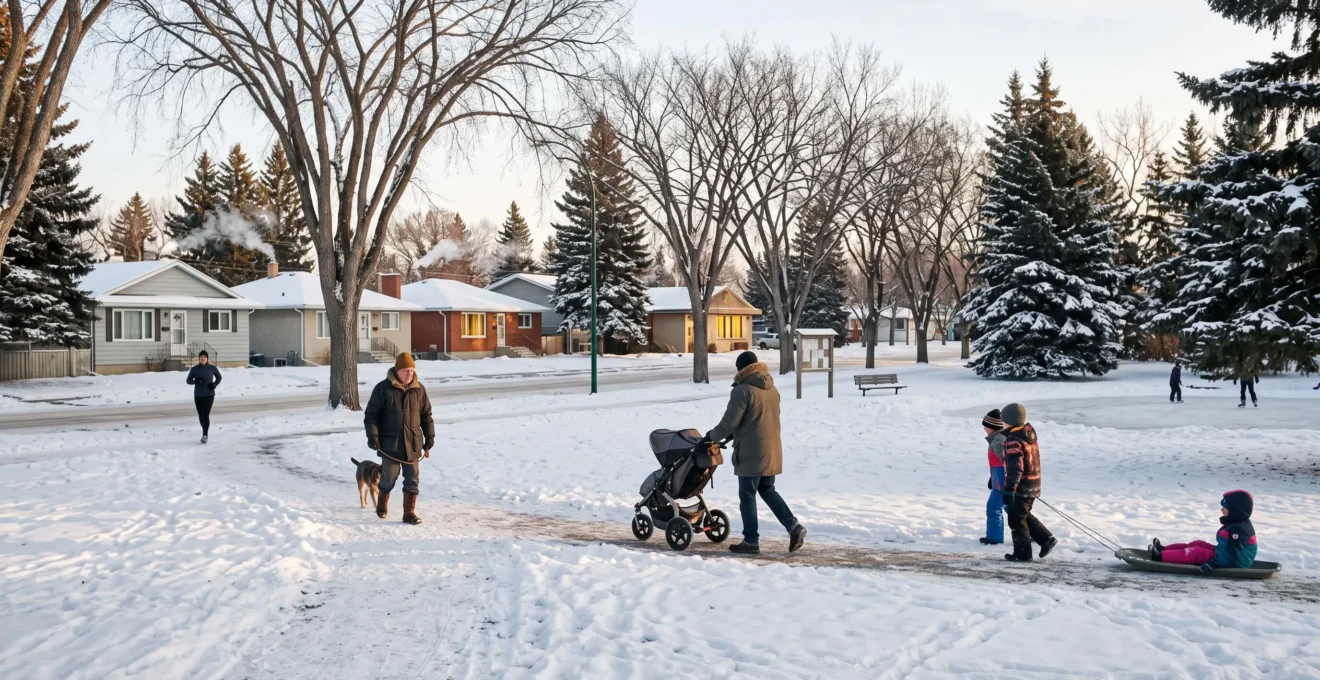
A useful Winnipeg public park is not necessarily the largest, newest or most heavily equipped. It is a place residents can reach safely, use comfortably throughout the year and incorporate into ordinary neighbourhood life. Its success depends on how well its location, recreation opportunities, accessibility and ongoing maintenance respond to the people living nearby.
Winnipeg’s climate makes these decisions particularly important. A playground may attract families during summer but offer little practical value during winter. Conversely, an accessible walking loop, sheltered seating and flexible open space can support different activities as seasons change.
Park planning also involves choices that are less visible in architectural drawings: who can cross the surrounding streets safely, whether mature trees will survive construction, how recreation amenities are distributed and who will maintain the site after opening.
Understanding these factors helps residents assess proposed parks, recognize when an existing park needs improvement and participate more effectively in decisions about neighbourhood investment.
What makes a Winnipeg public park genuinely useful?
- Everyday access: Safe walking routes, convenient entrances and proximity to homes often matter more than total park size.
- Year-round adaptability: Shade, sheltered paths, flexible recreation areas and winter maintenance extend practical usability.
- Long-term community value: Inclusive amenities, healthy trees, maintenance funding and opportunities for residents to influence design determine whether improvements remain useful.
- Why Do Some Winnipeg Public Parks Attract More Everyday Use Than Others?
- How Can Residents Assess a Winnipeg Public Park Proposal Before It Is Built?
- Sports Amenities or Quiet Green Space: What Should a Winnipeg Park Prioritize?
- Public Park Design Mistakes That Can Limit Community Use in Winnipeg
- When Does a Winnipeg Public Park Need Major Renewal Instead of Routine Repairs?
- How Can You Compare Winnipeg Recreation Facilities Before Choosing One?
- Why Are Mature Trees So Valuable to Winnipeg Neighbourhoods?
- Which Winnipeg Sports and Recreation Facilities Best Fit Your Activity Needs?
Why Do Some Winnipeg Public Parks Attract More Everyday Use Than Others?
Winnipeg public parks attract regular visitors when they are easy to reach, comfortable in different seasons and connected to everyday neighbourhood activities. A small park beside a walking route may serve residents more frequently than a larger destination park requiring a car trip. Accessibility, useful amenities and surrounding activity all influence how often people visit.
The distinction between neighbourhood parks and destination parks is fundamental. Destination parks can accommodate occasional outings, special activities and longer visits. Neighbourhood parks serve a different purpose: short walks, spontaneous play, informal meetings and routine outdoor exercise.
A parent might stop at a local playground after collecting a child from school. A senior might use the same park for a daily walk. Someone commuting on foot might cross the site without treating the journey as a recreational outing. All three patterns indicate that the park supports ordinary community life.
Walking access must be evaluated from actual entrances, not simply by drawing a circle around the park. A nearby resident may face a difficult road crossing or a long detour around fencing. Another household farther away might enjoy a direct, comfortable pedestrian route.
Seasonal design also matters. Winnipeg’s cold winters, warm summers and variable shoulder seasons create distinct requirements:
- Winter routes need suitable surfaces and maintenance arrangements if they are expected to remain usable.
- Skating areas and sledding spaces can support seasonal recreation where site conditions and operations allow.
- Tree shade and comfortable seating support summer visits.
- Evergreen planting and sheltered gathering areas can reduce exposure to prevailing winds.
The City’s CentrePlan 2050 Greening Downtown consultation page identifies improved street crossings, pedestrian connections, tree planting and winter activities among its planning objectives. These are Downtown-specific priorities, not evidence that the improvements have already been implemented throughout Winnipeg.
Surrounding buildings can further affect everyday usefulness. Housing frontages, community centres and active commercial edges may bring pedestrians near a park and provide informal observation. Large parking areas or blank building walls are less likely to generate the same casual interaction.
Residents can assess actual use through repeated short observations. Visit on a weekday afternoon, an evening and a weekend. Record the approximate number of visitors, the activities taking place and whether people stay or merely pass through. Repeat during another season when possible.
These observations offer a practical starting point, although weather, special events and school schedules can affect results. A quiet park on one visit is not necessarily unsuccessful.
Understanding patterns of use helps distinguish amenities that look attractive on a drawing from features residents are likely to depend on. That same distinction should guide the review of proposed park developments.
How Can Residents Assess a Winnipeg Public Park Proposal Before It Is Built?
Residents can assess a proposed Winnipeg park by reviewing its location, design drawings, accessibility, intended users and long-term maintenance commitments. The strongest assessments compare the proposal with actual neighbourhood needs and available recreation options. Municipal budgets, consultation materials and council records provide useful starting points, while questions about operating funding reveal whether the proposed amenities can remain usable.
A park proposal should be examined as both a physical design and a long-term public service. Attractive renderings are only one part of the evidence.
Winnipeg City Council approved its Recreation & Parks Strategies on May 26, 2022. According to the City of Winnipeg announcement approving the Recreation & Parks Strategies, these frameworks address long-term recreation investment alongside park renewal, operations and maintenance over a 25-year planning horizon.
The strategies establish municipal direction, but their approval does not confirm that a particular park project is funded, scheduled or complete.
Residents evaluating a proposal can examine four questions.
- Who is the park for? Compare proposed facilities with the surrounding population, including children, teenagers, older adults and residents with accessibility needs.
- Can people reach it? Examine crossings, sidewalks, entrances, transit connections and barriers between homes and the site.
- What activities will it support? Look for a balance between informal recreation, gathering, rest and any demonstrated demand for organized sport.
- Who will maintain it? Ask about responsibility and funding for paths, vegetation, equipment, washrooms and seasonal services.
Neighbourhood demographics can provide useful context. Statistics Canada census information for nearby dissemination areas may help reveal household composition and age patterns. However, census boundaries do not necessarily match a park’s actual catchment, and demographic averages cannot replace direct consultation.
Residents should also consider whose opinions have shaped the proposal. A consultation meeting attended mainly by organized sports groups may not reflect the preferences of seniors, families with limited free time or people who rarely attend public meetings.
Review both the number of participants and how input was collected. Surveys, accessible meetings, community outreach and opportunities for written comments can reach different audiences.
Five steps to evaluate a Winnipeg park proposal
- Identify the project. Find the municipal project description, location and responsible City contact or ward. Save a short project reference sheet.
- Review the design. Mark entrances, crossings, walking routes, seating, shade and activity areas on the available plan. Produce an annotated site map.
- Check local needs. Compare nearby facilities and available demographic information with the proposed amenities. Prepare a list of underserved groups or activities.
- Examine ongoing costs. Ask who will maintain the park, what seasonal services are planned and whether operating resources have been identified. Record the questions and responses.
- Submit specific feedback. Use an available consultation channel or contact the appropriate municipal representative. Keep a dated copy of your comments and requested changes.
Timing is important. Capital budgets, committee reports and consultation pages can indicate a project’s current stage, but a previously published engagement page does not prove that feedback is still being accepted.
A request for better crossings during early design may be easier to accommodate than the same request after construction arrangements have been finalized.
A useful proposal should demonstrate not just what will be built, but why those investments fit local demand. One of the most consequential choices is the balance between organized sports facilities and flexible public green space.
Sports Amenities or Quiet Green Space: What Should a Winnipeg Park Prioritize?
A Winnipeg park should prioritize sports amenities or quiet green space according to unmet local demand, nearby alternatives and maintenance capacity. Most neighbourhood parks benefit from a deliberate mix of activities rather than an all-sports or all-landscaping design. Scheduled athletic facilities and informal green spaces serve different users, so their value should be judged against the community’s actual recreation needs.
Sports fields, courts and diamonds provide dedicated areas for activities requiring particular dimensions, surfaces or equipment. They can support organized clubs, training and competition.
However, organized activities often occupy space at scheduled times. A field reserved for league use cannot always serve as an unrestricted gathering area during that period.
Quiet green space supports a different pattern of use: sitting outdoors, meeting neighbours, walking, reading and informal play. These activities may occur throughout the day without advance booking.
The distinction matters particularly in smaller neighbourhood parks, where one large specialized facility may occupy much of the available land.
A practical comparison considers how each option affects everyday use.
| Decision factor | Organized sports amenities | Flexible green space |
|---|---|---|
| Typical activity | Scheduled games, practice and structured exercise | Walking, resting, informal play and socializing |
| Access pattern | May involve reservations or designated activity periods | Generally supports spontaneous use |
| Space requirements | Depends on regulation dimensions and safety clearances | Can accommodate varied layouts and activities |
| Maintenance considerations | Specialized surfaces, markings and equipment | Vegetation, trees, paths and general site care |
| Potential limitation | May favour particular sports or organized users | May not support specialized athletic activities |
Costs should not be reduced to a universal rule that passive space is always cheaper. Irrigated landscaping, mature tree management and accessible paths also require substantial care. The appropriate comparison is the full lifecycle cost of the specific design options.
A useful decision starts with a neighbourhood catchment assessment. Identify existing fields, courts, playgrounds and recreation centres within realistic travel distances. Consider whether the nearby options are publicly accessible, already heavily booked or suitable for the age groups seeking activities.
If organized leagues have suitable facilities nearby, a smaller park may add more everyday value through shaded seating, accessible paths and flexible open space. Where a neighbourhood lacks appropriate athletic opportunities, a multi-use court or other sports facility may deserve greater priority.
There is also a middle ground between competitive sport and quiet recreation.
Outdoor fitness loops, modest skate features, casual basketball spaces and multi-use activity areas can serve teenagers and adults who do not participate in organized leagues but want something more active than sitting or walking.
Shared use requires attention to noise, circulation and safety. Active spaces should not force pedestrians through a ball-play area or place quiet seating immediately beside an activity likely to generate conflict.
The most useful allocation is rarely the one with the largest number of features. It is the layout that combines compatible activities without sacrificing comfort or excluding substantial groups of residents.
Public Park Design Mistakes That Can Limit Community Use in Winnipeg
Common park design mistakes in Winnipeg include poor winter protection, unsafe pedestrian access, isolated pathways, limited visibility and facilities designed for only one age group. These weaknesses can make an otherwise attractive park inconvenient or uncomfortable. Good design must consider how residents enter, move through and use the space under different weather, lighting and activity conditions.
One particularly consequential mistake is treating winter usability as an optional improvement rather than a basic design question.
Exposed benches, paths without shelter and play areas positioned in consistently windy locations can discourage use during colder periods. Spaces that receive winter sunlight may offer more comfortable stopping points than heavily shaded areas, although wind exposure and surrounding buildings also matter.
Winter usability begins with the site layout. A route that is pleasant in summer may become difficult when snow accumulates or when winter maintenance does not include that path.
Designers should also account for how snow storage, drainage and seasonal equipment affect entrances and circulation. A beautifully detailed route provides little benefit if its connection to the sidewalk becomes obstructed.
Another failure is weak visibility. Paths hidden behind dense barriers, isolated seating areas and entrances disconnected from surrounding activity can undermine users’ sense of security.
Better sightlines, understandable routes and activity near accessible park edges can improve legibility and opportunities for informal observation. Lighting may support evening use, but its effectiveness depends on placement, maintenance and surrounding conditions.
Accessibility problems frequently appear outside the park boundary. A proposed accessible playground, for example, may remain difficult to reach if visitors encounter unsafe crossings, missing sidewalk connections or an entrance placed on the wrong side of the site.
Residents should therefore examine the entire journey rather than judging accessibility solely by the equipment inside the park.
Designing for one age group creates another form of exclusion. A playground intended only for toddlers may meet an important need but offer little to older children, teenagers or adults accompanying them.
A more adaptable design can combine:
- Play opportunities suited to different developmental stages.
- Comfortable seating for caregivers and older residents.
- Paths accommodating mobility devices and everyday walking.
- Informal activity space for teenagers and adults.
- Quiet corners that do not conflict with active recreation.
Finally, excessive fencing and poorly positioned entrances can reduce the number of residents who can conveniently reach a park. The effective service area may be substantially smaller than the apparent distance shown on a map.
Many usability problems are easier to prevent during design than to fix later. When they persist alongside deteriorating infrastructure, residents may need to advocate for comprehensive renewal rather than isolated repairs.
When Does a Winnipeg Public Park Need Major Renewal Instead of Routine Repairs?
A Winnipeg public park needs major renewal when several facilities are deteriorating together, recurring repairs no longer address underlying problems or the layout no longer serves the surrounding community. Routine maintenance is appropriate for isolated defects that can be safely corrected. Renewal becomes more relevant when accessibility, aging infrastructure and changing recreation needs require coordinated redesign and investment.
The distinction is not simply whether equipment looks old. A well-maintained structure may remain usable for years, while a comparatively recent installation may require significant intervention because of safety, drainage or accessibility problems.
Routine repairs typically address specific failures: replacing damaged equipment, correcting an isolated surface defect or restoring a broken bench.
Major renewal examines the park as an interconnected system. Playground structures, pathways, lighting, drainage, trees and gathering spaces may all require attention, even though their expected service lives differ.
Visible warning signs include repeated closures, multiple deteriorated surfaces, inaccessible routes and facilities that remain unused despite apparent neighbourhood demand. These signs justify closer assessment but do not independently establish that full reconstruction is necessary.
A useful diagnostic question is whether repairing individual elements would leave the park with the same underlying disadvantages.
For example, replacing a damaged swing would not resolve a playground that is difficult to access, poorly shaded and unsuitable for the neighbourhood’s changing age profile.
Likewise, resurfacing a pathway may not solve recurring drainage problems or an entrance that requires an unsafe road crossing.
Municipal funding structures also affect what happens next. Routine work is generally associated with ongoing operations and maintenance, while larger renewal projects may require capital investment and planning approval. The precise classification depends on the work involved.
Winnipeg’s Recreation & Parks Strategies identify renewal, operations and maintenance as part of the City’s long-term responsibilities. However, the strategy announcement alone does not establish a particular park’s condition, renewal priority or approved construction date.
Residents seeking improvements should review available capital budget documents, committee decisions and project-specific engagement materials. A proposed allocation is not automatically the same as completed construction.
Hypothetical example: Repair or redesign a neighbourhood playground?
Consider a park with one damaged bench, otherwise sound equipment and convenient pedestrian access. A targeted repair may reasonably address the immediate problem.
Now consider a park where the playground surface is failing, paths are difficult for mobility devices, seating lacks shade and the equipment no longer accommodates local families. Individual repairs might restore selected features without resolving overall usefulness. A coordinated renewal assessment would be more appropriate.
Renewal also creates an opportunity to reconsider the original design. Rather than automatically rebuilding the same facilities, a project can assess winter access, changing household needs, shade, safety and connections to surrounding streets.
Effective advocacy identifies the specific shortcomings that need correction. Where some recreation needs exceed what an outdoor park can reasonably provide, nearby dedicated facilities become an important part of the decision.
How Can You Compare Winnipeg Recreation Facilities Before Choosing One?
To compare Winnipeg recreation facilities, start with the activity you want, then evaluate access, scheduling, cost, equipment and travel time. A well-equipped centre may be less useful than a modest facility close to home if its hours or registration requirements do not fit your routine. Comparing practical access produces better choices than ranking facilities by amenity count alone.
Winnipeg residents can choose among various forms of recreation infrastructure, including community centres, municipal facilities, pools, indoor activity spaces and outdoor recreation areas.
Each type serves different purposes. An indoor facility may accommodate regular exercise during winter, while a neighbourhood park may better support spontaneous walking or informal recreation without committing to scheduled programming.
Before comparing facilities, distinguish between drop-in access and registered participation. Drop-in activities may allow greater flexibility, whereas registered programs can offer structured instruction and predictable sessions.
The City of Winnipeg recreation programs and Leisure Guide provides information about municipal activities, including registered programs, drop-in opportunities and free recreation options.
The City’s program information identifies the Fall 2026/Winter 2027 Leisure Guide and describes accessibility accommodations and financial assistance. Individual course openings, registration status and available sessions can change, so these details should be checked before making plans.
A consistent comparison can help prevent misleading conclusions.
| Criterion | Question to ask | Why it matters |
|---|---|---|
| Activity fit | Does the facility support the intended sport or recreation activity? | Amenities must match the actual goal. |
| Access model | Is participation drop-in, registered or otherwise restricted? | Determines flexibility and planning requirements. |
| Total cost | Are there admission, registration or equipment expenses? | Shows the likely household commitment. |
| Travel | How convenient is the journey during the usual activity period? | Frequent travel affects sustainable participation. |
| Schedule | Do available sessions match work, school and family routines? | Prevents choosing a facility that cannot be used regularly. |
| Accessibility | Are the required accommodations and accessible features available? | Determines whether participation is practically possible. |
Consider two hypothetical options. One recreation centre offers extensive equipment but requires a lengthy cross-city journey. Another has fewer facilities but is located along a resident’s normal commute.
For a weekly class available only at the first centre, the additional journey may be worthwhile. For short, frequent exercise sessions, the second option might be easier to maintain over time.
This shows why facility quality and facility accessibility should be evaluated separately.
Residents should also confirm seasonal changes, equipment requirements and cancellation arrangements directly with the chosen operator. Municipal program information does not necessarily cover independently operated or private facilities.
Once suitable indoor and organized recreation options are identified, outdoor parks can be evaluated for the activities that benefit most from open space. Their trees and landscape conditions are particularly important to everyday comfort.
Why Are Mature Trees So Valuable to Winnipeg Neighbourhoods?
Mature trees make Winnipeg neighbourhood parks more comfortable and resilient by providing shade, moderating exposure to wind, supporting habitat and intercepting rainfall. Their established canopies contribute benefits that newly planted trees cannot immediately replace. Protecting healthy mature trees while planning long-term replacement is therefore an important part of maintaining parks that residents can enjoy.
The difference between a mature tree and a sapling is more than visual. An established canopy can shade paths, playgrounds and seating areas across a substantial area, while a young replacement generally requires years of growth before providing comparable coverage.
In summer, shade can make outdoor activities more comfortable during warm periods. In winter, appropriately placed evergreen trees and other landscaping may help shelter selected areas from wind. Site orientation and species characteristics determine the effect.
Trees also contribute to ecological function through rainfall interception, habitat and other environmental processes. These benefits vary according to species, health, location and surrounding surfaces; a single numerical benefit should not be assumed for every Winnipeg tree.
Canopy preservation is a long-term planning decision. Removing a healthy mature tree during redevelopment can change a park’s usability well beyond the construction period.
Winnipeg’s urban forest also faces disease and pest pressures. The City’s tree protection information identifies Dutch elm disease as a major threat and reports removing upwards of 6,000 American elms annually because of the disease.
The same municipal information records the first detection of emerald ash borer in Winnipeg in 2017, with 22 infected trees identified and removed between 2017 and 2025, followed by another group of infections discovered in early 2026.
These figures concern the wider urban forest and must not be interpreted as counts of trees lost exclusively from public parks.
More than 6,000
American elms the City of Winnipeg reports removing annually because of Dutch elm disease. This is a citywide urban forest figure, not a public-parks-only count.
City of Winnipeg, Tree protection
The pressure on established trees makes replacement planting important, but planting new trees is not a substitute for protecting healthy mature specimens wherever practical.
Residents reviewing park improvements can ask whether existing trees have been surveyed, which trees are proposed for retention, how construction activity will protect roots and how replacement species will be selected.
They can also report suspected damage or tree health concerns through appropriate municipal service channels and consult current City guidance on public tree protection before undertaking work near City-owned trees.
Tree stewardship should consider diversity as well as quantity. A replacement program heavily dependent on one vulnerable species can create future maintenance risks.
Public park planning benefits from considering tree condition, succession planting, suitable growing space and long-term care as connected responsibilities rather than separate landscaping details.
Healthy tree cover helps turn recreation infrastructure into comfortable public space. Yet the wider recreation system must still offer suitable places for activities that require specialized equipment, organized instruction or indoor facilities.
Key takeaways for choosing recreation spaces
- Start with the activity and how often it will realistically take place, rather than choosing the facility with the longest amenities list.
- Match seasonal conditions, schedules, travel and accessibility requirements to the person or household using the space.
- Treat neighbourhood parks and dedicated recreation facilities as complementary investments, not competing substitutes for every activity.
Which Winnipeg Sports and Recreation Facilities Best Fit Your Activity Needs?
The best Winnipeg recreation facility depends on the activity, required equipment, available time and individual accessibility needs. Organized team sports generally need suitable fields, courts or booked spaces, while swimming and many fitness programs require dedicated facilities. Parks and trails are often better for flexible activities such as walking, casual play and outdoor socializing.
Rather than assuming one recreation centre suits everyone, begin by defining the intended activity and how regularly it will happen.
For team sports, investigate whether appropriate fields, diamonds, courts or indoor spaces are available through local organizations and facility operators. Confirm whether the space requires a booking, a league registration or particular equipment.
For individual fitness, distinguish activities that depend on specialized equipment from those that can take place outdoors. Strength training with machines may require a fitness facility, while walking and some forms of bodyweight exercise can be compatible with neighbourhood parks.
Families often need a combination of activities. A household with children of different ages may value a facility offering several suitable programs, particularly if sessions can be coordinated without repeated cross-city journeys.
A shift worker may place greater importance on flexible access than on a large catalogue of classes. A senior seeking low-impact activity might prioritize walking conditions, accessible entrances, appropriate instruction and convenient transportation.
These differences make a short personal recreation needs profile more useful than a universal ranking.
- Primary activity: What activity will actually be practised?
- Frequency: Is it a daily routine, weekly session or occasional outing?
- Scheduling: Can participation happen spontaneously, or is advance registration necessary?
- Practical requirements: What equipment, supervision or accessibility support is needed?
- Seasonal suitability: Does the activity require an indoor alternative during part of the year?
For example, a resident hoping to walk for 20 minutes most days may gain more value from an accessible local trail than from travelling to an indoor facility. Someone learning to swim, however, needs an appropriate pool and potentially a registered instructional program.
Seasonality also affects outdoor sports. Fields, skating areas and some activity surfaces cannot be assumed available under all weather conditions. Maintenance arrangements and actual operating periods must be confirmed rather than inferred from the presence of the amenity.
The same reasoning should inform public investment. Dedicated recreation facilities are important for activities that parks cannot reasonably accommodate, while neighbourhood parks provide flexible public spaces supporting everyday movement, social contact and unstructured recreation.
Neither type of infrastructure can replace the other entirely. Residents advocating for a new park should identify which needs belong on the proposed site and which might be served more effectively through improvements to existing recreation facilities.
Before choosing a recreation option or supporting a park investment, document the intended users, practical access requirements and available alternatives. This creates a clearer basis for personal decisions and more constructive conversations about Winnipeg’s public recreation priorities.
Can a Winnipeg neighbourhood park be useful without a playground?
Yes. A park can support walking, sitting, informal recreation, socializing and access to green space without playground equipment. Its usefulness depends on neighbourhood needs and the availability of play opportunities nearby. Where families lack accessible playgrounds, adding suitable play facilities may become a stronger priority.
How can residents find out whether a park improvement has been approved?
Residents can examine City of Winnipeg capital budget documents, relevant council or committee decisions and project engagement materials. These records may distinguish planning proposals from approved allocations. A budget reference or consultation announcement should not be treated as proof that construction is underway or complete.
Should every Winnipeg public park provide winter recreation activities?
No. Winter facilities should reflect site conditions, neighbourhood demand, safety and maintenance capacity. Not every park needs a skating area or winter sports equipment. However, considering seasonal access, wind exposure, pedestrian routes and potential winter activities can improve the usefulness of public spaces throughout the year.
What should residents do if a park’s trees appear damaged or diseased?
Residents should avoid attempting unauthorized pruning or removal of public trees. They can document the location and visible concern, then use appropriate City of Winnipeg reporting or service channels. Municipal forestry staff can determine whether inspection, disease management or other action is warranted.
Does a newly renovated park automatically provide better community value?
No. Renovation improves community value when it resolves relevant problems such as deteriorated amenities, inadequate access, insufficient shade or facilities that no longer match local demand. A newly renovated park can remain underused if residents cannot reach it conveniently or its design does not support the activities they need.