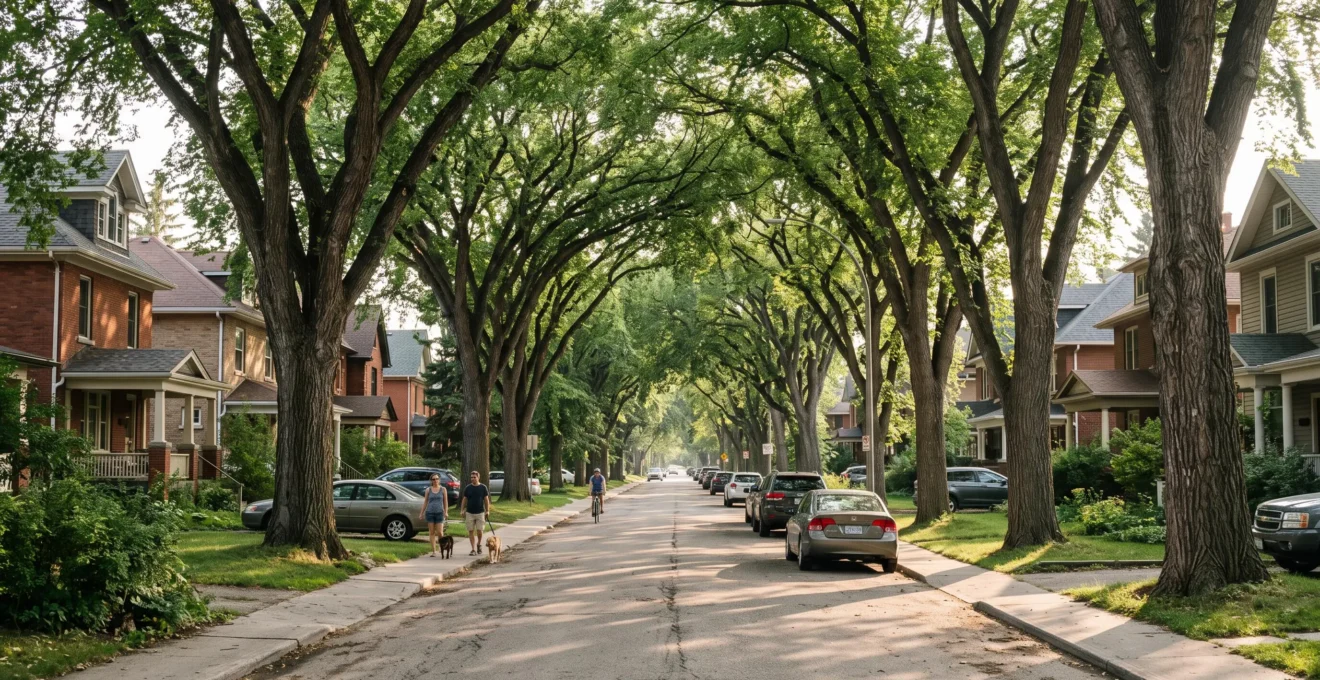
Winnipeg’s urban forest is more than a collection of trees. It is living infrastructure that cools neighbourhoods, manages rainfall, shelters wildlife and makes streets more comfortable for walking. Yet the same mature canopy that defines many established neighbourhoods faces pressure from invasive pests, disease, construction, changing weather conditions and infrastructure renewal.
Preserving this resource requires two complementary actions: protecting healthy existing trees and establishing diverse replacement trees before major canopy losses occur. Residents can contribute through appropriate tree care and early reporting, while municipal planning must accommodate tree roots, growing space and long-term maintenance.
Winnipeg City Council adopted an Urban Forest Strategy on December 14, 2023, establishing a 20-year vision covering trees, soil, vegetation and related natural processes on both public and private property. Its success depends on decisions made well beyond traditional tree planting programs, including street reconstruction, park redevelopment and neighbourhood growth.
Protecting Winnipeg’s urban canopy: the essentials
- Retaining healthy mature trees preserves established shade, cooling and environmental benefits that young replacements cannot immediately provide.
- Responsible watering, mulching, root protection and professional assessment can reduce preventable tree losses.
- Diverse succession planting, tree-conscious infrastructure design and balanced park planning are essential for long-term neighbourhood resilience.
- Why Are Mature Trees So Valuable to Winnipeg Neighbourhoods?
- How Can Winnipeg Residents Help Protect Trees During Stressful Conditions?
- Preserve or Replant: Which Strategy Better Protects Winnipeg’s Urban Canopy?
- Urban Tree Mistakes That Can Permanently Damage Winnipeg’s Canopy
- When Should a Winnipeg Tree Be Assessed for Decline or Removal Risk?
- Sports Amenities or Quiet Green Space: What Should a Winnipeg Park Prioritize?
- Infrastructure Planning Mistakes That Can Create Bigger Problems for Winnipeg Later
- What Makes a New or Improved Winnipeg Public Park Useful to Its Community?
Why Are Mature Trees So Valuable to Winnipeg Neighbourhoods?
Mature trees are valuable because their large crowns, established root systems and accumulated growth provide neighbourhood benefits that newly planted saplings cannot immediately reproduce. In Winnipeg, established elms, ash trees and Manitoba maples contribute shade, cooling, rainwater management and wind protection. Losing them can reduce street comfort and neighbourhood resilience long before replacements become substantial trees.
The broad crowns of established trees intercept sunlight before it reaches sidewalks, asphalt and building surfaces. During hot summer periods, this shade can make outdoor routes more comfortable and reduce heat exposure. Tree transpiration also contributes to localized cooling when sufficient soil moisture is available.
On established residential streets such as Wellington Crescent and around Corydon Avenue, mature canopy can influence the experience of walking, cycling and spending time outdoors. These locations illustrate the importance of tree-lined streets, although street-specific temperature measurements would be needed to quantify their effects.
Tree roots and surrounding permeable soil also help absorb and manage rainfall. This function matters in a city exposed to heavy rain and overland flooding, including the significant flooding conditions experienced in 2022. Trees complement drainage infrastructure rather than replace it, particularly when soils are saturated.
20 years
The planning horizon of Winnipeg’s Urban Forest Strategy, adopted by City Council on December 14, 2023. It addresses the urban forest across public and private lands.
City of Winnipeg: Winnipeg Urban Forest Strategy.
Age and size also matter. An established tree represents decades of growth and space occupied above and below ground. A replacement can eventually contribute substantial shade, but its benefits develop progressively and depend on species, site quality, survival and maintenance.
Winnipeg’s canopy is particularly exposed to species-specific threats. Dutch elm disease affects a characteristic component of the city’s historic streetscape, while emerald ash borer threatens ash trees. These overlapping pressures show why relying heavily on a limited group of species creates long-term vulnerability.
The urban forest extends beyond municipal streets and parks. Trees growing in private yards contribute to neighbourhood canopy continuity, habitat and shade. A resident’s decision to retain a healthy backyard tree can therefore have public environmental value, even when the City does not manage that tree.
Preserving that canopy depends not only on citywide policy but also on everyday practices that prevent avoidable damage during stressful growing conditions.
How Can Winnipeg Residents Help Protect Trees During Stressful Conditions?
Winnipeg residents can help protect trees by maintaining adequate soil moisture, applying mulch correctly, avoiding root-zone compaction and reporting visible problems early. These measures are particularly useful during hot, dry summer periods and around construction activity. Tree care should reflect species, age, drainage and site conditions rather than follow a single watering schedule for every tree.
During dry July and August spells, slow watering over the root-growing area is generally preferable to a brief spray against the trunk. For a young tree, concentrate moisture around the developing root system and surrounding soil. For a larger established tree, consider the broader area beneath and beyond the canopy instead of watering only at the base.
Water should infiltrate gradually without prolonged pooling. Check soil moisture before adding more: heavy soil that remains wet requires a different approach from fast-draining soil. Residents should also follow any current municipal watering restrictions or applicable requirements rather than assume unrestricted watering is always permitted.
Mulch provides another straightforward protective measure. A broad, relatively flat layer of coarse organic mulch helps reduce grass competition, moderate soil temperature and limit evaporation. Keep mulch clear of the trunk and exposed root flare.
Piling mulch directly against bark, sometimes called volcano mulching, creates persistently damp conditions around the trunk and can contribute to bark deterioration and other health problems. More mulch is not automatically better.
Roots deserve as much attention as leaves. Much of a tree’s absorbing root system occupies relatively shallow soil. Parking vehicles beneath a crown, repeatedly storing heavy equipment on exposed ground or driving machinery over the root zone can compress soil and interfere with water and oxygen availability.
Damage may not become obvious immediately. A tree disturbed during a renovation can show declining growth or canopy thinning in later seasons, making prevention especially important.
A five-action tree protection routine for Winnipeg homeowners
- Inspect the canopy: check for dead branches, unusual thinning or premature leaf loss and record any concerns with dated photographs.
- Check soil moisture: examine the root-growing area before watering and record whether the soil is dry, adequately moist or saturated.
- Correct the mulch ring: remove any mulch touching the trunk and photograph the exposed root flare and completed flat ring.
- Mark the root-protection area: identify where vehicles, stored materials and renovation equipment must be kept away; share a simple site sketch with contractors.
- Report suspected public-tree problems: document the location and symptoms, then contact Winnipeg 311 when municipal attention is needed; retain the service-request reference when provided.
Public and private ownership matters. Winnipeg residents can report suspected pest infestations or concerning City-owned trees through 311. Private property owners remain responsible for arranging appropriate care and assessment of their trees.
Good maintenance protects today’s trees, but sustainable canopy management also requires choosing when to preserve existing specimens and when to establish replacements.
Preserve or Replant: Which Strategy Better Protects Winnipeg’s Urban Canopy?
Preservation generally delivers the greatest immediate canopy benefit when a mature tree is healthy, structurally sound and suitable for its location. Replanting is essential when trees decline, become hazardous or face unavoidable removal. Winnipeg needs both approaches: retain functioning mature canopy wherever practical while planting diverse young trees early enough to support future canopy continuity.
Removing a healthy large tree and planting a sapling does not produce an equivalent environmental outcome in the near term. The smaller tree has less leaf area, provides less shade and requires time to develop a substantial root system and crown.
Depending on growing conditions and species, building a meaningful replacement canopy may take decades. A 20–40-year planning interval can help illustrate the long horizon, but it is not a universal timetable for achieving the shade or environmental benefits of a specific mature tree.
Preservation is not always appropriate, however. A severely declining tree with significant structural defects may create unacceptable risks in a heavily used location. Similarly, an ash tree affected by emerald ash borer may need treatment or removal depending on its condition and professional assessment.
Winnipeg’s exposure is substantial: approximately 30% of its boulevard and park trees are ash, according to the City. This proportion refers specifically to public trees in those settings, not to total citywide canopy cover.
30%
Approximate share of Winnipeg boulevard and park trees classified as ash. Emerald ash borer, first detected locally in 2017, threatens this component of the public urban forest.
City of Winnipeg: emerald ash borer control information.
The City’s management approach includes treating suitable healthy or slightly infested ash trees and removing those that cannot be saved. Not every ash tree should be removed merely because the pest is present in Winnipeg.
The practical differences between preservation and replacement become clearer when decisions are compared by tree condition.
| Tree condition or situation | Preferred approach | Important consideration |
|---|---|---|
| Healthy, structurally sound mature tree | Preserve and maintain | Protect roots and growing space during nearby work. |
| Aging tree with manageable defects | Assess and retain where appropriate | Professional pruning, monitoring or treatment may extend useful life. |
| Ash tree showing possible pest symptoms | Obtain an assessment | Treatment suitability depends on condition and infestation severity. |
| Tree with unacceptable structural risk | Manage risk, potentially through removal | Consider available mitigation before deciding on replacement. |
| Neighbourhood with a uniform aging canopy | Plan diverse succession planting | Build future canopy capacity before widespread losses occur. |
Succession planting offers a stronger long-term strategy than reacting only after removals. This means identifying appropriate planting opportunities while older trees remain, creating overlapping generations rather than allowing an entire street to lose shade at once.
New plantings must also diversify species selection. Replacing every affected ash or elm with another uniform planting can reproduce the vulnerability that made earlier canopy losses so disruptive.
That continuity can still be undermined when otherwise healthy trees suffer preventable damage from landscaping, road maintenance or construction.
Urban Tree Mistakes That Can Permanently Damage Winnipeg’s Canopy
The most damaging urban tree mistakes often occur below ground or during seemingly routine property improvements. Trenching through roots, changing soil levels, paving over growing areas, excessive pruning and inappropriate winter de-icing can compromise mature trees. In Winnipeg’s challenging climate, poor species selection and inadequate aftercare can also prevent replacement trees from surviving long enough to rebuild canopy.
Construction is a particularly important risk because root damage is easy to overlook. Digging a utility trench or installing a new driveway can sever structural or absorbing roots, especially when work takes place close to the trunk.
Raising the soil level over established roots can interfere with gas exchange, while removing soil can expose and damage roots. Installing impermeable surfaces across significant portions of a root zone may also change the availability of water and oxygen.
These effects are not always visible immediately. A tree may initially retain foliage after disturbance but lose vigour in subsequent growing seasons.
Winnipeg’s winter maintenance practices add another challenge. Road salt can reach roadside trees through splash, spray and contaminated runoff. Sensitive species may experience leaf or bud damage, soil stress and impaired growth where salt accumulates.
Where practical and consistent with winter safety requirements, responsible de-icing choices, attention to runoff and suitable species selection can help reduce this exposure.
Improper pruning also has lasting consequences. Topping a tree is not a substitute for professional risk reduction. Large indiscriminate cuts can stimulate weakly attached regrowth, create substantial wounds and alter the tree’s structure. A professional arborist can assess whether targeted pruning offers a safer outcome.
Finally, replacing a lost tree with an attractive but climatically unsuitable species can produce repeated failures. Winnipeg’s cold winters, exposed sites and variable soil conditions demand species selected for local hardiness and site suitability, not appearance alone.
Even hardy species require adequate planting space, soil moisture and establishment care. Selecting a tree that will eventually outgrow its narrow boulevard or conflict with overhead wires merely postpones another maintenance problem.
When damage or decline is already apparent, the priority changes from prevention to deciding whether professional assessment is needed and how urgently to act.
When Should a Winnipeg Tree Be Assessed for Decline or Removal Risk?
A Winnipeg tree should be professionally assessed when it develops persistent canopy thinning, significant dead branches, fungal growth, structural cracks or unusual leaning. Sudden changes following a storm, disturbed roots or large unstable limbs near people or property warrant more urgent attention. Visible symptoms do not automatically justify removal; their severity, causes and associated risks need evaluation.
Early warning signs can include thinning foliage near the crown, abnormal leaf drop during the growing season, increasing branch dieback and declining annual growth. These symptoms may result from drought, disease, pest pressure, root damage or several interacting problems.
Fungal fruiting bodies on the trunk or near the base can indicate internal decay, although their significance depends on the fungus, location and condition of the tree. Similarly, a lean that has existed for years is not equivalent to a new lean accompanied by soil movement.
A practical distinction is whether symptoms suggest gradual decline or immediate structural instability. Monitoring can be reasonable for limited, slowly developing symptoms when no immediate hazard is apparent, but suspected defects in heavily occupied locations deserve prompt professional review.
| Observed condition | Indicative urgency | Recommended response |
|---|---|---|
| Limited crown thinning without obvious structural damage | Monitor and arrange assessment if persistent | Record changes and consider moisture, pests and site conditions. |
| Repeated premature leaf loss or expanding branch dieback | Arrange professional assessment | Investigate possible disease, pest or root problems. |
| Fungal conks or visible decay near the trunk base | Prompt professional assessment | Evaluate structural condition and nearby targets. |
| Sudden leaning, raised soil or major trunk cracking | Urgent | Keep people away and contact the appropriate responsible service. |
| Large broken or hanging limb above a frequently used area | Urgent | Restrict access and obtain qualified assistance. |
Ownership determines the assessment route. Concerns about City-owned boulevard and park trees should be reported through Winnipeg 311. A private tree normally requires assessment arranged by its owner through a qualified arborist, preferably one with relevant professional certification and adequate insurance.
Residents should not attempt hazardous pruning or removal near electrical wires. Where power infrastructure is involved, contact the appropriate utility and follow its safety instructions.
Professional assessment can identify alternatives to removal, including selective pruning, monitoring, treatment where appropriate or other risk-management measures. Emerald ash borer symptoms are especially important to interpret carefully because affected trees can remain outwardly normal during early infestation.
Removal should be a risk-based decision, followed by species-appropriate replacement planning whenever the location remains suitable for planting.
Tree safety decisions also arise at neighbourhood scale, particularly when public parks must accommodate recreation, natural vegetation and competing community priorities.
Sports Amenities or Quiet Green Space: What Should a Winnipeg Park Prioritize?
A Winnipeg park should prioritize a combination of active recreation and accessible green space based on neighbourhood needs, ecological value and year-round use. Sports facilities support organized activities and community participation, while tree-covered quiet areas provide shade, habitat and places for informal recreation. The appropriate balance depends on the park’s size, surrounding population and existing amenities.
Different residents use public parks differently. Families may value playgrounds and open play areas, organized teams need appropriate playing surfaces, and people seeking quieter recreation may prefer shaded walking routes, seating and naturalized areas.
These uses can compete for space. Sports fields generally require open, managed surfaces and may need drainage, irrigation, lighting or supporting infrastructure. Preserving established groves instead can support habitat continuity, shade and quieter activities without the same type of facility development.
Neither option should automatically dominate. A neighbourhood lacking accessible playing fields may have a strong case for active recreation investment, while an area facing substantial canopy decline may benefit from prioritizing existing tree stands and new planting opportunities.
Winnipeg’s long winter adds another dimension. Outdoor skating, winter walking and related seasonal activities can make a park valuable even when summer attendance does not reflect its full use.
The City Council-approved Recreation and Parks Strategies provide a long-term framework for these decisions. Approved on May 26, 2022, they were designed to guide recreation and parks investment, renewal, maintenance and service planning over 25 years.
The municipal process incorporated input from community groups, stakeholders and residents, reflecting the importance of considering different users when allocating public space.
A practical hybrid design can concentrate active facilities where they work best while protecting established trees around pedestrian routes, seating areas and quieter sections. Vegetated buffers can help separate activities, although the effectiveness of any particular layout depends on site conditions.
Lighting hours, programming and seasonal scheduling can also be adjusted through consultation, potentially reducing conflicts without sacrificing established vegetation unnecessarily.
For substantial redevelopment, planners should examine whether existing trees can be retained before determining the final footprint of fields, paved areas or buildings. The most affordable opportunity to protect mature canopy is often before the design becomes fixed.
Making such designs sustainable also requires coordination with roads, utilities, drainage and other infrastructure that influences whether trees can survive long term.
Infrastructure Planning Mistakes That Can Create Bigger Problems for Winnipeg Later
Winnipeg can create long-term urban forest problems when infrastructure projects leave insufficient space for tree roots and crowns, ignore underground utilities or postpone maintenance planning. These mistakes can lead to repeated pruning, premature removal, poor survival of replacement trees and lost environmental benefits. Integrating trees into project design from the beginning is generally more effective than treating planting as a final decorative step.
Narrow boulevards illustrate this challenge. A tree planted beside extensive pavement, buried utilities and overhead wires may have limited growing space even if the species is otherwise suitable for Winnipeg’s climate.
As the tree grows, roots may encounter restricted or compacted soil while branches approach wires, signs or traffic clearances. This can create a recurring cycle of corrective pruning or eventual removal.
Utility installation and renewal are particularly important. Excavations for water, sewer, electrical or communications infrastructure may conflict with established roots. Planning routes, construction methods and tree protection before work begins can reduce avoidable damage, subject to engineering and safety requirements.
Treating canopy as infrastructure changes how projects are evaluated. Trees contribute to summer cooling, rainfall interception and the quality of pedestrian environments. A redevelopment that maximizes paving but leaves little room for vegetation may produce long-term environmental and maintenance trade-offs that are not obvious at construction completion.
Planting sequence matters too. Young trees installed in compacted construction soil may struggle even when planting specifications appear adequate on paper. Suitable soil volume, drainage, moisture availability and access for future care should be considered before the surface design is finalized.
The City of Winnipeg’s right-tree, right-place planting guidance highlights appropriate species selection, root-growing conditions, utility constraints and maintenance responsibilities. It also identifies the first two years following planting as requiring considerable care.
Winnipeg generally undertakes municipal tree planting from May to October, although individual planting decisions still depend on conditions and species suitability. Installing trees within the normal season does not compensate for poor soil, inadequate rooting space or insufficient establishment care.
Deferred maintenance presents another risk. When inspection and appropriate pruning are postponed, developing defects may become more difficult to address and can contribute to emergency responses after storms. Regular assessment is therefore an investment in both public safety and canopy retention.
Successful infrastructure design should account for the eventual size of a tree, not merely the space occupied by a sapling on opening day. This is especially relevant along streets scheduled for future utility work or repeated reconstruction.
These same principles apply to new and renewed public parks, where early design choices determine how effectively green space serves residents over time.
Key decisions for Winnipeg’s next generation of green spaces
- Protect established trees during design and construction instead of treating their removal as an unavoidable consequence of redevelopment.
- Reserve sufficient rooting space, suitable soil and future maintenance access for every proposed planting location.
- Evaluate parks by actual community use, seasonal accessibility and their contribution to neighbourhood canopy continuity.
What Makes a New or Improved Winnipeg Public Park Useful to Its Community?
A useful Winnipeg public park is one residents can comfortably access and use throughout the year, with amenities reflecting local needs. Shade, seating, accessible paths, safe connections and flexible recreational space often determine everyday usability more than the number of installed features. Integrating healthy trees and future canopy growth from the beginning also helps a park remain comfortable as neighbourhoods and climate conditions change.
Park design should begin with how people move through and spend time in the space. A shaded bench near a walking route can provide a practical benefit for someone taking a short break, while a connected path can make the same park useful for walking and informal exercise.
Access matters as much as destination features. Sidewalk connections, understandable entrances and routes suitable for users with different mobility needs influence whether nearby residents can reach a park comfortably.
Tree placement should respond to these activities. Providing growing space for shade trees near seating, playgrounds and walking routes can improve summer comfort as the canopy establishes. Species must also be selected for local hardiness, eventual crown dimensions and compatibility with the surrounding infrastructure.
New parks cannot immediately reproduce the shade of mature wooded spaces. Where healthy established trees already exist, design should consider retaining them. Where trees are absent, planting plans need realistic expectations for establishment, maintenance and gradual canopy development.
Community participation helps determine which amenities are genuinely useful. Nearby residents may identify needs ranging from quiet paths and community gardens to dog areas, youth recreation or spaces for informal gatherings.
These priorities should be tested against available space, accessibility, maintenance requirements and ecological impacts rather than assuming every requested facility belongs in the same park.
For example, a small neighbourhood park might achieve more daily value through a connected walking loop, strategically located seating and retained mature trees than through multiple intensive facilities that leave little room for vegetation. This is a planning illustration rather than evidence that a particular Winnipeg neighbourhood prefers such a design.
Park renewal also offers an important opportunity to establish replacement generations of trees. Where elm or ash decline threatens future canopy, suitable planting sites can support a more diverse urban forest while improving recreational spaces.
To evaluate a proposed park improvement, residents and planners can consider four practical questions:
- Does the design retain healthy existing trees and provide enough growing space for new ones?
- Can people reach and use the space comfortably across different ages, abilities and seasons?
- Do the proposed amenities correspond to demonstrated neighbourhood needs?
- Are maintenance resources and long-term tree care incorporated into the project?
Winnipeg’s Recreation and Parks Strategies establish a long-term municipal planning direction, while its Urban Forest Strategy recognizes trees across public and private lands as an interconnected resource. Considering both frameworks together can support park decisions that improve recreation without overlooking canopy protection.
Residents can help advance this approach by documenting tree conditions, participating in park consultations, reporting concerns through 311 where appropriate and asking that future neighbourhood projects include clear commitments to tree protection, diverse planting and ongoing care.
Who is responsible for trees growing on Winnipeg boulevards?
City-owned boulevard trees fall under municipal management, while homeowners generally remain responsible for trees on their private property. Residents can contact Winnipeg 311 about damage, suspected infestation or safety concerns affecting public trees. Before arranging work near a boulevard tree, confirm ownership and any applicable municipal requirements.
Does emerald ash borer mean every Winnipeg ash tree must be removed?
No. Winnipeg’s management approach includes treating suitable healthy or slightly infested ash trees while removing trees that cannot be saved. The appropriate response depends on condition and professional evaluation. Emerald ash borer symptoms can take years to appear, making monitoring important even when an ash tree looks healthy.
Can residents plant trees on City-owned land themselves?
Planting on public land is subject to municipal requirements. Residents and private contractors should confirm the applicable City of Winnipeg procedures before planting. Species suitability, underground and overhead utilities, growing space and maintenance responsibilities must all be considered.
How can Winnipeg increase tree diversity without sacrificing established shade?
Succession planting can introduce a broader range of suitable species while healthy mature trees remain in place. This allows younger trees to establish before older canopy is lost. Planting decisions must still account for available sunlight, rooting space, species compatibility and long-term maintenance.
What should residents do after a storm damages a large tree?
Keep away from hanging branches, unstable trunks, disturbed roots and any nearby electrical wires. Report concerns about City-owned trees through Winnipeg 311, and contact the appropriate emergency service or utility when there is an immediate danger. Private-tree hazards should be evaluated by qualified professionals rather than handled through unsafe do-it-yourself removal.